Eyes, ears and the size of the hall: the science of reading the ball
In this post9 sections
Have you ever noticed that, when your opponent hits the ball hard, you “seem to know” how it is coming before you even see it cross the net? I have always had the impression that we react faster to a sound than to an image. Not because of the speed of sound or light through the air, but because of the time the brain takes to receive and decode each one.
Something else we notice often, and that many professionals talk about: in a big hall, the ball seems to travel less. Some players even adjust their racket for these venues, making it a little faster. In a small room, it is the opposite: everything seems faster. Part of this is perception and part is real physics, and I will explain both.
The idea for this post came from a conversation with my friend Luiza, who is starting out in table tennis at our Academy. Few people in the table tennis world know this, but I worked for many years in car audio, on systems built for in-car sound quality and competitions, which forced me to study acoustics and our hearing system; I also taught classes on loudspeakers and speaker cabinets at Senai Ipiranga, in São Paulo, for JVC do Brasil. Luiza is “just” an aerospace engineer and an acoustics specialist, which gives you a good idea of what our conversations are like. In this particular one, she mentioned that we react faster to a sound than to an image, and that matched what I have always seen at the table. I went to find out what science says. And the two impressions are more connected than they seem.
TL;DR: the sound of the hit arrives after the image, but the brain processes sound faster and, over the distance of a table, it wins the race. The ear gives the first clue about the spin: every racket has three sounds, and a study from the University of São Paulo showed you can recognize spin by ear alone. The eyes can be trained (in a German TV test, the fighter pilot scored average and Timo Boll came close to double), and sound even changes the speed you “see”: a ball that cracks loudly scares you more than it actually travels. In a big hall, sound, background, distance and cold rubber add up; the air only changes the game at altitude, where the same topspin lands longer. At the end, what the pros do and what to take to your game: arrive early at the hall, train with earplugs (the Deaflympics even ban hearing aids), use peripheral vision against glare and look after your eyes and ears.
Sound arrives later, but the brain reads it first
First, the physics. Light is practically instantaneous. Sound travels at about 343 meters per second (in air at 20 °C). With your opponent 4 meters away, the noise of the hit reaches you about 12 milliseconds after the image.
Now, the biology. In the ear, sound physically moves the cells that pick up the vibration, and the signal goes out almost immediately. In the eye, light has to trigger a chemical reaction in the retina before it becomes an electrical signal. Result: sound takes about 8 to 10 ms to reach the brain; the image, 20 to 40 ms (figures gathered in Kosinski’s review, from Clemson University, citing Kemp and Marshall).
This shows up in reaction time. On average in the classic studies, we react to a sound in 140 to 160 ms and to a light in 180 to 200 ms. A study with students (Shelton and Kumar, Neuroscience & Medicine, 2010) measured 284 ms for sound and 331 ms for the image: almost 50 ms of difference. A larger study, with 120 medical students (Jain and colleagues, 2015), reached the same conclusion.
Do the math: the ear starts about 40 ms ahead and loses about 12 ms on the sound’s journey. There is still an advantage left. Researchers call the distance at which the two tie the “horizon of simultaneity”: somewhere between 10 and 15 meters (an idea from neuroscientist Ernst Pöppel). At a table tennis table, well before that, sound wins.
And 40 ms seems like nothing, but a ball at 60 km/h travels about 67 cm in that time. That is a quarter of the table.
What the ear tells you before the eye sees it
In the post about the invisible enemy of your drive, I explained the Tau factor: the brain works out when the ball will arrive from how fast it “grows” on the retina. The problem is that Tau needs the ball to already be traveling. At the instant of the hit, it has nothing to measure yet.
Sound does. It arrives practically at the instant of contact with the ball and carries information about the hit: whether it was flat or brushed, hard or soft. A Brazilian study (Santos and colleagues, Journal of Human Kinetics, 2017) recorded the sound of forehands with four levels of spin and asked 34 players to identify each one by ear alone. They got it right 50.9% of the time, well above chance (25%). And training level (years of practice and hours per week) made no difference: everyone “hears” spin.
I usually tell my students that every racket has three sounds, and each one tells you how the ball is coming:
- Contact mostly on the topsheet (the ball just brushes the rubber): it makes almost no noise. It is a ball with a lot of spin.
- Mostly on the sponge: a characteristic sound, reminiscent of the “click” of the old speed glues. It is the stroke that sinks into the sponge, with speed and spin together.
- Mostly on the blade: a louder, drier crack. It is the flattest ball, more power than spin.
🔬 Did you know: what the USP study measured
Researchers from USP in Ribeirão Preto invited 34 players during the 2014 South American Championship: 24 men and 10 women, with almost 10 years of practice and about 16 hours of training per week, on average. In the lab, a professional athlete played topspin forehands, all at about 50 km/h, changing only the spin; high-speed cameras measured the rotation of each ball. Then each player listened to 20 of these sounds on headphones and tried to say what the spin was.
| Sound of the hit | Ball rotation | Correct |
|---|---|---|
| Flat | up to ~60 per second | 76.5% |
| Medium spin | ~105 per second | 46.5% |
| Heavy spin | ~140 per second (~8,400 per minute) | 42.9% |
| Light spin | ~84 per second | 36.5% |
The flat ball was by far the easiest to recognize: it is the crack of the blade. And the most curious part: players with more years in the game did not hear better. The authors’ hypothesis is that table tennis players train vision and touch a lot, but almost never the ear. In other words: game hearing is a skill almost nobody trains, and it is right there, for free, waiting to be trained.
But the ear does not replace the eye. In 2025, researchers from Taiwan (Lin and Liu, Psychology of Sport and Exercise) tested high-level university players with sound only, image only and both. With sound only, they still recognized the ball, but started the movement later and with more irregular timing. Vision is still in charge; sound is the clue that arrives first.
Table tennis has known this for a long time. In the late 1970s and early 1980s, the “combination” racket became fashionable: an offensive inverted rubber on one side and pips or an anti-spin on the other, both the same color. And it was not a choice: the rule at the time required both sides to be the same color. The player twiddled the racket in their hand between points (or during the point), and the opponent had no way of knowing, by color, which side had hit the ball. That left the sound, which is different for each rubber. That is why stamping your foot on the serve was such a great trick: it hid exactly the noise that would give the rubber away. The ITTF gradually closed the loopholes: in 1983, at the Tokyo congress, it began requiring two clearly different colors, required players to show the racket to the opponent and the umpire before the match (and at every racket change), and banned foot stamping on the serve; in 1985, it decided that one side would be black and the other red, a rule that took effect in July 1986. With color giving the rubber away, the foot-stamping rule lost its purpose and was dropped. Today, players who stamp their foot on the serve want to mask the spin, not the type of rubber.
Fast eyes can be trained
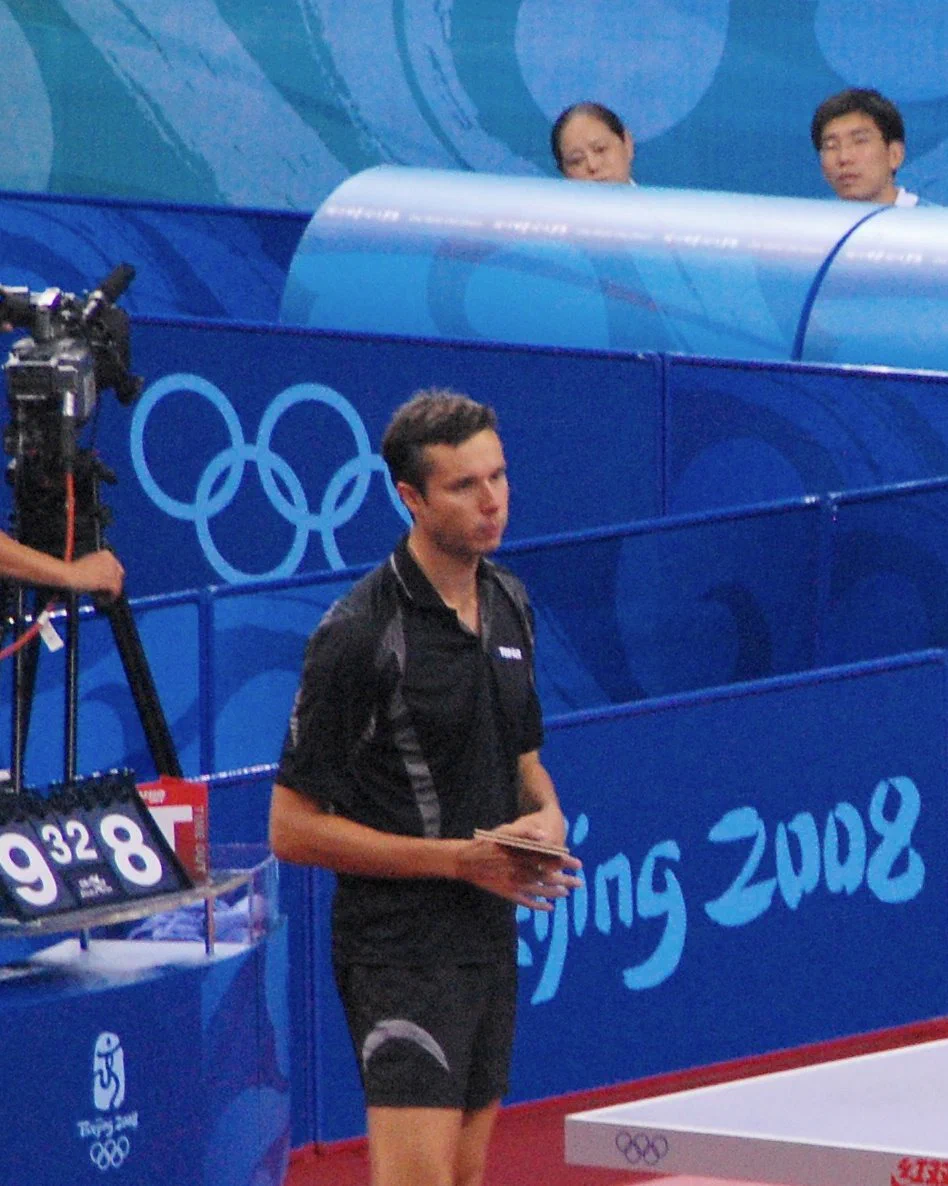
There is a video I have kept for years that came to mind while writing this post. It is a German TV report (the Planetopia program, around 2008) called “The magic eye”, about the vision of Timo Boll, then 27. “You have to get into tunnel vision and focus on what matters: the stamp on the ball,” he says, talking about the brand and model printed on the ball. From the spin of that stamp, he adjusts his arm and the racket angle “in fractions of a second”. (The cover of this post is Boll at the Beijing Olympics, in 2008, in a photo by Andre Kiwitz, CC BY-SA 2.0.)
The report was filmed at Ruhr University Bochum, with researcher Gernot Jendrusch, and has two tests. If you want to watch it, the video is on YouTube, in German; you can turn on subtitles with automatic translation into English.
The stamp replaced by numbers. They replaced the stamp on the ball with numbers from 0 to 9, and a machine fired balls at three speeds. Boll got 4 out of 5, then 3 out of 5, then 2 out of 5. The challenger was Benedikt, 21, an amateur player from the state league. At the highest speed, he got one more number right than Boll. The reason, according to Jendrusch: he followed the ball’s trajectory for longer and had a chance to read the number at the last instant. A word of caution: it was a test of reading the ball, not of hitting it.
The speed of the eyes. A ring with a gap moves across the screen, faster and faster, and the person has to “jump” their eyes to it and say which side the gap is on. The test measures up to what speed the eye can locate the target. A German fighter pilot joined the challenge, 40 years old with 3,600 flight hours in a Tornado fighter jet, who deals with planes approaching at about 500 meters per second:
| Who | How far the eye located the target |
|---|---|
| Ordinary person (average) | 180 degrees per second (~50 km/h) |
| Fighter pilot | 180 degrees per second (average) |
| Benedikt, amateur table tennis player | 205 degrees per second |
| Timo Boll | 330 degrees per second (~90 km/h) |
The pilot was average. Jendrusch explains that his profession does not demand that much from the eye muscles; racket sports do. As for Benedikt, he says the result comes from his age (he is young) and also from the sport, which taught him to perceive movement early. Boll’s motion vision, according to him, is 50 to 60% above the average person.
Behind the report there is serious work. Between 2007 and 2008, Bochum and the Aalen Institute of Optics put together a complete profile of the German national team’s vision. Boll’s motion vision was about 20% better than that of his teammates. In the interview that accompanies the study (Zeitschrift für praktische Augenheilkunde, 2008), he says he reads the stamp on the ball mainly on the serve; on hard balls, it is not possible. In the same work, racket sport athletes score well above athletes from other sports and people who do not play sports.
And the good part: according to Jendrusch, motion vision can be trained very well. In tennis and volleyball, there are already specific exercises for it. Boll himself says the same.
Sound also changes the speed you “see”
This is where it gets interesting. Sound does not just arrive first: it changes the speed you think the ball has.
German researcher Rouwen Cañal-Bruland and colleagues showed tennis videos in which the hit sounded louder or quieter, with the same image. The louder the sound, the farther people thought the ball would land (Psychology of Sport and Exercise, 2018). In a second study (Cognitive Research, 2022), with and without the sound of the hit, people judged the ball faster when they heard the sound, even though it was exactly the same video. In a simulated baseball test (eNeuro, 2023), a louder hit made people overestimate the ball’s speed.
And then there is the startle. A loud, sudden sound triggers an ancient body reflex that speeds up the reaction and puts more force into the movement. In a 2024 study, reaction time dropped from about 169 ms (image only) to 140 ms (image and sound) and to 108 ms with a 120-decibel startling sound. That is why we get “startled” by that ball that cracks loudly off the opponent’s racket, and often it is not even that fast. Beginners even blink, which makes defending that ball even harder. The body reacts to the noise, not to the ball.
Why the ball seems slower in a big hall
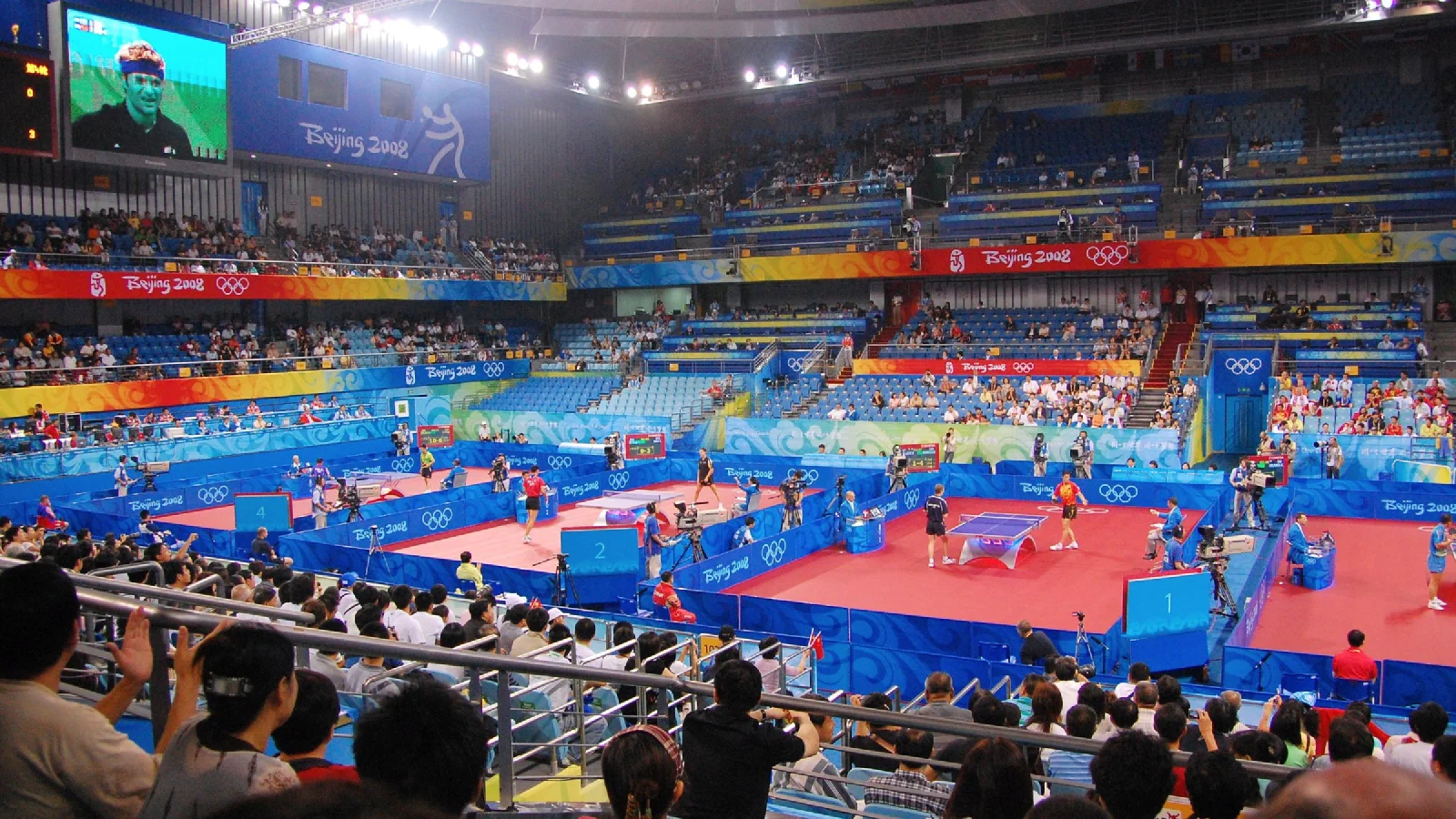
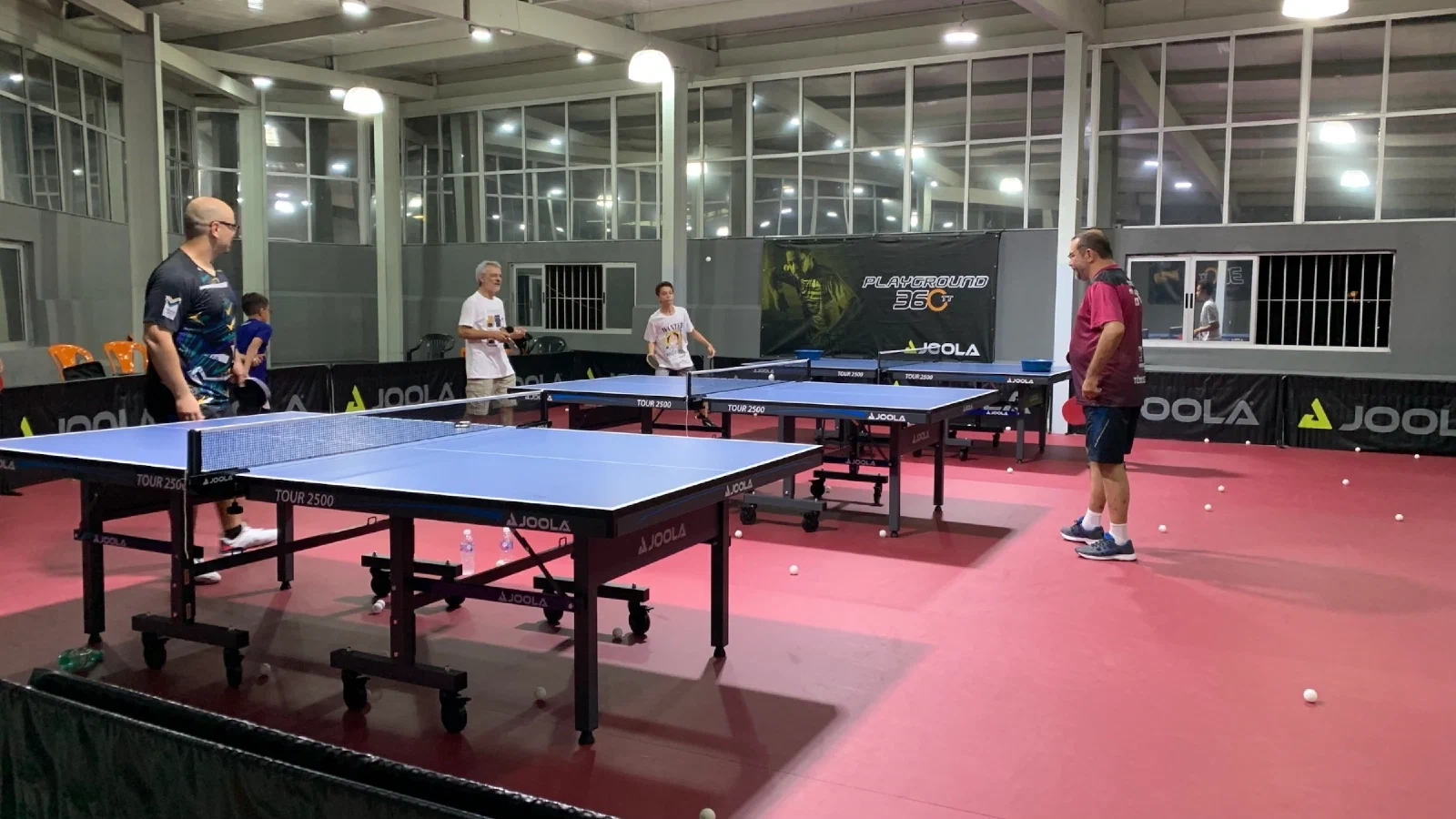
Now put all this together with what everyone feels in a big hall. There are four things adding up: two of perception and two real ones.
1. Sound spreads out
In a small room, the walls and ceiling are close. The echo of the hit comes back almost together with the original sound, and the noise gets louder and “fuller”. In a big hall, the ceiling is high and the walls are far away: with a wall 15 meters away, the echo arrives about 85 ms later, separate, weak, mixed with the noise from other tables and the crowd. The hit sounds smaller. And, as we saw, a quieter hit makes the ball seem slower. I did not find a study measuring this inside a hall: it is the link between what the studies show and what we experience at the table.
2. The eyes lose their reference
In 1931, psychologist J. F. Brown showed that the speed we perceive depends on the “frame” around the movement: in a larger frame, the same movement seems slower (Psychologische Forschung). In a small room, the ball passes in front of nearby walls and objects. In a big hall, the background is far away and dark, and the table even looks smaller.
3. Distance: the ball travels farther and really arrives slower
This part is not an illusion. In larger halls, there is often more space per table, and with more room behind the table we tend to step back further. A table tennis ball is light and loses speed very quickly in the air, especially today’s 40+ balls, which are larger than the old 38 mm ones (I told that story in the ball guide). By our calculations, a ball that leaves the racket at 72 km/h and flies 4.5 m instead of 3 m arrives about 19% slower and about 130 ms later. It is the factor that weighs the most.
4. Cold and humidity on the rubber
A big hall, air-conditioned or without sunlight, tends to be colder. And rubber is very sensitive to cold: it loses elasticity and plays slower. Humidity matters too: the rubber loses grip and the ball slips. It is no accident that so many players rub the rubber with their hand and breathe on it between points: the breath warms the rubber a little and, together with the hand, removes the dust. Sure, we live in a tropical country and it is hot here, but bear in mind that in many countries where table tennis is popular, winters are harsh and below-zero temperatures are normal.
The subject is so serious in those countries that heated racket cases have appeared: one by Donic, called Rubber Warmer, and a case with a patented heating element that, according to the manufacturers, brought the rubber to 40–50 °C. Players who tried them say on forums that the racket gets much faster for about 30 to 40 minutes. The idea did not catch on, but it shows how big the effect of cold is.
What about the air in the hall?
That barely changes anything. Air pressure depends on altitude, not on the size of the room: it is the same in the big hall and the small one in the same city. Temperature changes air density a little: between 15 °C and 30 °C, the ball loses only about 1% more speed in the cold by the time it reaches you. Humidity changes the air even less. In other words: in a big hall, the culprits are the sound, the background, the distance and, perhaps, the cold rubber. Not the air.
At altitude, the air really changes the game
Changing cities is another story. The higher you go, the thinner the air, and that affects two things.
The first is air resistance: with thinner air, the ball loses less speed along the way.
The second is the Magnus effect, the force that makes a spinning ball curve. On a topspin, the spin pushes the ball down; that is why you can hit hard and the ball still lands on the table. And this force is huge: in our simulation, the same ball without spin would go more than 1 meter farther. The catch is that the Magnus effect depends on the air: with thinner air, the same spin curves the ball less.
Colombian researcher Jorge Escobar, a fluid mechanics specialist and table tennis player, says that in Bogotá (2,600 m) topspin drops less and balls go long (American Physical Society, 2012). We did the math for a topspin at 54 km/h that leaves the racket 40 cm behind the table, 15 cm above it, and lands near the end of the table at sea level. The same stroke, changing nothing:
| Where | Air thinner than at sea level | The ball lands |
|---|---|---|
| Santos (sea level) | reference | at the end of the table |
| Belo Horizonte (~850 m) | ~10% | ~15 cm farther |
| Brasília (~1,170 m) | ~13% | ~20 cm farther |
| Bogotá (~2,600 m) | ~27% | ~46 cm farther (off the table) |
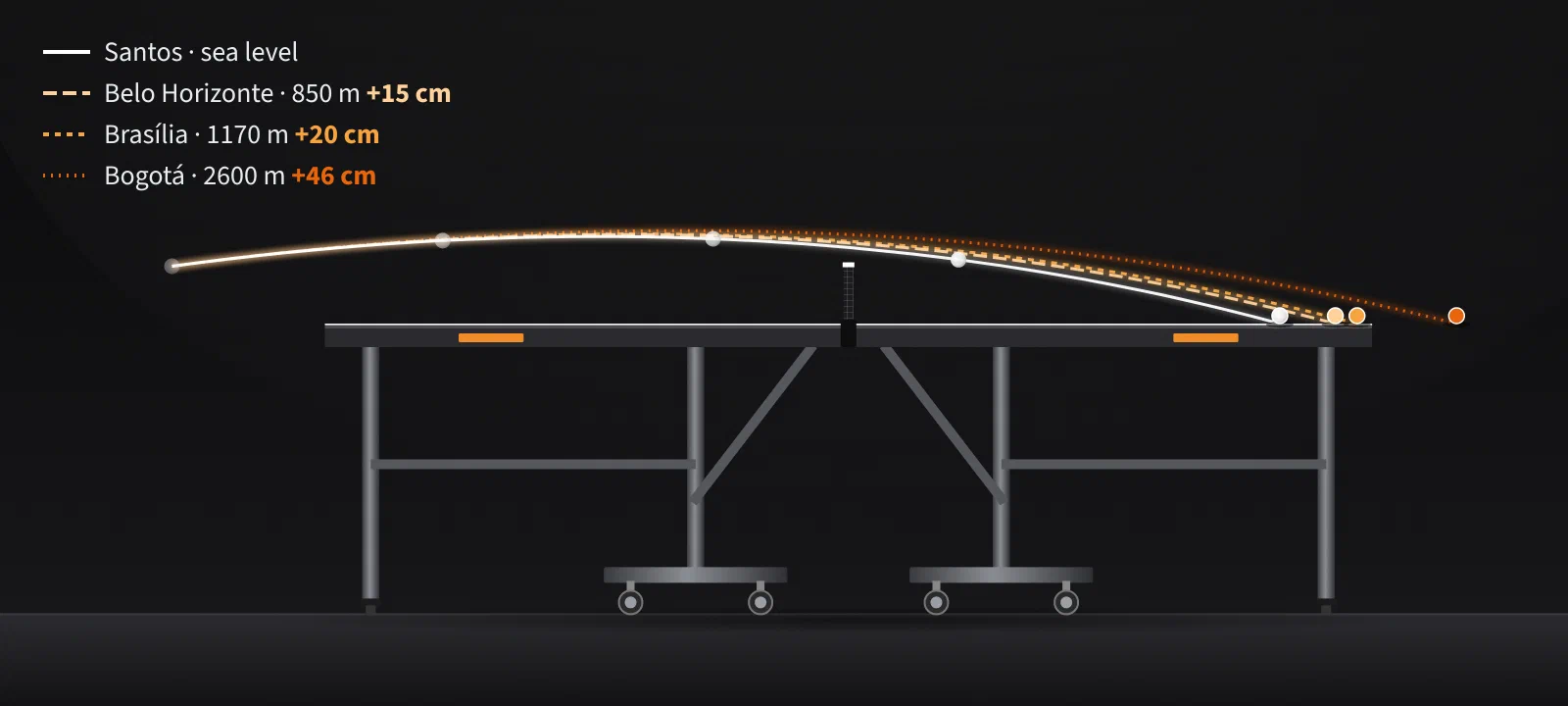
These are estimates from a simple model, not measurements. Temperature also plays a part: the same stroke lands about 7 cm farther on a 30 °C day than on a 15 °C one.
What this means in practice:
- If you train at altitude and play on the coast, you feel the ball dropping sooner and arriving slower, the same feeling as in a big hall. It is worth raising your topspin arc a little and, if needed, making your racket a little faster. Playing closer to the table can also help.
- If you come from sea level to altitude, you see the ball going long. The answer is to close the racket more and trade a little power for spin.
- In both cases, use your first session in the new place to calibrate the length of your ball: pay attention to the sound and the depth of your ball, whether it is landing shorter or longer on the opponent’s side.
What the pros do
That is why so many professionals adjust their racket for big halls. In a 2021 video showing how he glues his rubbers, Dimitrij Ovtcharov says he uses more layers of glue when the hall is big. I also remember Samsonov saying he switched to a faster blade in these venues. Others use more booster. And this is nothing new: when the 40+ ball arrived, slower and with less spin, even Ma Long changed his blade to compensate (Ma Long’s lesson).
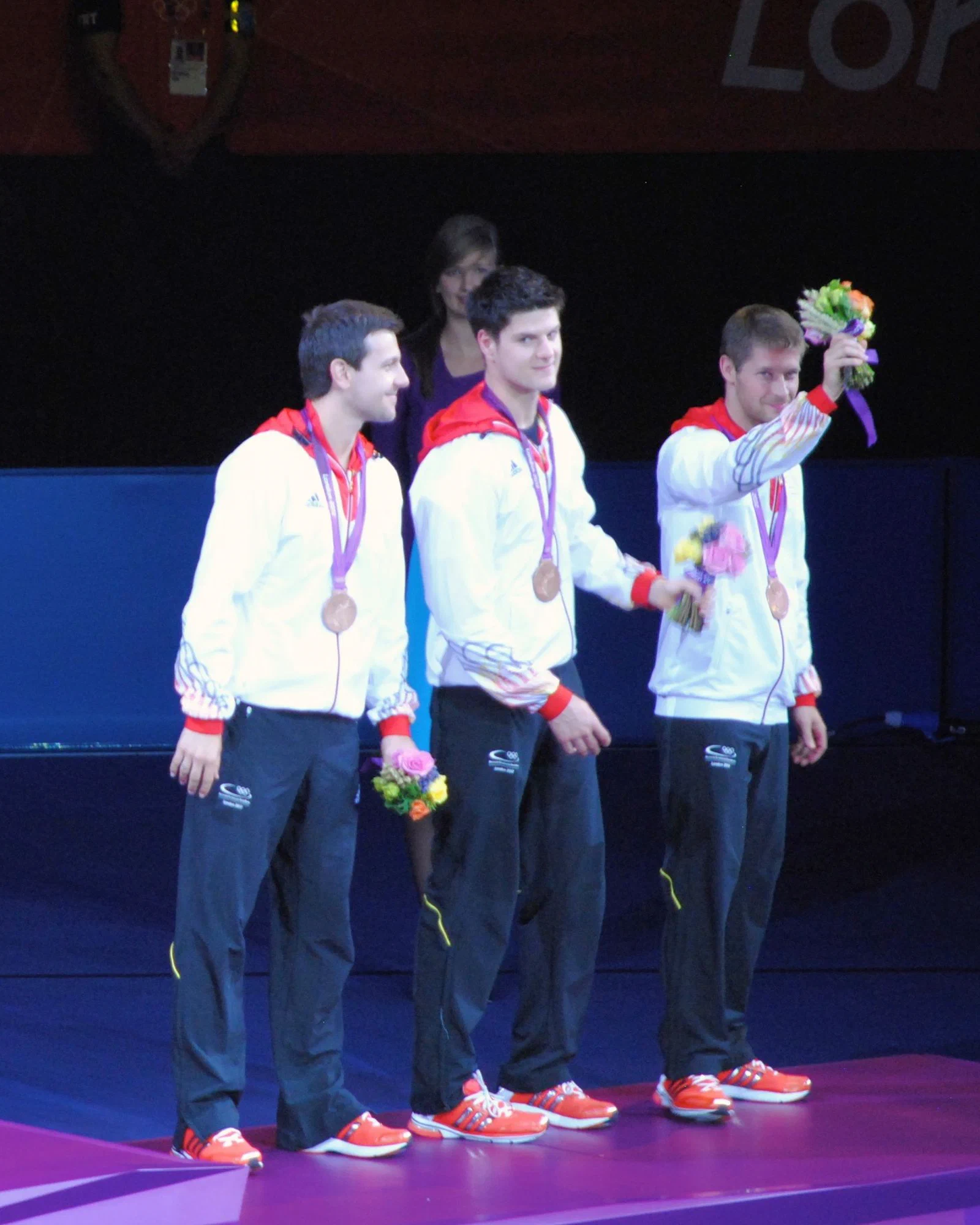
And they all do one thing first: they get to know the hall. At major tournaments, the best players practice in the competition hall in the days before, precisely to recalibrate sound, background, distance and ball. We can say that acclimatizing to a new playing venue is extremely important.
What to take to your game
1. Arrive early and hit in the hall
A tournament in a big hall, or in another city? Arrive early and hit as much as possible at the venue. Your brain needs to recalibrate the sound, the background, the distance and the length of the ball. The first points of the match are not the place for that. And, between points, keep your rubber clean, dry and warm if the venue is cold.
2. Adjust your racket carefully, and never on match day
If you always play in a small room and are going to a tournament in a big hall (or coming down from altitude to the coast), you can do what Ovtcharov does: one more layer of glue. Our performance glues work exactly like that. With EasyGlue Green+, two layers keep the original speed of the setup, and from the third layer on the glue creates an elastic film that makes the racket faster with each layer. EasyGlue Carbon does the same with a more direct response, like a carbon blade.
 EasyGlue Green+ glue360TT water-based performance glue: two layers keep the speed of the setup; three or more make the racket faster with each layer.
Visit the store →
Two rules: test it in practice before the tournament (never change anything on the day) and remember that the glue film counts toward the ITTF’s 4 mm thickness limit. Booster is another option; I explained everything in the post Let’s talk about boosters?.
3. Train with earplugs
Wear earplugs in some practice sessions. You will notice how often the sound of a hard ball scares you more than the power of the ball: without the crack, that ball that seemed like a rocket arrives much more “normal”. You also learn to trust your visual reading more, which helps in a noisy hall. A German study (Petri and colleagues, 2017) found no difference in the stroke quality of beginner and advanced players when the sound of the ball was removed or its volume changed: you can play well without it.
🤟 Table tennis without sound: the Deaflympics
Deaf athletes do not compete in the Paralympics: they have their own Games, the Deaflympics, which have existed since 1924 (older than the Paralympics) and include table tennis. Brazil has already hosted one edition, in Caxias do Sul (2022), and the most recent was in Tokyo, in November 2025.
The most curious rule: to compete, athletes need a hearing loss of at least 55 decibels in the better ear, and hearing aids and cochlear implants are banned in the entire playing area. Athletes are checked at the entrance to the court and can be disqualified if they are wearing one. In other words: everyone plays without the sound clue, on purpose. It is earplug training taken to the extreme. And notice what this rule says: if hearing the ball made no difference, hearing aids would not need to be banned. The rule itself recognizes that hearing matters in the game, exactly what this post argues.
And the brain compensates. In a study with lights flashing at the sides of the field of vision (Codina and colleagues, Frontiers in Psychology, 2017), adults deaf from an early age reacted on average about 146 ms faster than hearing people. The advantage only shows up in peripheral vision, precisely the kind that helps follow the ball’s trajectory.
The greatest example comes from China: Shi Ce, who was born with an ear malformation and started playing at age 9, won more than 10 golds at the Deaflympics. In 2005, Shi Ce won all four events at the Chinese National Games, against hearing athletes, in the strongest country in the world in the sport.
Then take the earplugs out and do the opposite: pay attention to the sound of your opponent’s hit (flat, brushed, muffled). In multiball, the coach varies the spin and you try to say what it was by the sound, before the ball arrives.
4. With glare in the hall: listen to the hit and watch the trajectory
In a hall with glare (light reflecting off the floor, a window behind the table) or with low contrast in the background (a white or light wall), the ball tends to “disappear” at some point along its trajectory. When you have the ball locked in your sights, that disappearance creates a pause: the brain waits for the ball to reappear before reacting, and you are late.
In these venues, I have always told my athletes to pay more attention to the sound of contact on the opponent’s racket and to watch the ball with their peripheral vision, following the trajectory instead of locking onto the ball. It seems the brain already identifies the trajectory and does not depend on the ball all the time. Science supports this:
- The periphery of the retina is faster at picking up changes than the center, which is best for detail (Jendrusch, 2008).
- High-level players do not always follow the ball with their eyes all the way: they jump their gaze to where it is going (Aoyama and colleagues, Frontiers in Sports and Active Living, 2022). With a slow ball, the eye glides along with it; with a fast ball, it “jumps” after it, and Boll’s brain, according to Jendrusch, already knows where the next jump has to go.
- When the ball disappears for an instant, the brain completes the trajectory on its own, using experience and gravity (Bosco and colleagues, PLOS ONE, 2012).
Combine this with the sound of the hit, which arrives first, and the ball that disappears in the glare is no longer a problem.
Tip
The ear gives the clue; the eye confirms it. If sound and image “disagree” (a hit that cracks loudly, but a ball that comes slowly), trust what you see.
5. Keep your vision and hearing in check
None of this replaces eyes and ears that work well. If you have not read it yet, go back to the post on vision in table tennis and, when in doubt, see an eye doctor.
The same goes for your ears. We lose a little hearing over time, slowly and almost without noticing; age-related loss starts before old age, and years of noise (concerts, loud headphones, work) speed it up. If the sound of the ball is part of how you read the game, it is worth seeing an ENT doctor and getting an audiometry, the test that measures hearing. Hearing loss cannot be reversed, but you can catch it early, protect what you have and compensate in your game by relying more on your eyes.
The bottom line
The ball is the same in any hall. What changes is what reaches your eyes and your ears, and how your brain puts the two together. Sound arrives first, tells you the spin before the image does and even changes the speed you think the ball has. Big hall, small room, cold, altitude: each place affects that reading, and those who understand it adapt faster.
And most importantly: reading the ball is not a gift for the few, it is training. The eyes learn to follow the trajectory, the ears learn to recognize the hit, and a good amount of time in the hall before the match recalibrates everything. If you learn to hear the ball, you gain a few milliseconds that, on a 2.74 m table, are worth points. Train your eyes, take care of your ears and pay attention to the next crack that comes from the other side of the table.
And you, do you pay attention to the sound of your opponent’s racket? Have you ever noticed the ball “slower” in a big hall, or felt strange playing in a higher city or on the coast? Tell me in the comments.
hearing the ball · ball noise · big gym · accoustics · deaf ping pong · auditory · pingpong · eyesight
Read also
The Invisible Enemy of Your Drive
Missing the ball even with lots of practice? Science says your vision may be the culprit. Learn about the Tau factor, the 5 ms window and how to fix it.
Train to Play: The 360TT Rational Guide to Periodization
Train like a lion but play like a kitten? Discover the 360TT 50/30/20 periodization method and turn your training into results at the tournament.

Table Tennis Serve: 5 Tips to Surprise Your Opponent (and the Equipment That Helps)
Turn your serve into an attack! See 5 expert tips to surprise your opponent and discover the ideal equipment to power up your game. Check them out.
Comments
Comment with your account (email or Google). Every comment is reviewed before it appears.