Blackout by Sauer & Tröger: it kills your opponent's pace
In this post12 sections
Irritatingly slow. That is what I thought most during my 45 days with the Blackout on my backhand. The ball comes back so slowly that it looks like it won’t clear the net, and very often that is exactly what takes the opponent apart.
This is the blog’s first review, a mini review with my impressions from using it, no lab measurements. I’ll start with the most important thing: 360TT sells the product tested here. The Blackout is made by Sauer & Tröger, whose official distributor we are in Brazil, and the rubber I tested was supplied by S&T itself for testing. That changes nothing in what follows. Here you will read the good and the bad, no beating around the bush. It is common to see reviews that only praise what the shop itself sells. The idea here is different: to tell how it went, including what didn’t work, who this rubber is for and, perhaps most importantly, who it is not for!
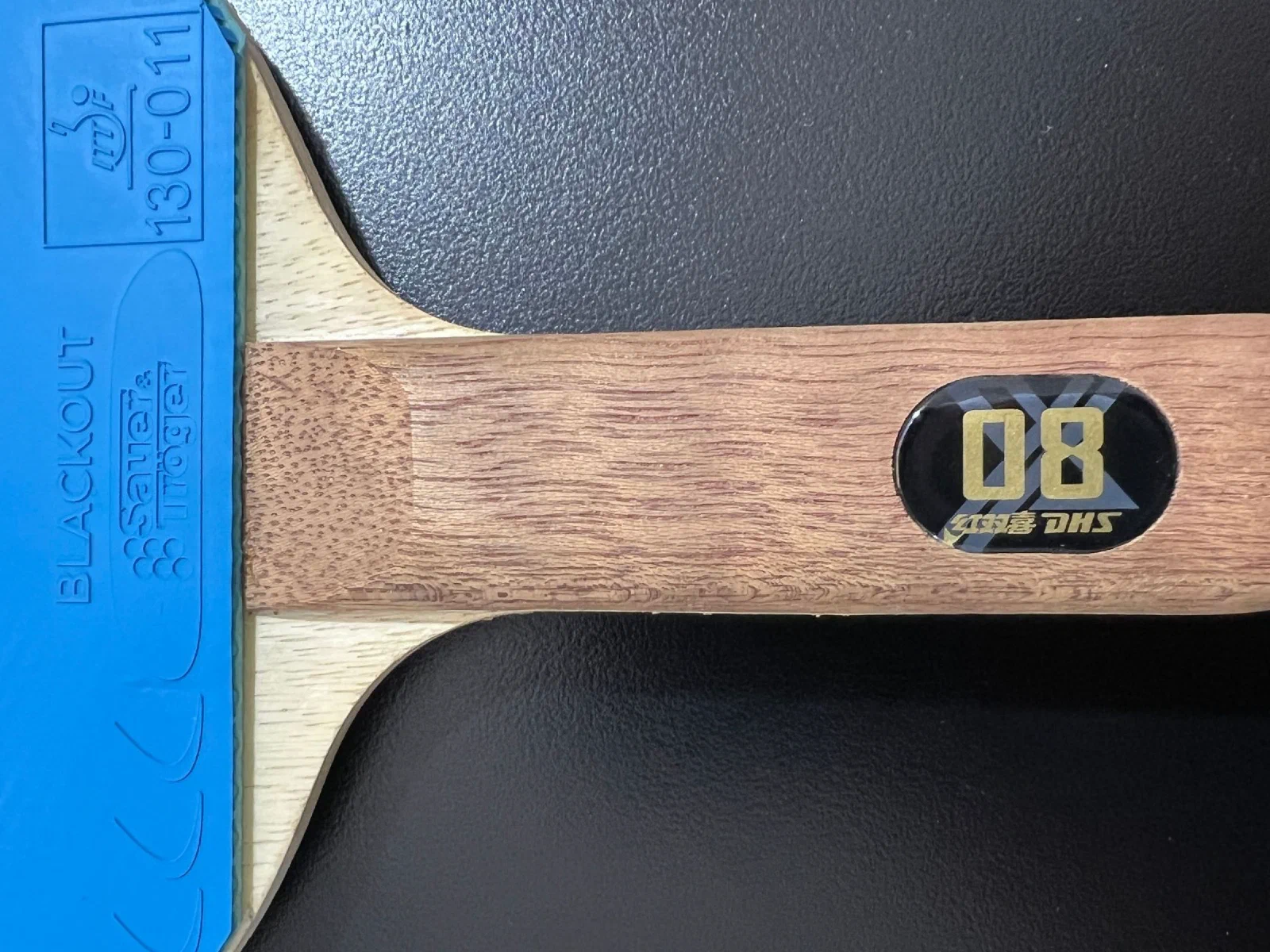
I was the tester: I play a classic style, close to the table, and I used the Blackout on my backhand for about 45 days, on a DHS 08X blade with a black Hurricane 3 NEO 37° on the forehand. That meant training sessions and some doubles against first- and second-division players from Minas Gerais. After that, I stopped using it. The reason is further down, and it is not a flaw in the rubber. I never meant to keep it anyway; I just wanted to test it.
TL;DR: the Blackout is an anti-spin with an ultra-soft absorption sponge: the opponent’s ball “dies” and comes back heavy, low and slow (why). Shot by shot, it shines when blocking a strong topspin and when receiving heavily spun serves, and it struggles against passive, backspin or high balls. The strengths are the block, the control and what it does to the opponent’s head; the weaknesses, attacking and pushing dead balls. It works well for players with a good pivot or who want to defend close to the table; it is not at its best for those who rely on attacking with the anti side. And be careful when removing it: the sponge is very fragile.
What is an anti with an absorption sponge
An anti-spin is a smooth rubber (pips in, like a regular offensive inverted rubber) with a topsheet that has very little friction. Instead of creating spin, it sends back a good part of the spin it receives: the opponent’s topspin comes back as a no-spin ball or with heavy backspin, depending on how you play the shot.
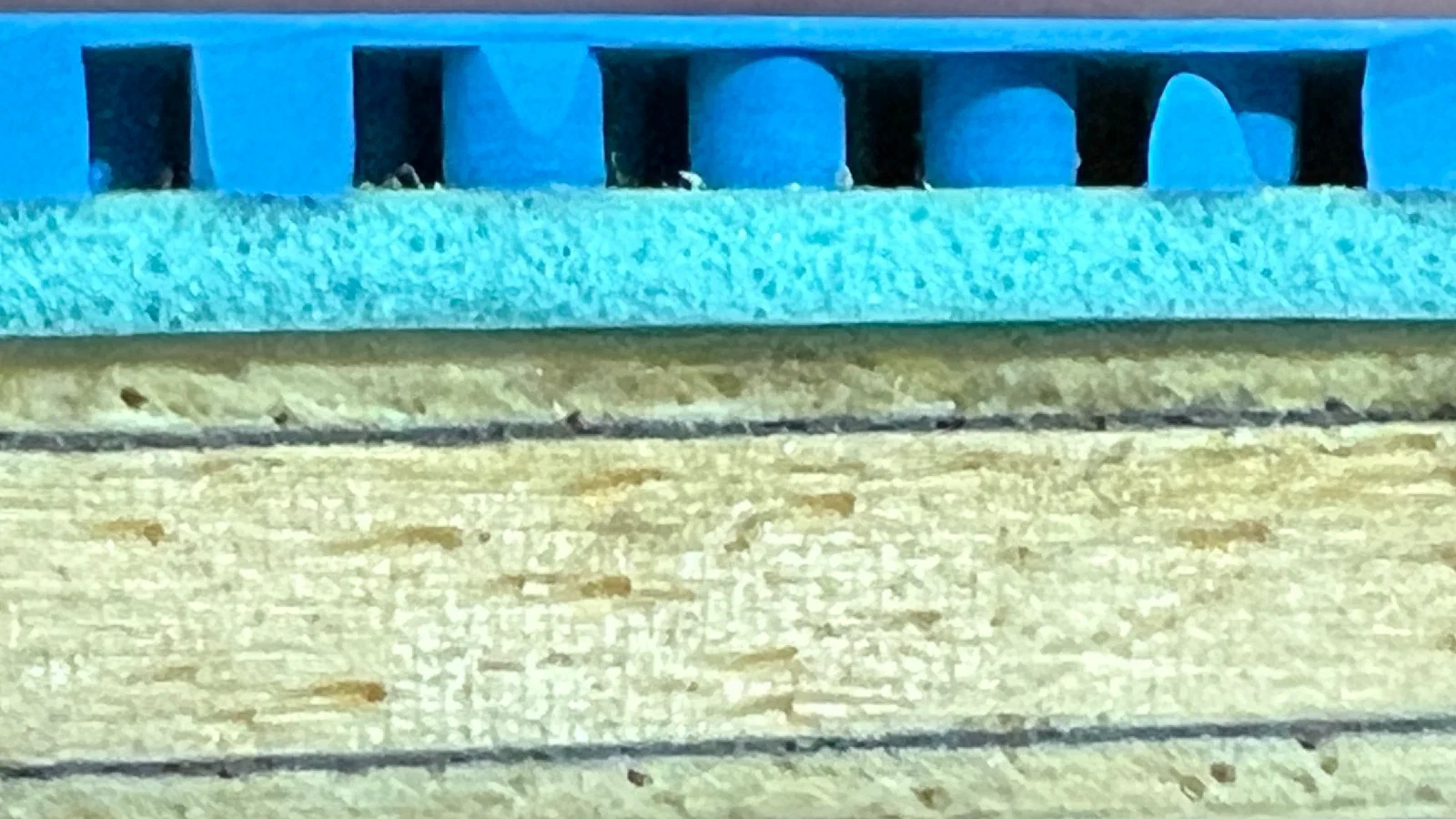
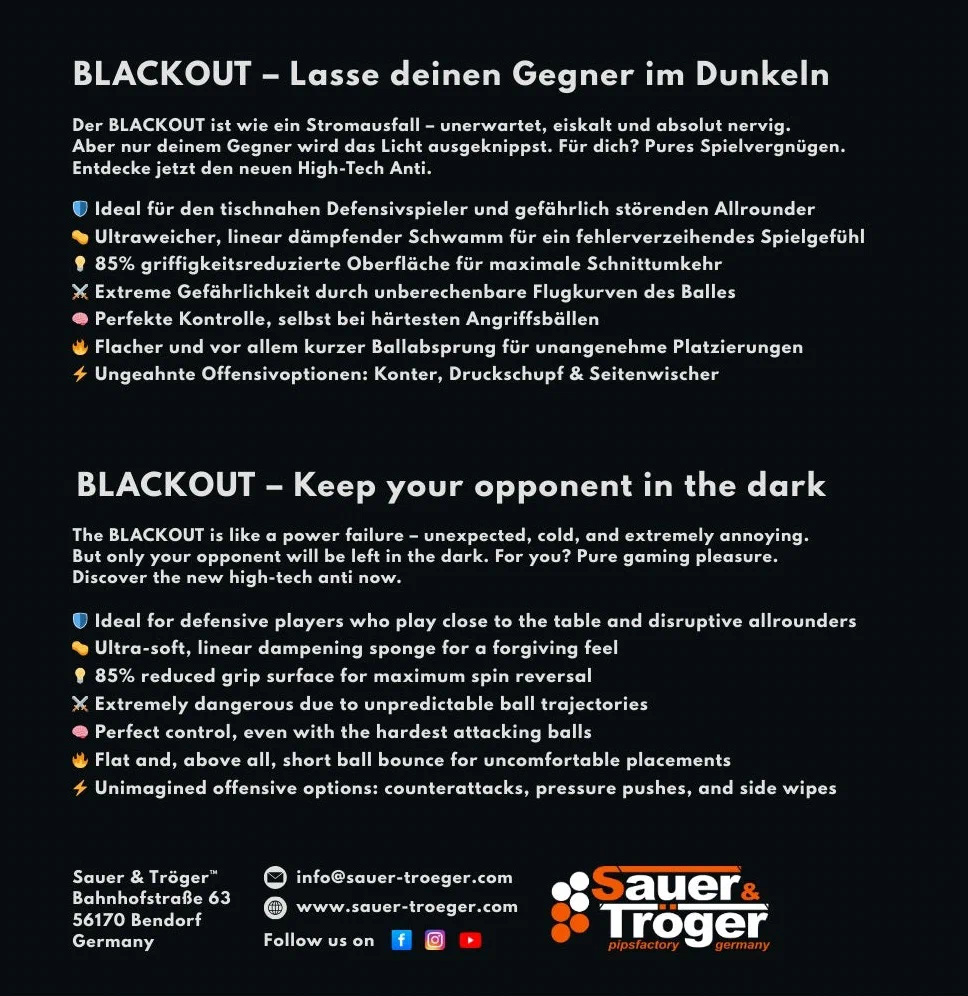
The Blackout adds an absorption sponge to that: extremely soft, made to “swallow” the ball’s speed instead of returning it. Sauer & Tröger describes an ultra-soft, linearly damping sponge and a topsheet with about 85% less grip than a regular rubber. The result, at the table, is a ball that reaches the other side slow, low and with reversed spin. That combination is what confuses the opponent.
And here is the rule for every absorption sponge: the thicker, the slower. It is the opposite of an offensive sandwich rubber (topsheet + sponge), where more sponge means more speed.
Why the ball dies and drops
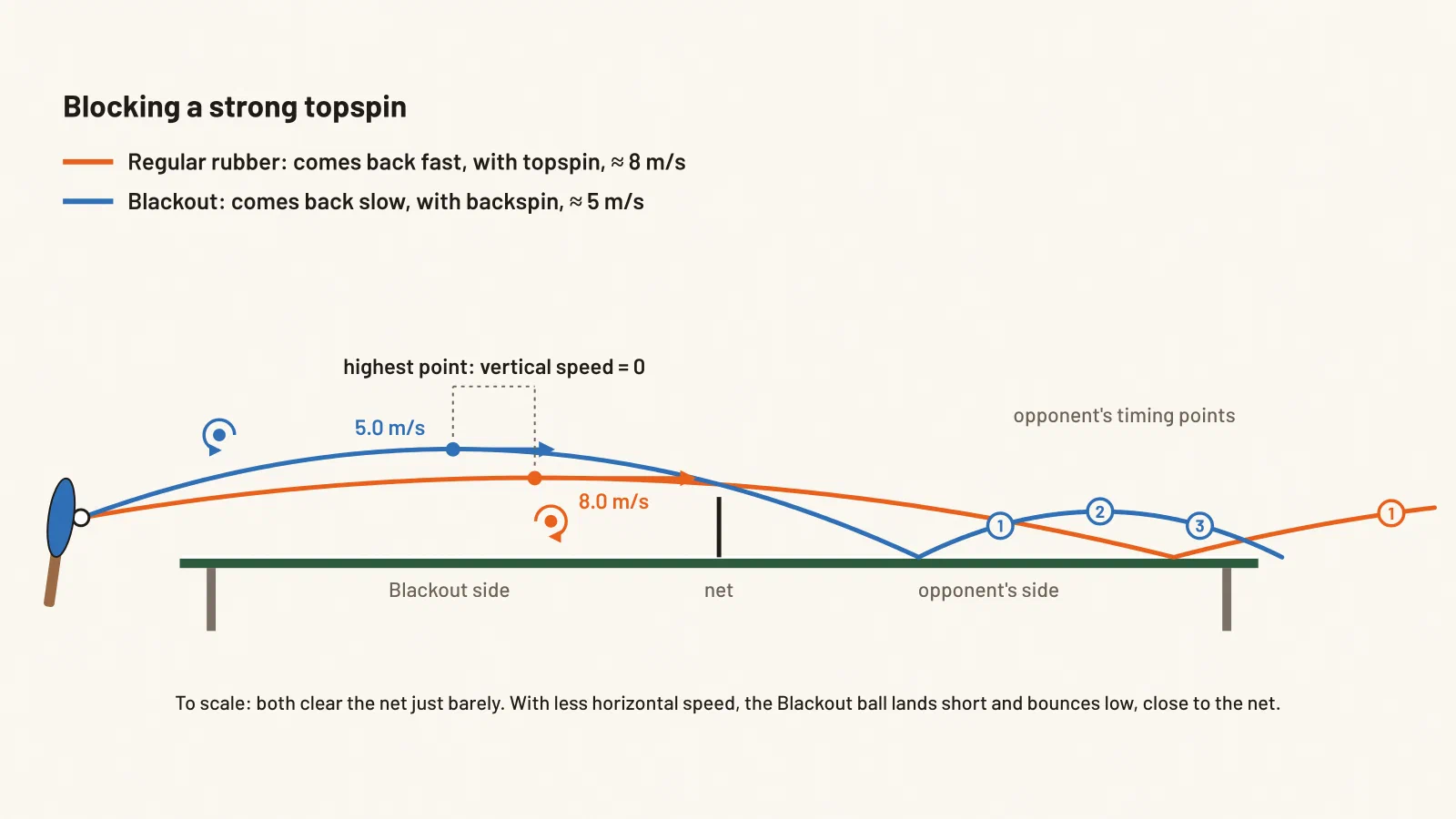
We say a moving ball has two speeds. Horizontal speed is how fast it travels forward, toward the other side of the table and back: it is what we call a fast or slow ball. Vertical speed is how fast it goes up or down. At the highest point of any arc, vertical speed is zero: the ball has stopped rising and has not started to fall yet. The horizontal speed carries on.
Timing points, the way we organize the moment of hitting the ball, only count after the bounce on your side of the table, because that is when you are allowed to touch it (there is no volley in table tennis): point 1 is on the rise, before the top of the arc; point 2 is the highest point; point 3 comes after it, on the way down.
The absorption sponge mostly steals horizontal speed. The ball leaves the Blackout moving slowly forward, while gravity keeps pulling it down as hard as ever. Even clearing the net by a hair, it travels less forward in the time it takes to fall: it lands short, and the bounce comes out low and does not travel far. The opponent’s point 2 is low and close to the net. To attack, they have to go and get the ball and put all the horizontal speed back on it by themselves.
The drawing below shows this when blocking a strong topspin: a regular rubber sends the ball back fast and with topspin; the Blackout sends it back slow and with backspin.
Specifications
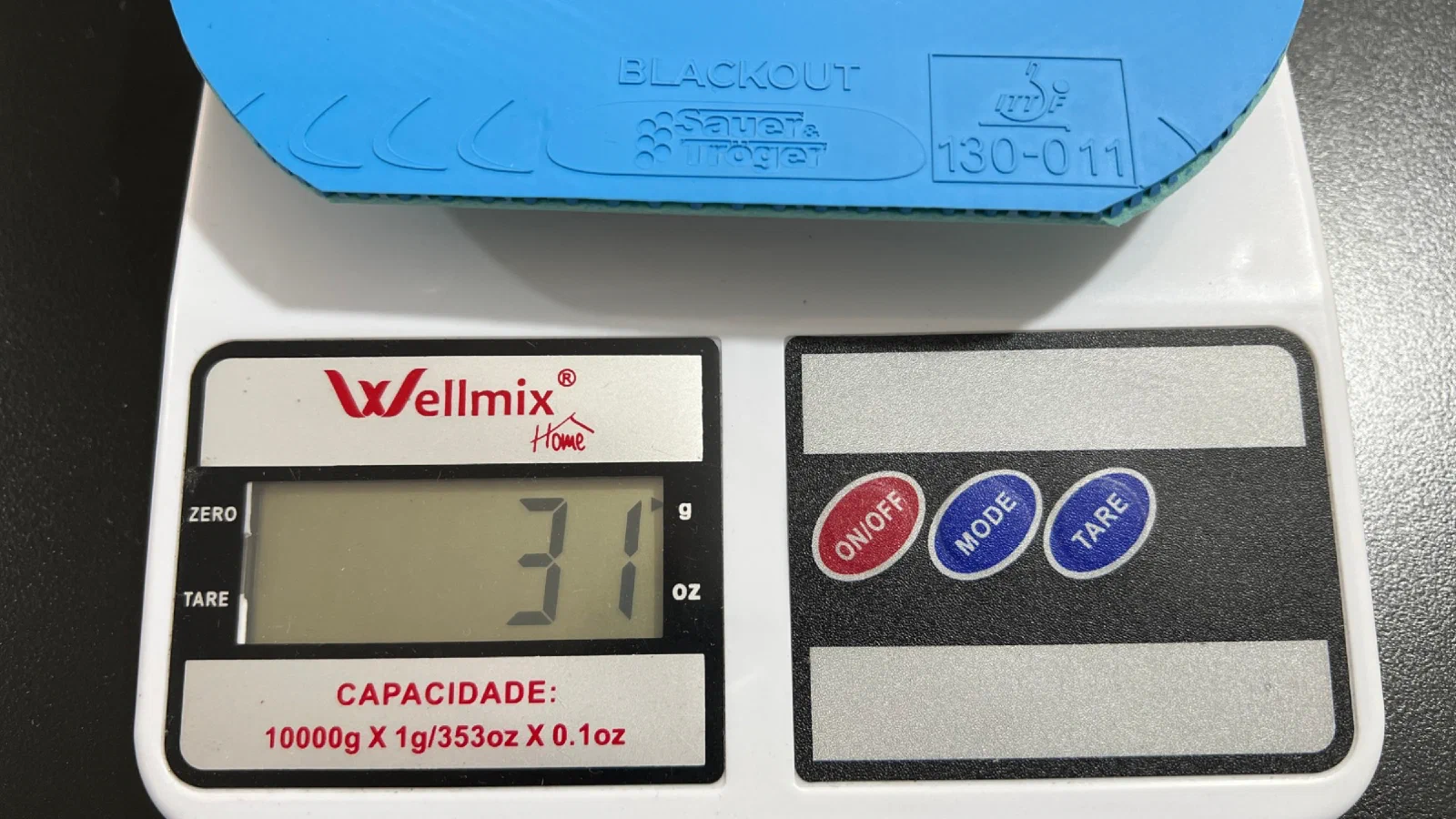
I didn’t measure much, I admit: the plan was just to test it, not to write a review. But I did weigh the rubber: my 1.5 mm Blackout, cut for the 08X (a large blade), weighed 31 g, without glue. It is light, and the sponge is, in my words, “ridiculously slow”.
What the manufacturer says (official Blackout page):
| Item | Blackout |
|---|---|
| Type | anti-spin with sponge |
| Thicknesses | 1.5 mm and 2.0 mm |
| Sponge | ultra-soft, linearly damping |
| Topsheet | about 85% less grip |
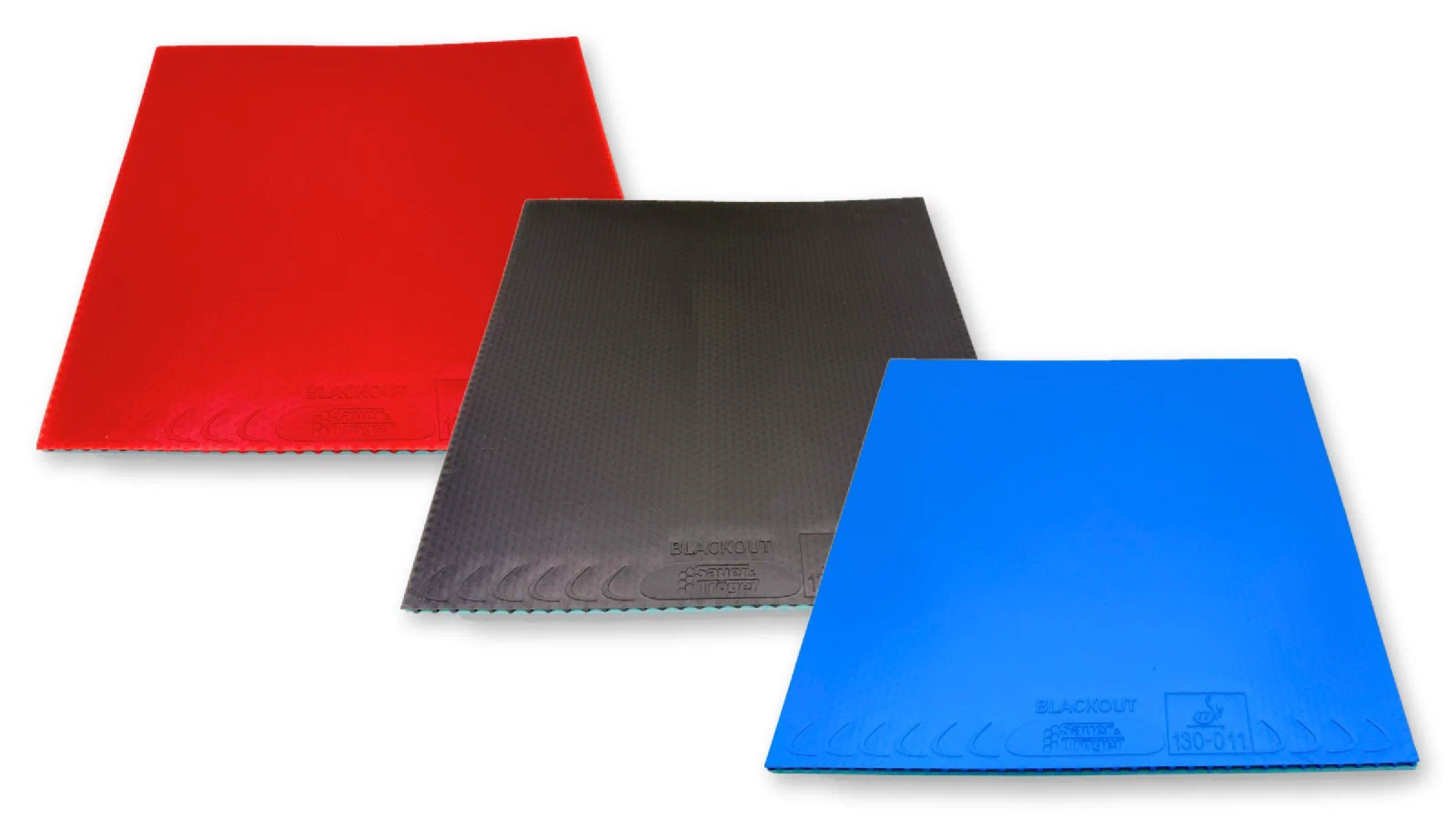
| Colors | red, black and blue |
| Speed / control / disruption | 33 / 98 / 99 (S&T scale) |
| Recommended style | defensive, close to the table |
I used the 1.5 mm, the thinnest (and therefore the faster of the two), in blue (the sponge is blue too).
How the test went
About 45 days of use, only in training and some doubles, always on the backhand, with the setup I described at the start. I didn’t take the Blackout to a tournament, partly because I stopped competing in 1995 and never went back, nor do I plan to. The opponents were first- and second-division players from Minas Gerais, people who attack well and know how to read spin.
I expected a less slow rubber than it is. Its ability to absorb speed surprised me. The topsheet is very smooth, but not as smooth as the Dr. Neubauer A‑B‑S 3 Pro (another anti with an absorption sponge), and that little bit of friction helps with some pushes.
It took me about two weeks to get used to it. Having used the Monkey long pips in 0.6 mm before helped a lot; it is also from Sauer & Tröger and also uses an absorption sponge, like the Blackout. Anyone coming straight from an offensive rubber will probably need more time.
Shot by shot
Blocking a strong topspin
This is where the Blackout shines. Against a strong topspin, the ball dies on the racket and comes back really heavy, low and slow. The opponent who went all out gets a ball with no pace at all and has to generate the power again, from scratch.
Receiving serves
It depends on the serve. Against serves with lots of spin, it works very well: the rubber ignores much of the spin and the ball comes back under control. A slow, no-spin serve, on the other hand, is chaos: there is no speed or spin for the rubber to use, and the ball tends to pop up far too easily.
Against backspin balls and pushes
This is the weak spot. Against backspin, the Blackout is too slow, and pushing is not very effective. What worked well was a firmer chop, even close to the table. Players used to pushing with OX long pips will need to adapt.
Slow balls and the short game
Against passive balls, it doesn’t work well. Without the energy of the opponent’s ball, the rubber has nothing to send back, and the push lacks weight, forcing you to hit harder and take more risk.
Attacking
Very hard and not very effective. You can push backspin balls, but not as well as with long pips, and hitting firmly is really difficult.
Serving
Very limited. Serving with the Blackout side gives an average player an easy ball to attack.
Away from the table
Only chopping, and quite hard, or the ball won’t even reach the other side. And it always comes back slow, with little spin. A more offensive blade might help, but I didn’t test that.
What about twiddling?
I don’t twiddle the racket during the point: I never learned to think of it in time. Whenever I use pips or an anti on the backhand, I lose the touch of an inverted backhand; I would need a lot of training to turn it into a skill. For those who twiddle, the Blackout helps: you can choose between the anti and the inverted rubber on every ball, and also create chances to attack.
On the other side of the table
The Blackout ball drops before it gets there, it is so slow, and that makes it hard for the opponent to attack: they have to go and get the ball and generate all the power on their own. And yes, it often messes with the head of whoever is on the other side. That psychological effect helps a lot: if the Blackout ball is followed by an attack right after, the opponent is under even more pressure.
But one kind of opponent put me at a disadvantage: the one who understands spin and, instead of going all or nothing, builds the point with more passive, well-placed balls, especially to the backhand, waiting for the right ball to finish. Against that player, I had to get out of the passive backhand and attack with the forehand, that is, pivot, or risk attacking with the Blackout, which doesn’t work well.
The players who attacked more were the best ones for me. That is where the Blackout shines: on defense.
Why I stopped using it
I have a total hip replacement, as I mentioned in the post Your heart lost the point. Because of it, my movement is limited, and attacking almost everything with the forehand is not a real option for me. I also had no plans to keep using it: the idea was just to test it, and it was a lot of fun and quite a challenge.
The Blackout made my backhand purely passive. Without the pivot to compensate, it limited my game too much. That is not a flaw in the rubber: it is its profile. Players who are quick enough to attack with the forehand, or skilled enough to twiddle, live a different reality with it.
Compared with other rubbers
Super Stop (Sauer & Tröger): another anti from the same brand. The main difference is the absorption sponge, which the Super Stop doesn’t have. The Super Stop makes attacking much easier, but it doesn’t absorb as much speed and spin as the Blackout. Want more attack from your anti? Super Stop. Want to kill the ball? Blackout.
Dr. Neubauer A‑B‑S 3 Pro: its main direct competitor, also with an absorption sponge, and it costs quite a bit more: a quick search showed me the Blackout’s average price is about 40% lower (prices checked in October 2026).
Blade: on a slow blade, the Blackout is almost unworkable. The blade needs medium or even high speed to make up for the slowness of the sponge. Very soft, flexible blades are not the best options either. On a 7-ply like the DHS PG7, it works really well.
Gluing, cleaning and durability
Gluing is easy, like any rubber (if you’re not sure which glue to use, see Which 360TT glue to use?). Removing it is the big problem: the sponge is extremely fragile. Gluing it with a double-sided adhesive sheet, instead of glue, can be a good idea here.
Careful when removing it
The Blackout’s sponge tears easily. Peel it off slowly, without rushing and without bending the rubber. We recommend using a plastic spatula to help. If you change equipment often, count on this risk.
Cleaning: we recommend the regular SpinUp. It doesn’t need a protective film, and you should never put an adhesive protective film on its topsheet, or on any anti-spin’s.
Durability: here it is the opposite of other rubbers. When it wears out, the Blackout starts to grab spin, that is, it gradually loses exactly what makes it an anti. I used it for a short time, so I can’t say how long it lasts; from what I saw, it lasts a long time. Mine looked like new.
Strengths
- Blocking heavy topspin: the ball dies on the racket and comes back heavy, low and slow.
- Receiving heavily spun serves: the rubber ignores much of the spin, and the ball comes back under control and dropping.
- Control: it absorbs speed and spin very well, even against strong attacks.
- It gets into the opponent’s head: the slow ball with reversed spin breaks the attacker’s rhythm, and the pressure grows if you attack right after.
- Light and durable: 31 g cut for a large blade, and mine looked like new after the test.
- Price: its main direct competitor costs quite a bit more.
Weaknesses
- Passive, dead or high balls: attacking and pushing these balls is chaos. Against backspin it still works, but not as well as with pips.
- Attacking: very hard and not very effective.
- Serving: easy for the opponent to attack.
- Removing it: the sponge is fragile, be careful.
- The slowness: you can hardly call it a weakness, since it is made to be this way, but it is, in my words, irritatingly slow. That is the price of absorbing so much.
Who it may suit
Where it works well:
- with players who have a good pivot and want to use the backhand to create chances after the opponent’s attack;
- with players who want to play mainly defending close to the table;
- with players who twiddle during the point, breaking the rhythm;
- with veterans: the Blackout fits well in the game of those who already read spin and prefer blocking to attacking.
Where it doesn’t shine (nothing stops anyone from adapting and using it, but it is not its strength):
- for players who rely on pushing or attacking with the anti or pips side;
- for players who chop away from the table: you can adapt, but it is not where it shines;
- for beginners: without reading spin and without the pivot, they struggle more.
The bottom line
Irritatingly slow, and that is exactly why it works.
The Blackout does very well what it promises: it kills the opponent’s speed and sends back a low, slow ball with reversed spin. In return, it charges a high price from anyone who needs to attack with it. If your game has the pivot to take advantage of what it creates, it is worth a try.
Now I want to hear from you: have you used the Blackout or played against it? Do my impressions match yours? And which DHS, Sauer & Tröger and 360TT products would you like to see in the next review? Tell me in the comments.
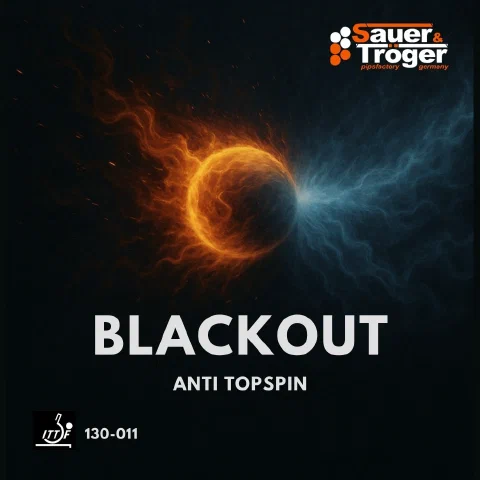 Blackout – Sauer & TrögerAnti-spin with an ultra-soft absorption sponge: it kills the speed of the topspin and sends back a low, slow ball with reversed spin.
Visit the store →
antispin · anti spin · anti top · black out · blakout · sauer troger · damping sponge
Read also
So, which rubber should you use? The null hypothesis method
Catalog speed and spin, "tried it and liked it", your idol's rubber: see why almost all of it misleads and how to choose your table tennis rubber methodically.
DHS Hurricane 3 NEO: The Guide to the World's Most Famous and Most Used Rubber
Commercial, Provincial, National or Player Edition? See what changes in the DHS Hurricane 3 NEO, which hardness to pick and how to avoid counterfeits.
You Don't Need Your Idol's Rubber (and Clóvis de Barros Explains Why)
Are you blowing the bugle in a nursing home? See, through Clóvis de Barros' philosophy, why a pro rubber can be the villain of your game. Check it out!
Comments
Comment with your account (email or Google). Every comment is reviewed before it appears.