Double Happiness: the story of DHS, the brand intertwined with Chinese table tennis
In this post9 sections
If you play table tennis, you have seen those three letters a thousand times: on your training ball, on your forehand rubber, on the colorful table in the World Championships broadcast. Few people know that DHS stands for Double Happiness, and that the name was born from two celebrations in 1959, one of them a world title. By the way, many players call a ball that clips the net and then the edge a double happiness: double luck for the hitter, none for the receiver.
Telling the story of DHS means telling the story of Chinese table tennis. Since the first title, the two have walked together, in a cycle that has repeated itself for more than 60 years: the team tests, the factory adjusts. When the rules change, both adapt together, and they almost always come out ahead.
This post is based on the DHS Service Guide, the brand’s technical handbook (4th edition, 2022, in Chinese), which DHS made available to 360TT as its official distributor in Brazil. It includes a timeline of the sport and of the factory. Since it is the brand’s own version of its history, I checked what I could against other sources and I point out when a figure comes only from DHS.
TL;DR: the ball reached China before the national team did: the sport landed in Shanghai in 1904 and the first Chinese ball came out in 1927 (before the national team, the ball). In 1959, China’s first world title gave the brand its name, and it debuted at the 1961 World Championships in Beijing, the same event where a 15-year-old Brazilian knocked out the champion. Then came ping-pong diplomacy, the 40 mm ball and the Hurricane (the world against China), the Ma Long era and Paris 2024. At the end, what this story teaches players.
Before the national team, the ball
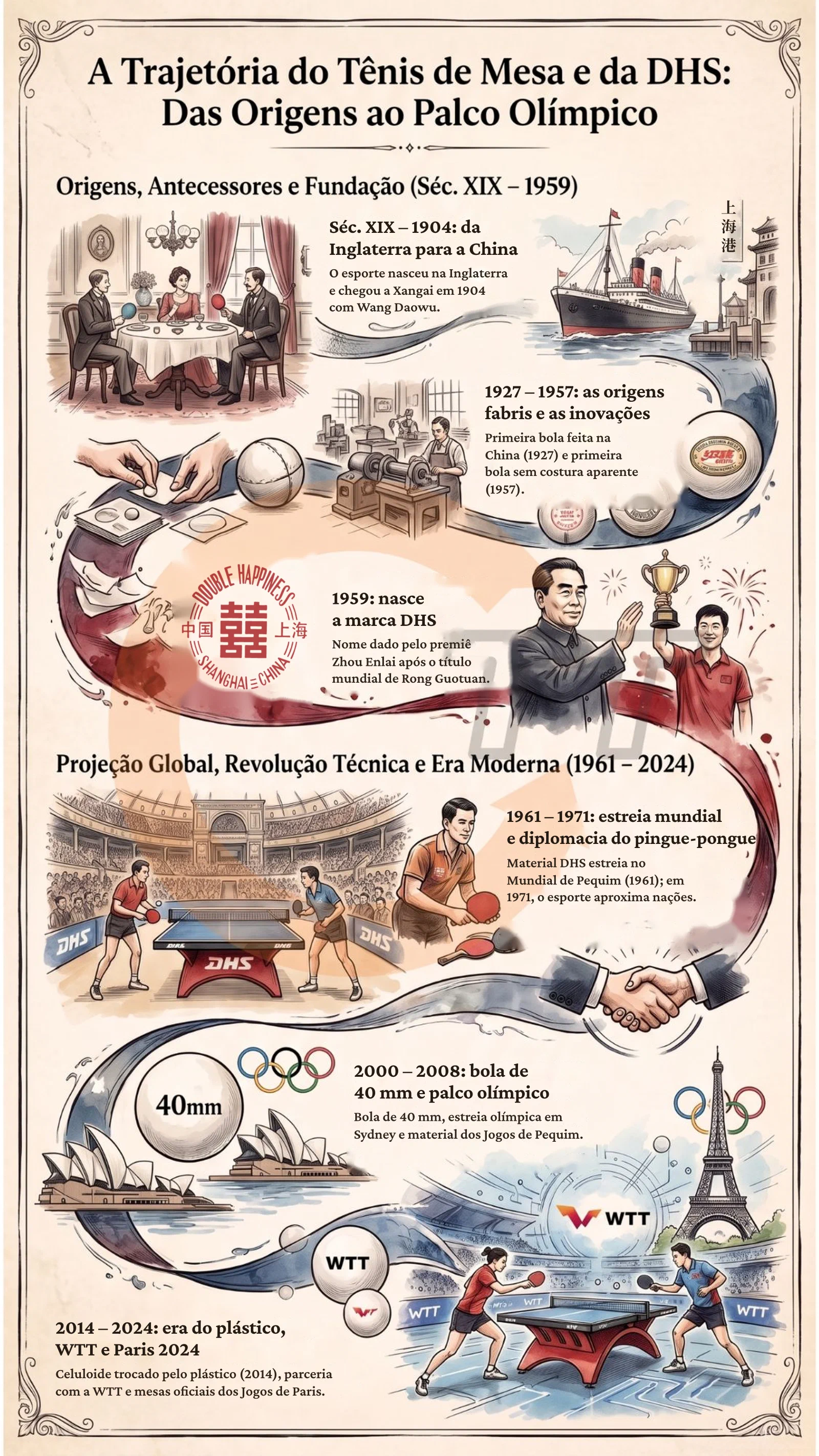
Table tennis was born in England at the end of the 19th century as a dinner-table game: rackets made of stretched skin, rubber or cork balls wrapped in wool so as not to damage the furniture, a net strung between two chairs. Around 1890, the Englishman James Gibb adapted a hollow celluloid toy ball, and the game got the ball we know. From there the sport went to Japan, where it became takkyu.
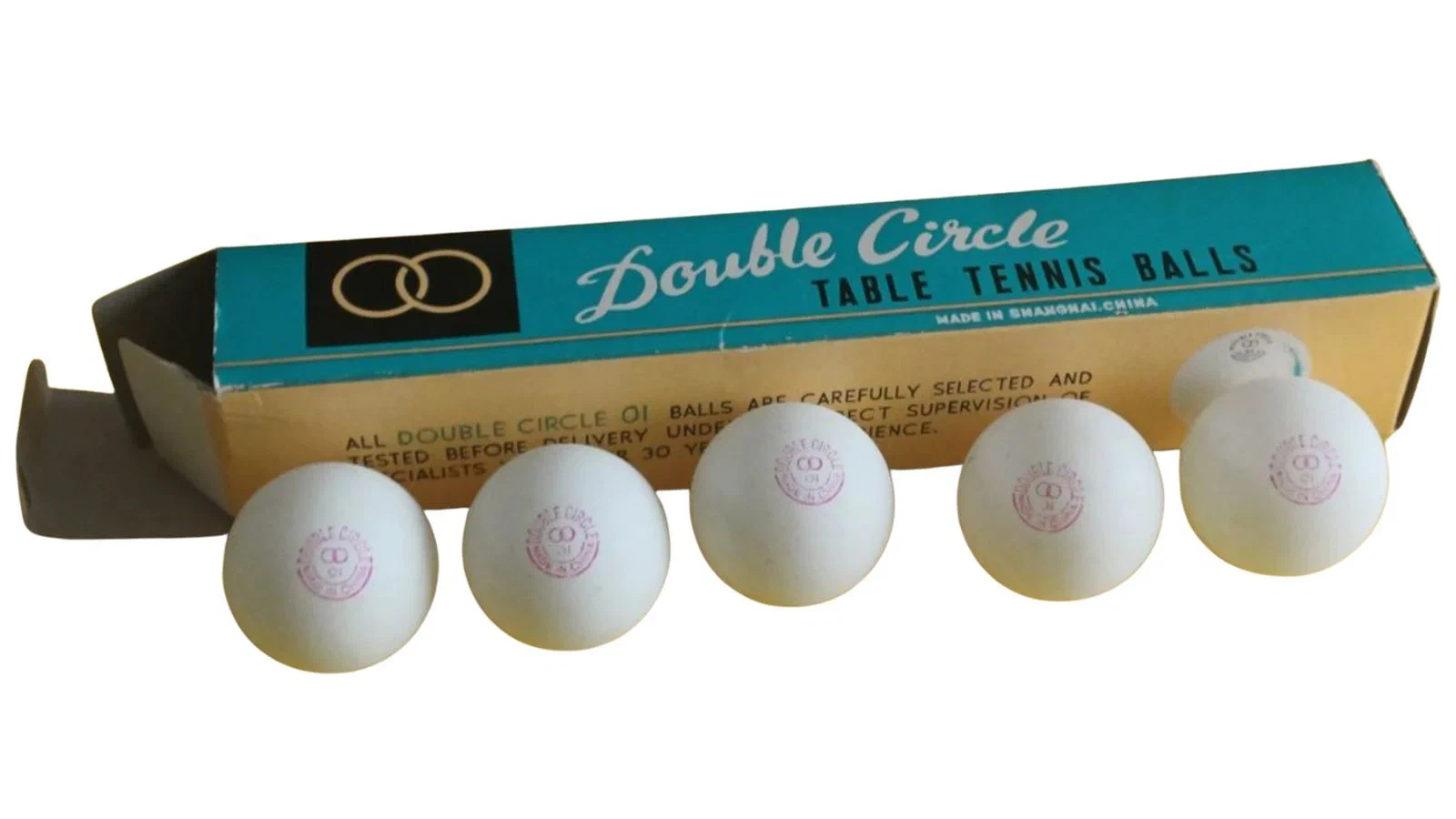
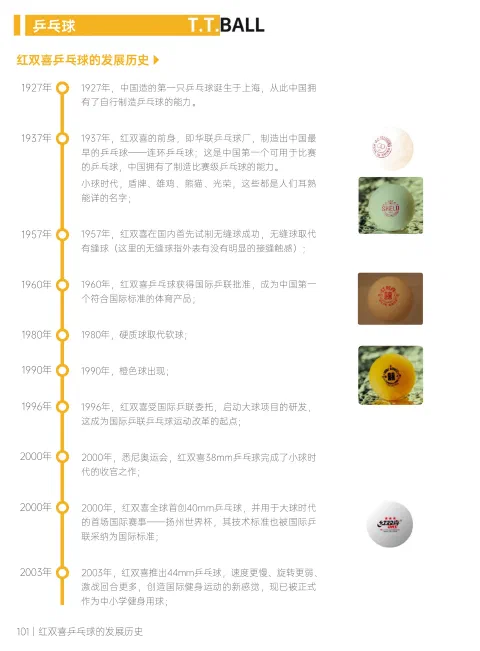
In 1904, Wang Daowu, the owner of a stationery shop in Shanghai, brought ten complete sets back from Japan and gave the sport the name that stuck: pingpang, after the sound of the ball. Curiously, in the West that name had an owner: the English company Jaques registered “Ping-Pong” as a trademark in 1901, and in the United States the rights went to Parker Brothers (today they belong to Escalade). That is why the federations adopted the name table tennis. In China, pingpang simply became the name of the sport. In 1926 the ITTF was founded and held the first World Championships in London that December. And Shanghai started manufacturing: the first ball made in China came out in 1927; in 1928 and 1929 the first racket workshops appeared (one of them made 2,000 to 3,000 a year); in 1937, the Lianhuan ball (“linked rings”) was the first Chinese ball good enough for competition. In English, DHS itself calls that ball Double Circle, and the two interlocked rings survive to this day as the mark of DHS’s training ball line, such as the Double Circle D40+. In 1946 the Hualian ball factory was founded.
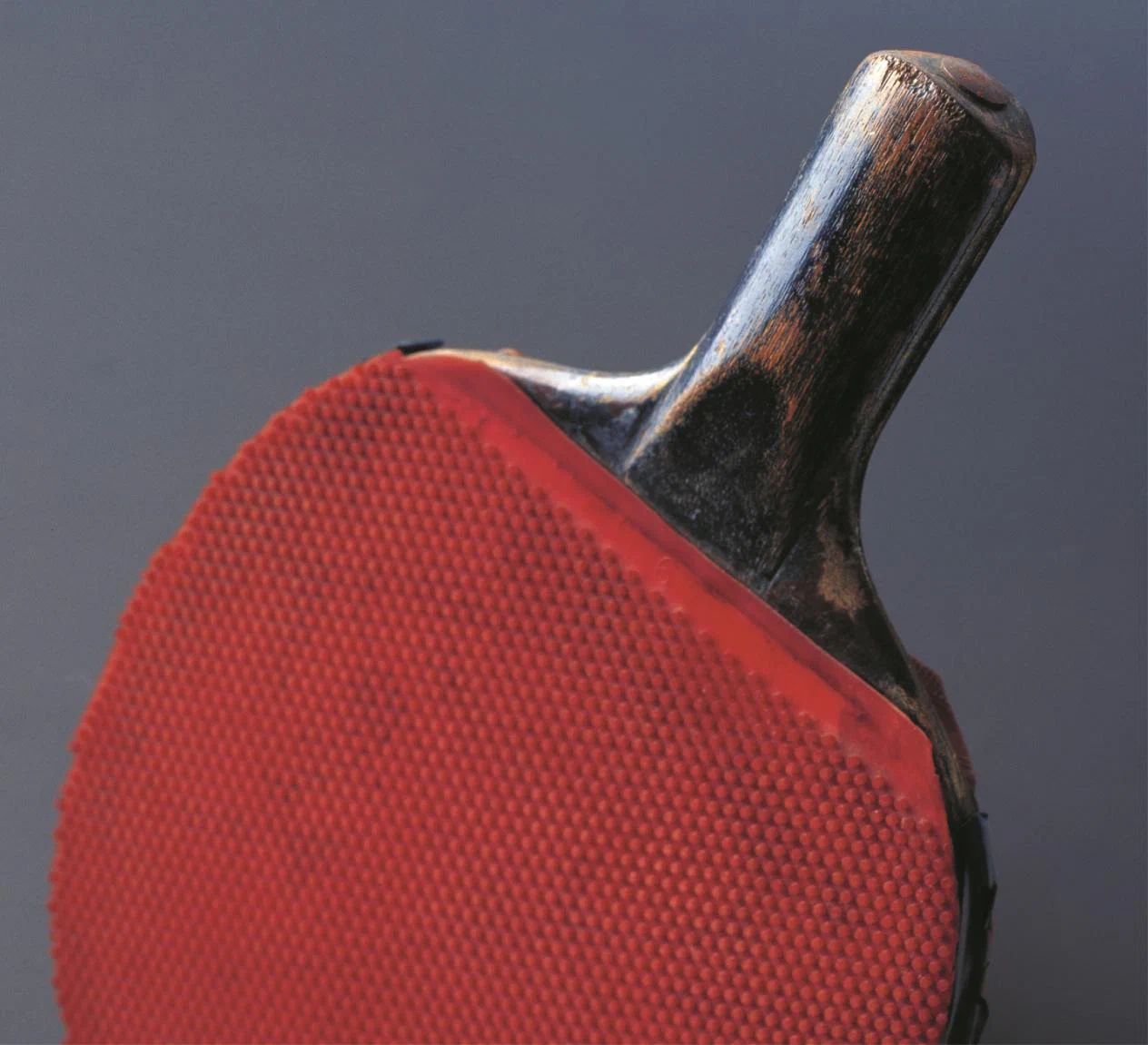
Meanwhile, world table tennis already had an owner. The handbook tells this story in five eras, and in each one the game and the equipment change together. From 1926 to 1951, Europe ruled: 109 of the 117 world titles, with the shakehand grip, defensive play and pips rubber with no sponge, which gave little speed and very little spin; the idea was to miss less than the opponent. From 1952 to 1959, Japan changed the game twice: it swapped the shakehand grip for the penhold, to attack from a distance with the forehand, and brought the novelty that changed everything, the sponge, which gave rise to sandwich rubber (rubber with sponge), still used today, and multiplied speed and spin.
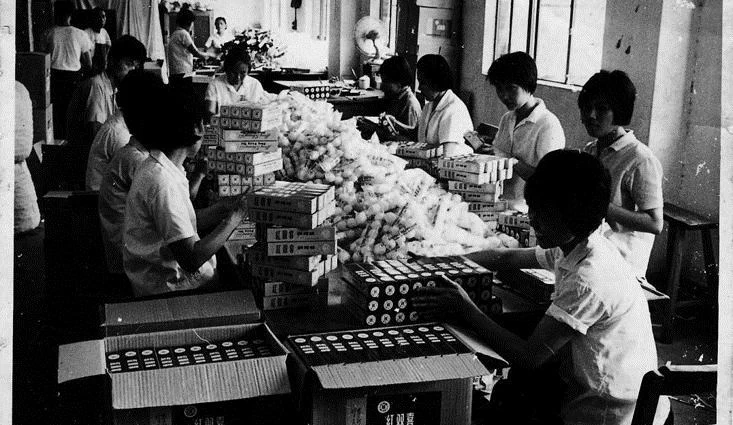
China only joined the ITTF in March 1953, and that same year it played its first World Championships, in Bucharest: it beat Austria and Sweden and lost to England and Hungary. Between 1956 and 1958, Hualian and three other Shanghai factories became joint ventures with the state and formed the basis of what would become DHS. In 1957, Hualian made the first Chinese ball with a sealed seam. All that was missing was the name.
1959: two joys and a name
In 1959, in Dortmund, Germany, Rong Guotuan won the men’s singles at the 25th World Championships and became China’s first world champion in any sport. That same year, the People’s Republic turned ten. Two joys. According to DHS and the Chinese press, Premier Zhou Enlai named the ball made in Shanghai Hong Shuang Xi, “red double happiness”, the same name as the 囍 symbol the Chinese use at weddings. In English, Double Happiness. As an acronym, DHS.
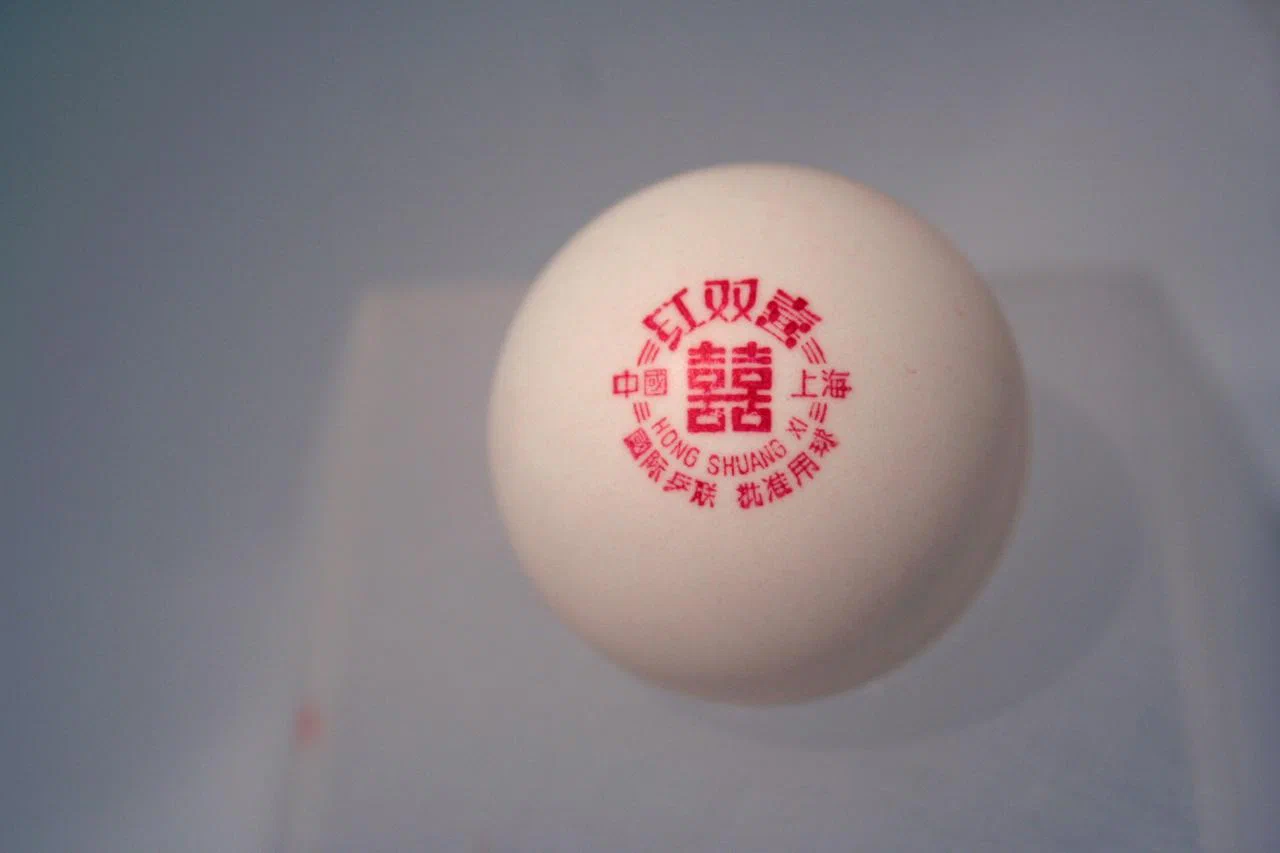
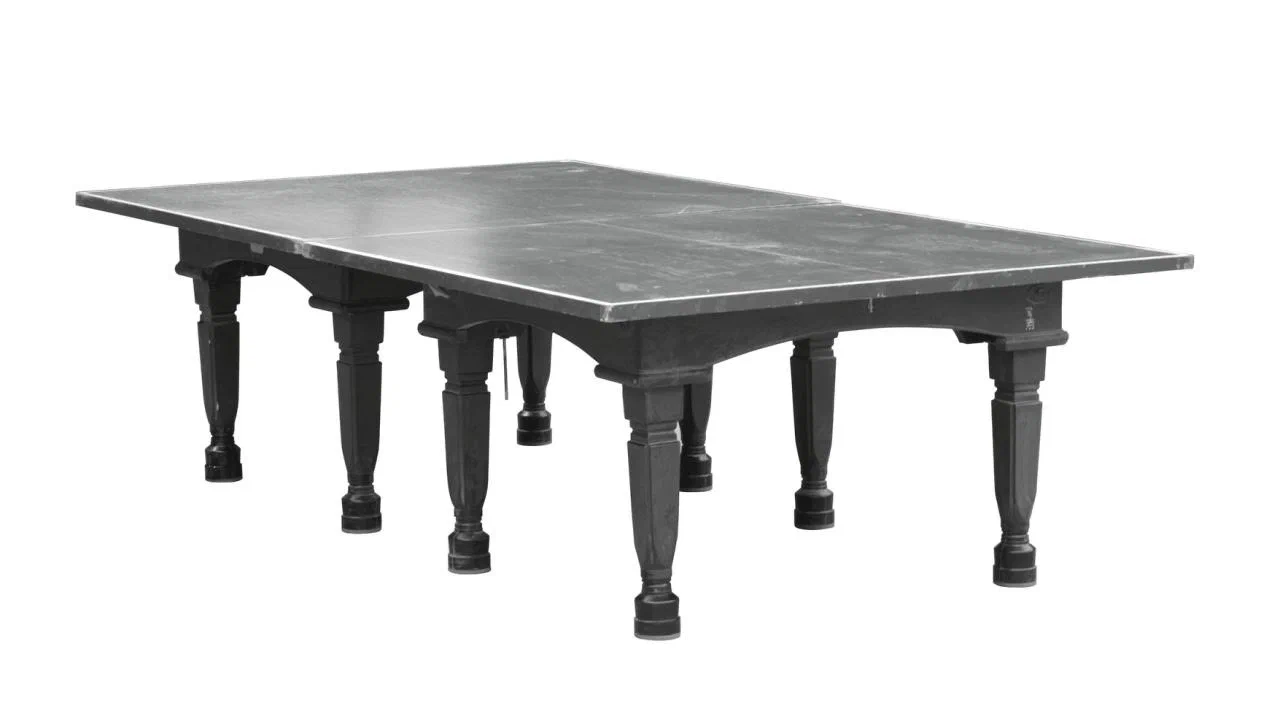
The name came with a deadline. China was going to host the 1961 World Championships and wanted to play with its own equipment, so the country set up a joint technical effort with factories and research institutes. In September 1959, the new ball and table were tested by national team players, among them Xu Yinsheng, and approved. The same effort produced the first Chinese racket with inverted rubber and sponge. In 1960, the ball was approved by the ITTF, the first Chinese sports product to get that approval. It was the first turn of the cycle: the team tested, the factory adjusted.
1961: Beijing, the home debut
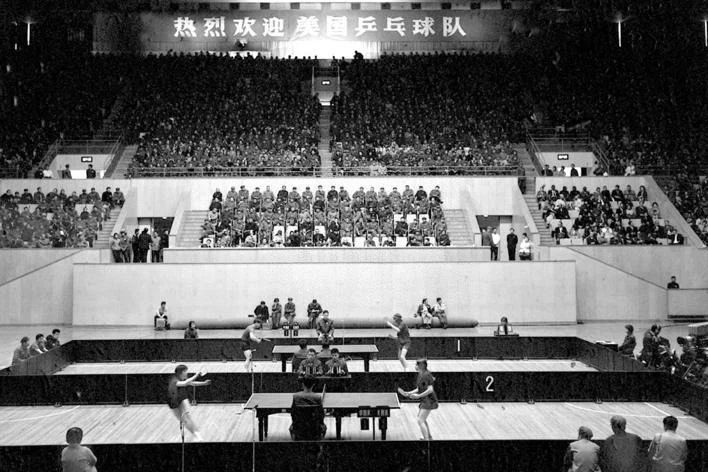
At the 26th World Championships, in Beijing, the ball, the table and the scoreboard were DHS: it was the first time sports equipment made in China appeared at a world championship. And at home, China won the men’s team event, the men’s singles and the women’s singles. For the handbook, this is when the center of table tennis moves from Japan to China, with fast close-to-the-table attack, and the game becomes China’s “national sport”.
🇧🇷 Biriba, 15, against the world champion
At that same World Championships, in April 1961, a boy from São Paulo wrote his name into history. Ubiraci Rodrigues da Costa, known as Biriba, aged 15, beat Rong Guotuan, the 1959 champion whose title had given DHS its name. It was in the third round of the men’s singles, in front of some 15,000 Chinese fans, and he reached the last 16. He received a telegram from Brazilian President Jânio Quadros, and his run was only matched by Claudio Kano in 1987 and surpassed by Hugo Calderano in 2021.
It was no bolt from the blue. At 11, Biriba was already South American champion among adults; at 13, he beat two Japanese world champions, Ichiro Ogimura and Toshiaki Tanaka, in exhibition matches at the Ibirapuera arena in São Paulo, the school that dominated the sport at the time. On November 18, 1958, the sports newspaper A Gazeta Esportiva put him on its front page alongside Pelé and tennis player Maria Esther Bueno: “the golden triangle of Brazilian sport”.
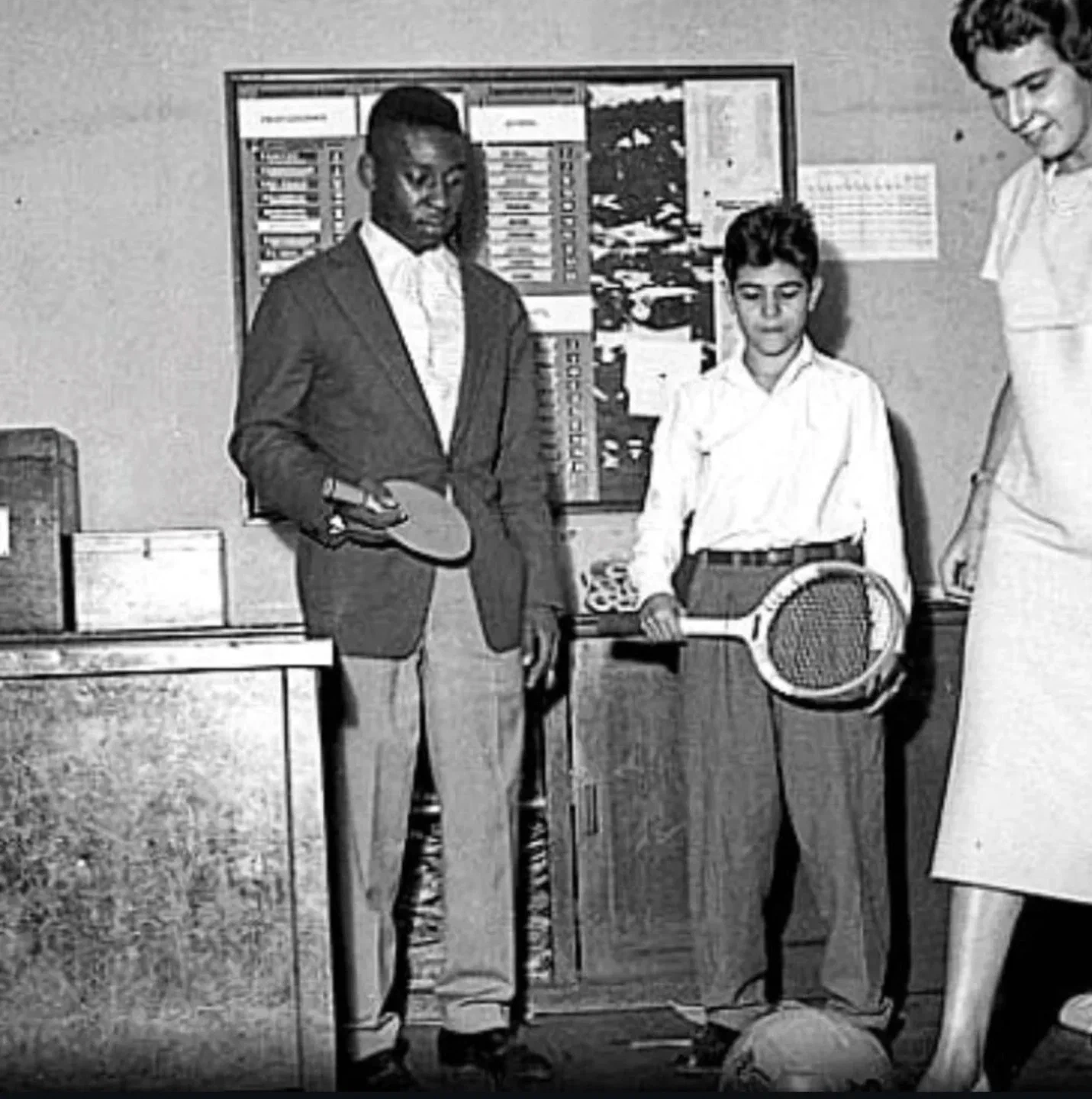
Biriba died in São Paulo on September 25, 2025, aged 80. This is 360TT’s tribute to the first great name in Brazilian table tennis.
The rest of the decade strengthened the partnership. In 1963, in an ITTF test, the DHS ball tied for first place with England’s Halex. In 1965, at the World Championships in Ljubljana, every Chinese player used DHS rackets (the “65” series), China took 5 of the 7 titles and the Chinese women beat Japan, which had dominated the women’s game for eight years.
The small ball moved the big ball
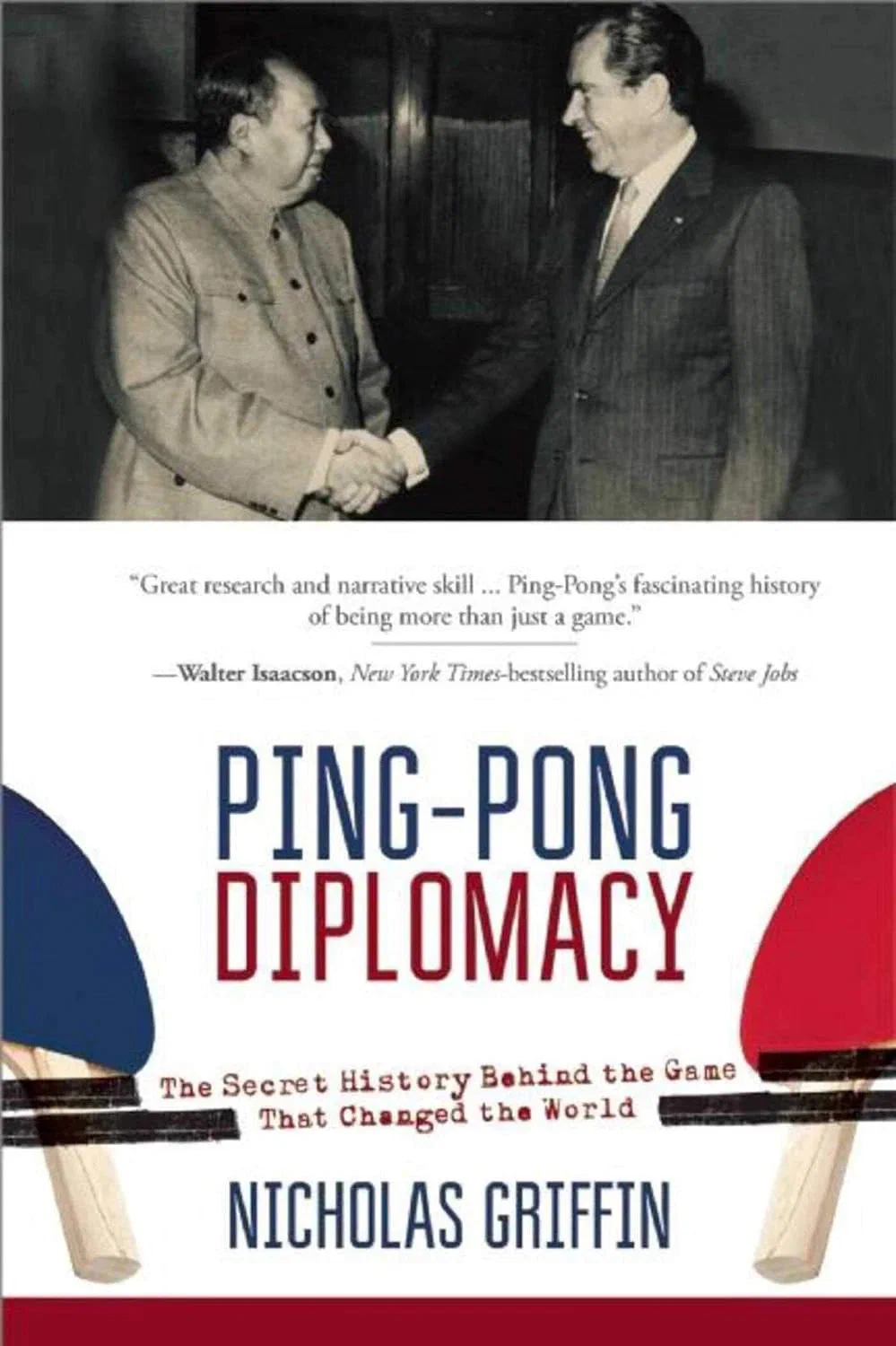
China stayed away from the World Championships for six years and returned in 1971, in Nagoya, Japan. That is where the most famous episode in the sport’s history took place. The American Glenn Cowan, 19, got on the Chinese team’s bus (by mistake, according to the best-known version). Zhuang Zedong, three-time world champion, went to talk to him and gave him a silk painting of the Huangshan mountains; Cowan returned the favor with a T-shirt bearing the peace symbol. The photos went around the world, and days later the American team was invited to play in China, one of the first groups of Americans to enter the country since 1949. This was “ping-pong diplomacy”, which brought China and the United States back together after 22 years of closed doors and paved the way for Richard Nixon’s visit to Beijing in February 1972. “The small ball moved the big ball”, as the Chinese say.
If you want the behind-the-scenes story, there is a great book: Ping-Pong Diplomacy: The Secret History Behind the Game That Changed the World, by American journalist Nicholas Griffin (Scribner, 2014). He tells how table tennis was used as a political tool from the 1950s on, and he even doubts the “chance” encounter in Nagoya: in his view, the Chinese were expecting Cowan.
With the sport back to life in the country, DHS production grew again, and in 1972 its ball got the highest overall score in an ITTF test.
The 1970s, however, belonged to Europe’s comeback. The Europeans combined Chinese fast attack with Japanese topspin and caught up with the Asians. China’s answer came in 1981: after two years of rebuilding, the team won all 7 titles at the World Championships in Novi Sad, the first time a single country took everything in 55 years of the event.
In the early 1980s, DHS also went out into the world with the PF4 line (ball, racket and rubber), the first Chinese brand to open markets abroad. The PF4 still exists, today as a family of tacky-topsheet rubbers.
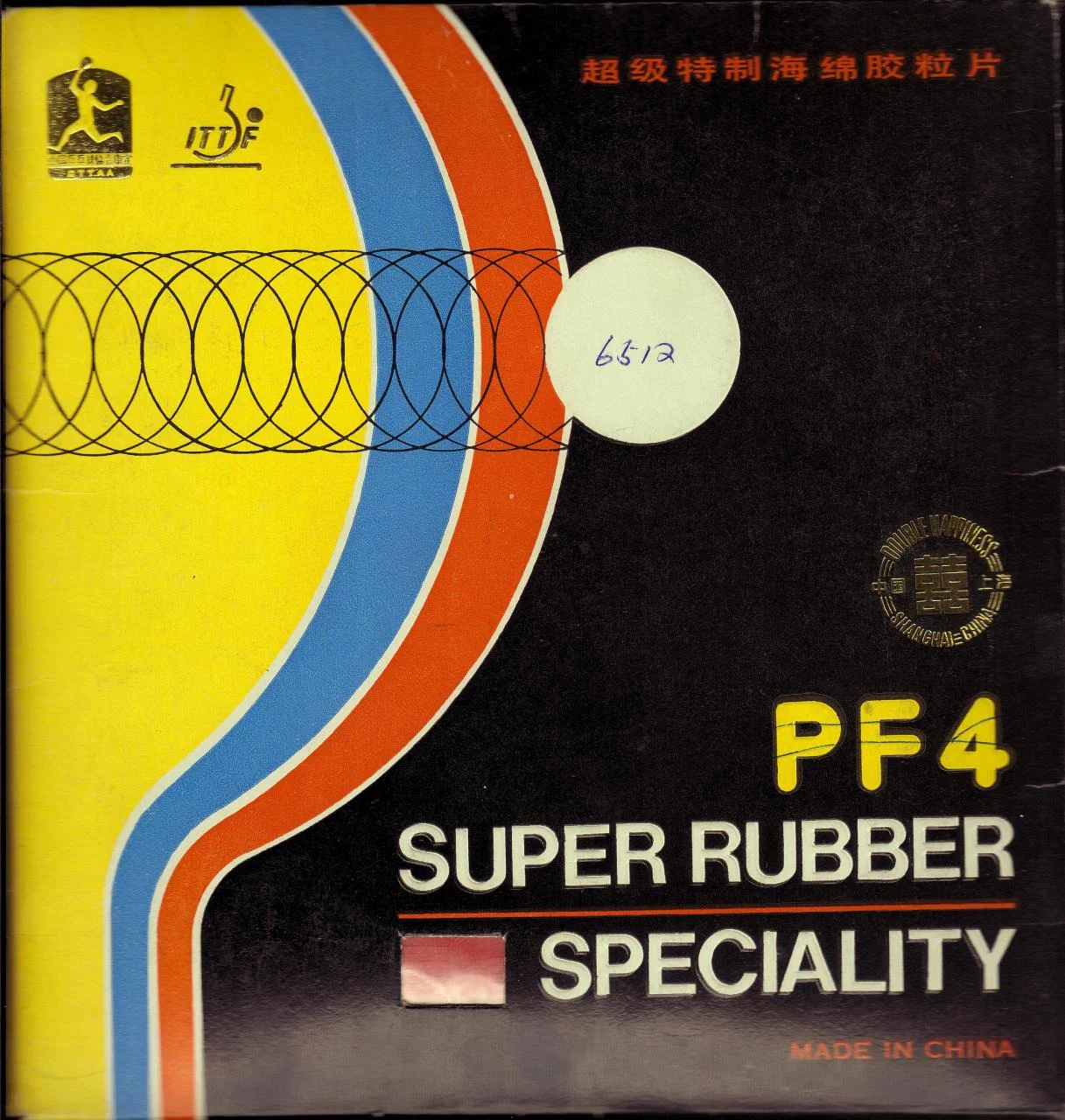
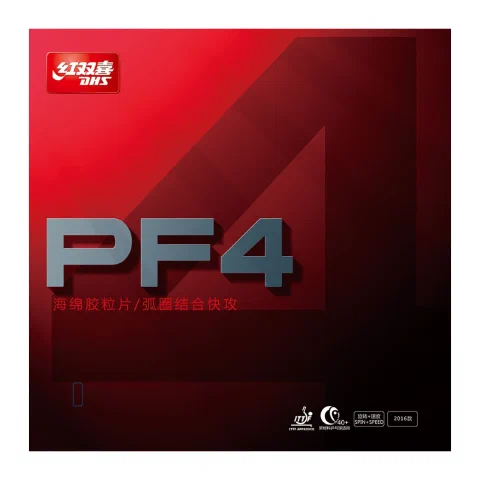 DHS PF4The legendary rubber that took DHS to the world, updated for the 40+ ball: the same spin as always, with more speed in attack.
Visit the store →
In 1988, in Seoul, table tennis became an Olympic sport. In 1995, DHS unified its brand into a single company, and its ball was the official ball of the World Championships in Tianjin, where China, once again, took all 7 titles. That is the birth of what the Chinese call “the world against China”.
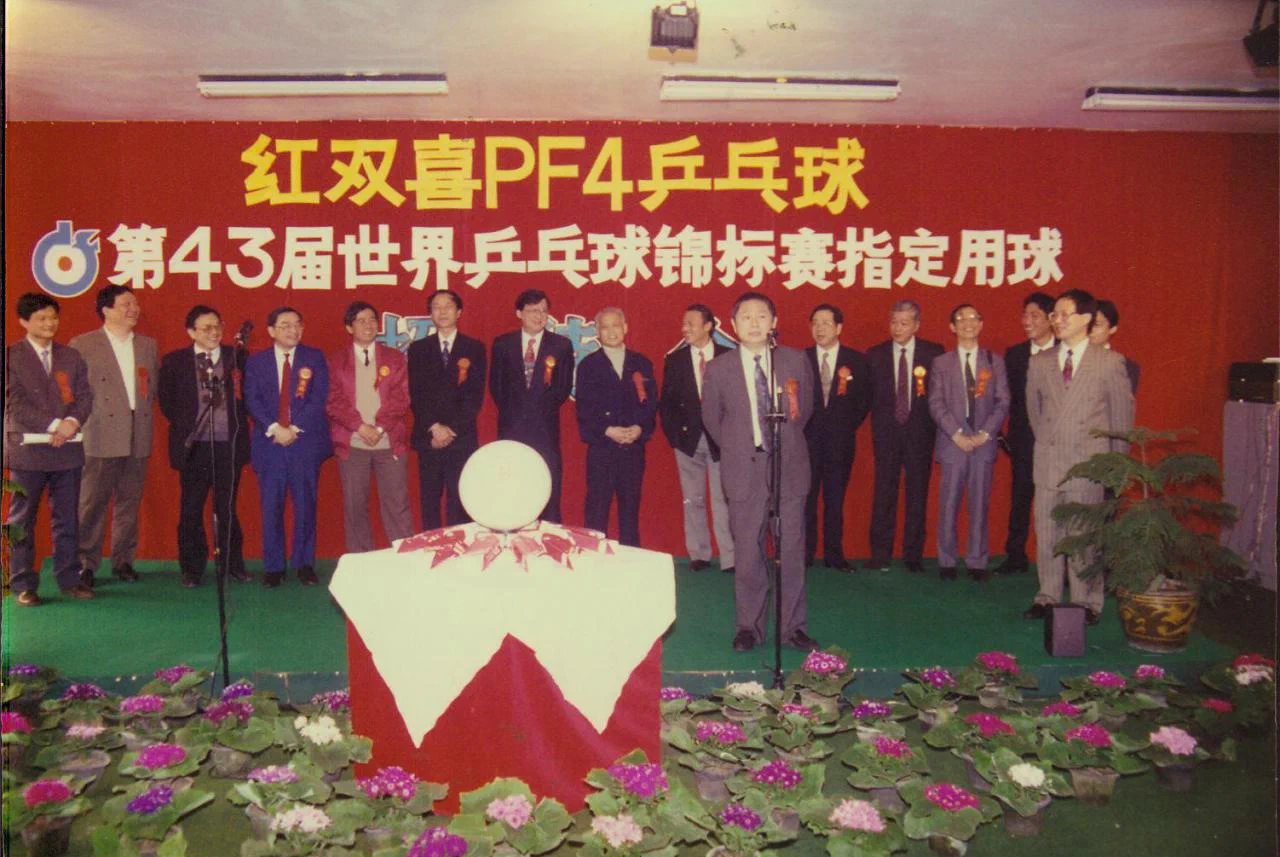
The world against China
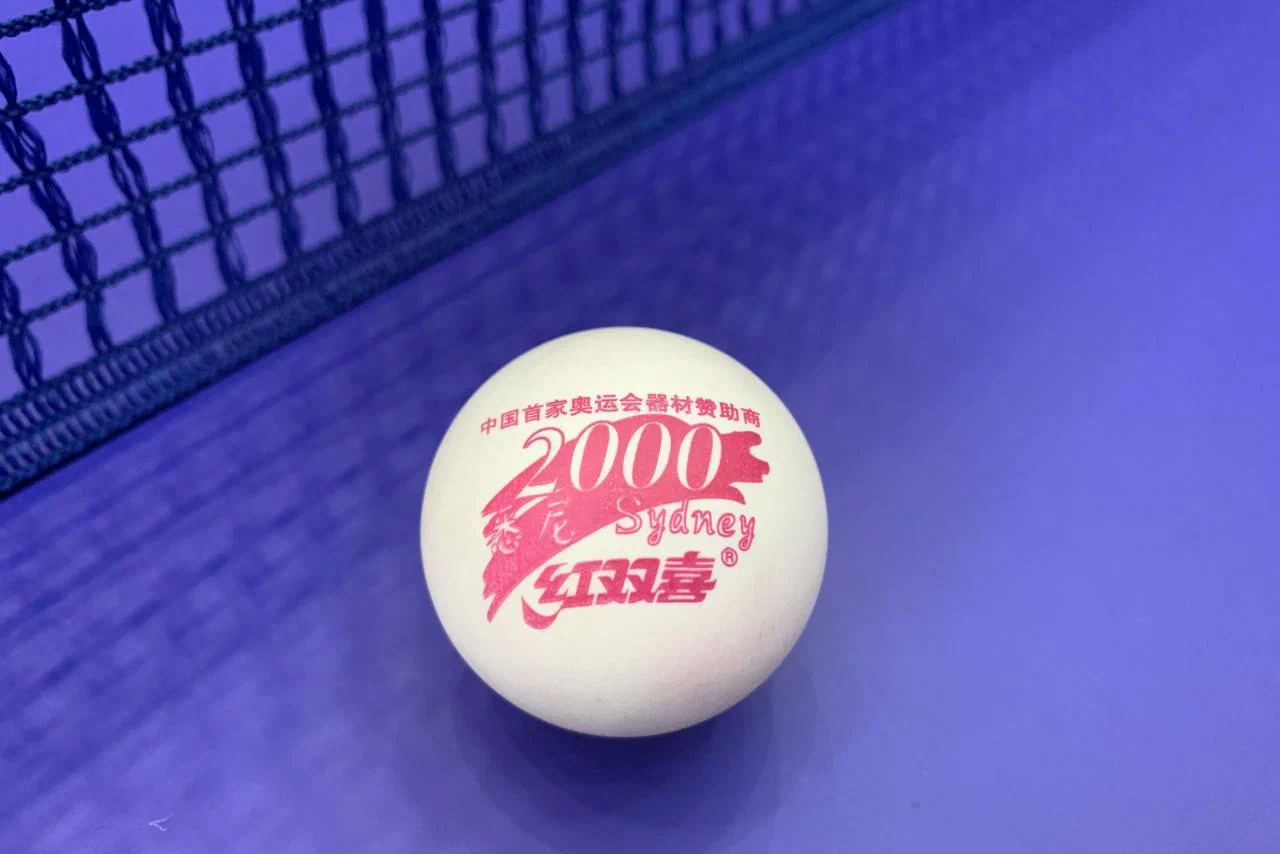
With China winning everything, the ITTF began changing the rules to make the game more competitive and easier to watch on TV. DHS was involved in those changes. In 1996, according to the handbook, the ITTF commissioned it to develop the bigger ball. The Sydney Olympics, in 2000, were the last major competition with the 38 mm ball, and a DHS ball: the first time Chinese equipment was official at an Olympic Games. That same year, the World Cup in Yangzhou debuted the 40 mm ball, also DHS. I covered that change in detail in the ball guide, from 38 mm to 40+. Next came 11-point games (2001) and the serve without hiding the ball (2002).
In rubbers, the turning point had come in 1998, when DHS launched the rubber already glued to its sponge at the factory. Until then, Chinese players bought the topsheet and the sponge separately. That is how the G888 (used by Wang Liqin and Yan Sen while the ball was still small) and the Kuangbiao family, known worldwide as Hurricane, were born. With the 40 mm ball, speed became the priority, and the Hurricane 2 and the Hurricane 3 were designed for it.
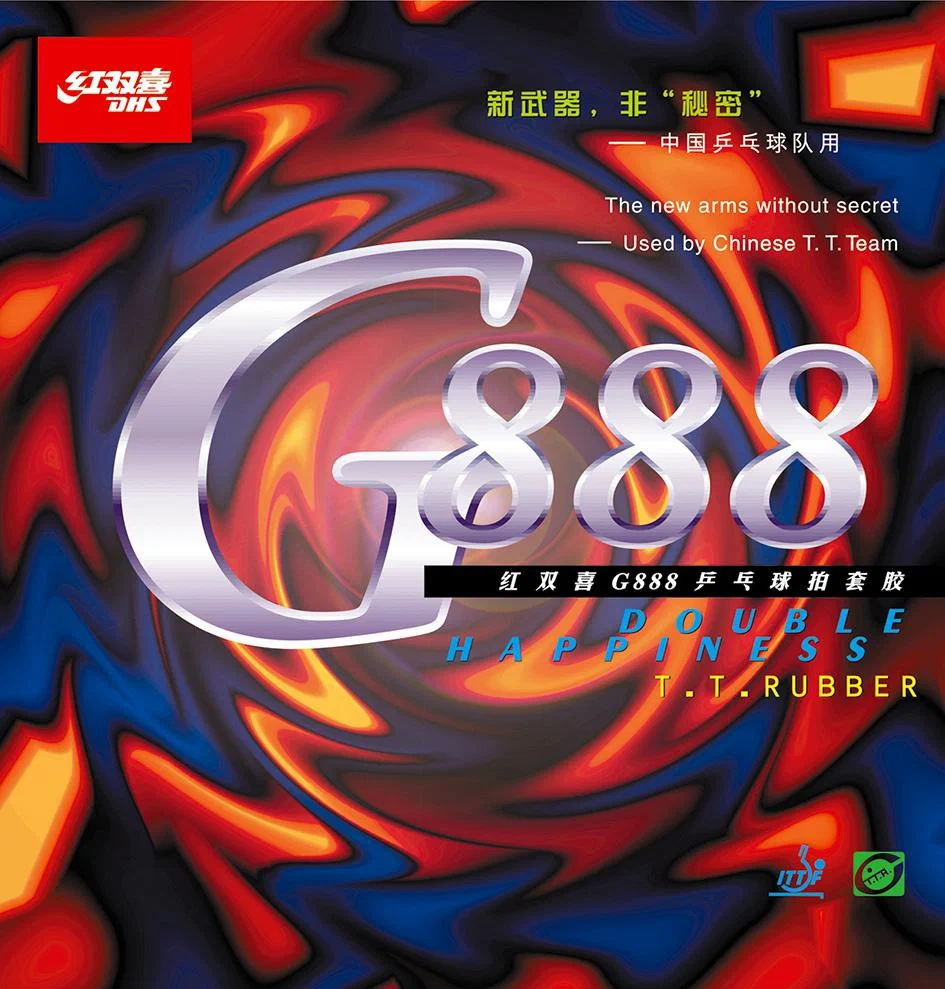
 DHS G888DHS's first rubber already glued to its sponge is still in production: a very tacky topsheet for maximum spin in mid-distance attack.
Visit the store →
In blades, it is a comeback story. Since the 1980s, the Chinese team had used almost only foreign blades. In 2003, DHS studied the game of eight national team players and launched Hurricane blades named after each of them. In 2005, at the World Championships in Shanghai, the Hurricane Wang helped Wang Liqin win the singles and the mixed doubles. In 2006, the Skyline 2 and Skyline 3, made for Ma Lin and Wang Hao, completed the lineup, and 70% of the team’s forehands were already on DHS rubber.
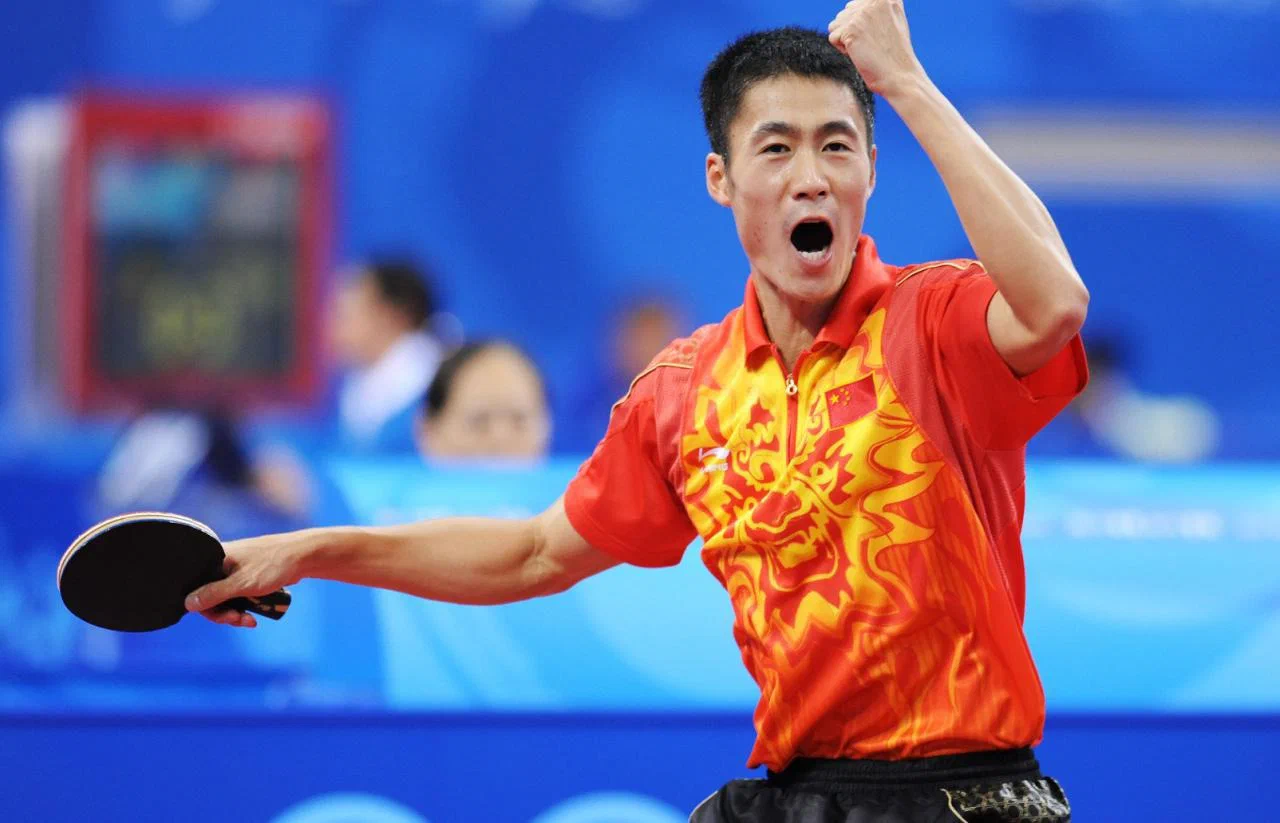
In 2008, DHS supplied the Beijing Olympics, and China won the team events and the top three places in both singles.
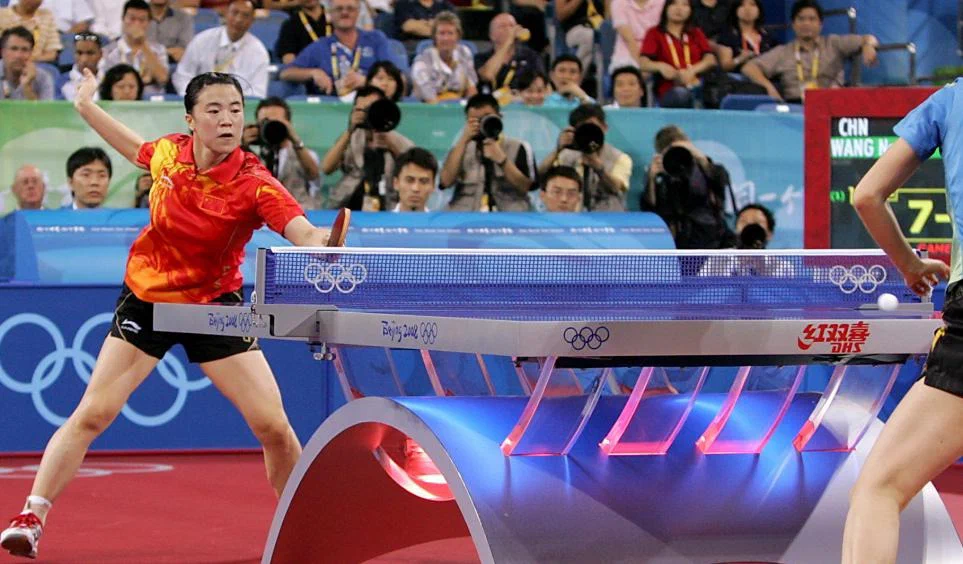
Shortly afterwards, on September 1, 2008, the ban on solvent-based speed glue came into force (I told that story in Why Is Your Glue Water-Based Today?). It is the best example of the cycle: DHS tested less tacky rubbers and thicker pimples with the national team, and the players’ answer was to keep the rubber tacky. So the factory worked on the sponge instead. That is how the NEO line was born, with a sponge treated at the factory to be “stretched”, imitating the effect the glue used to give.
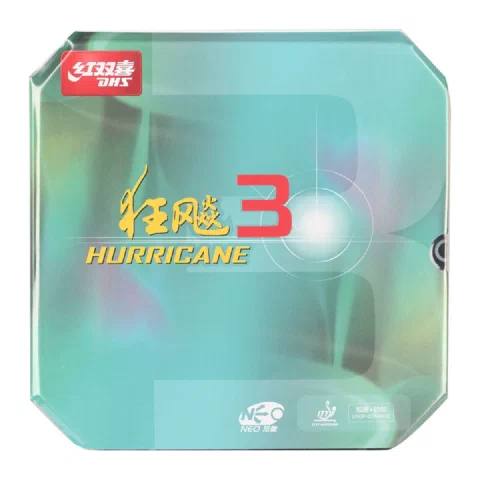 DHS Hurricane 3 NEOThe rubber that has followed the Chinese team from the 40 mm ball to the present day, with a factory-treated NEO sponge.
Visit the store →
The Ma Long era
Ma Long signed with DHS in 2008, and the history of his blades shows the cycle in detail. According to the handbook:
- 2008: the first Hurricane Long, built on the blade he was already using;
- 2011: he switches to a seven-ply, all-wood blade and puts together 51 straight wins starting at the Suzhou Open. DHS launches the Hurricane Long 2;
- 2012: the Hurricane Long 3, with improved internal glue at his request, and the blue handle with the yellow crescent that became his trademark;
- 2013: the Hurricane Long 5, with inner carbon and aramid layers, with which he wins the National Games;
- 2016: after the gold in Rio, the Long 5 gets a smaller blade face;
- 2021: the Golden Slam edition, to celebrate his Tokyo feat.
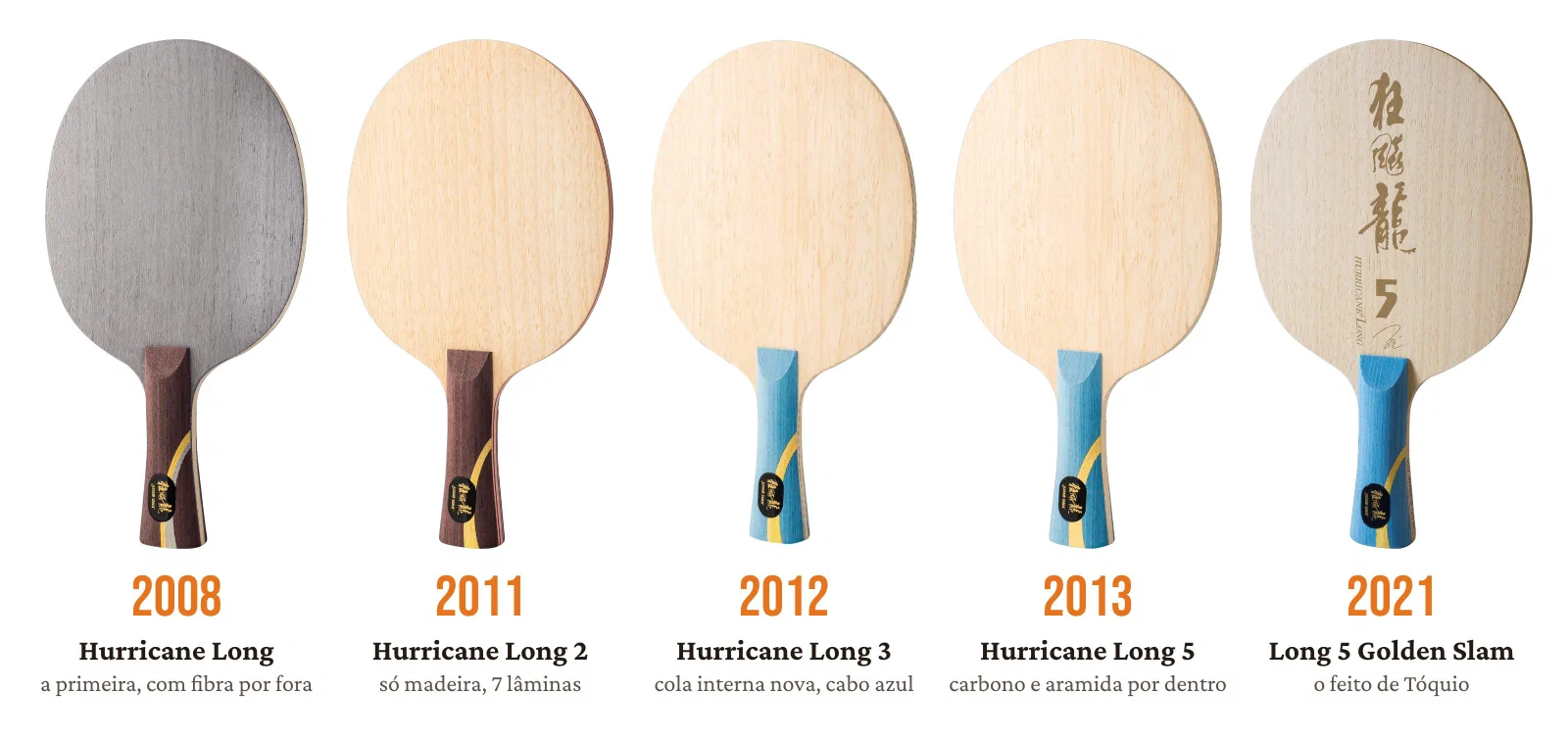
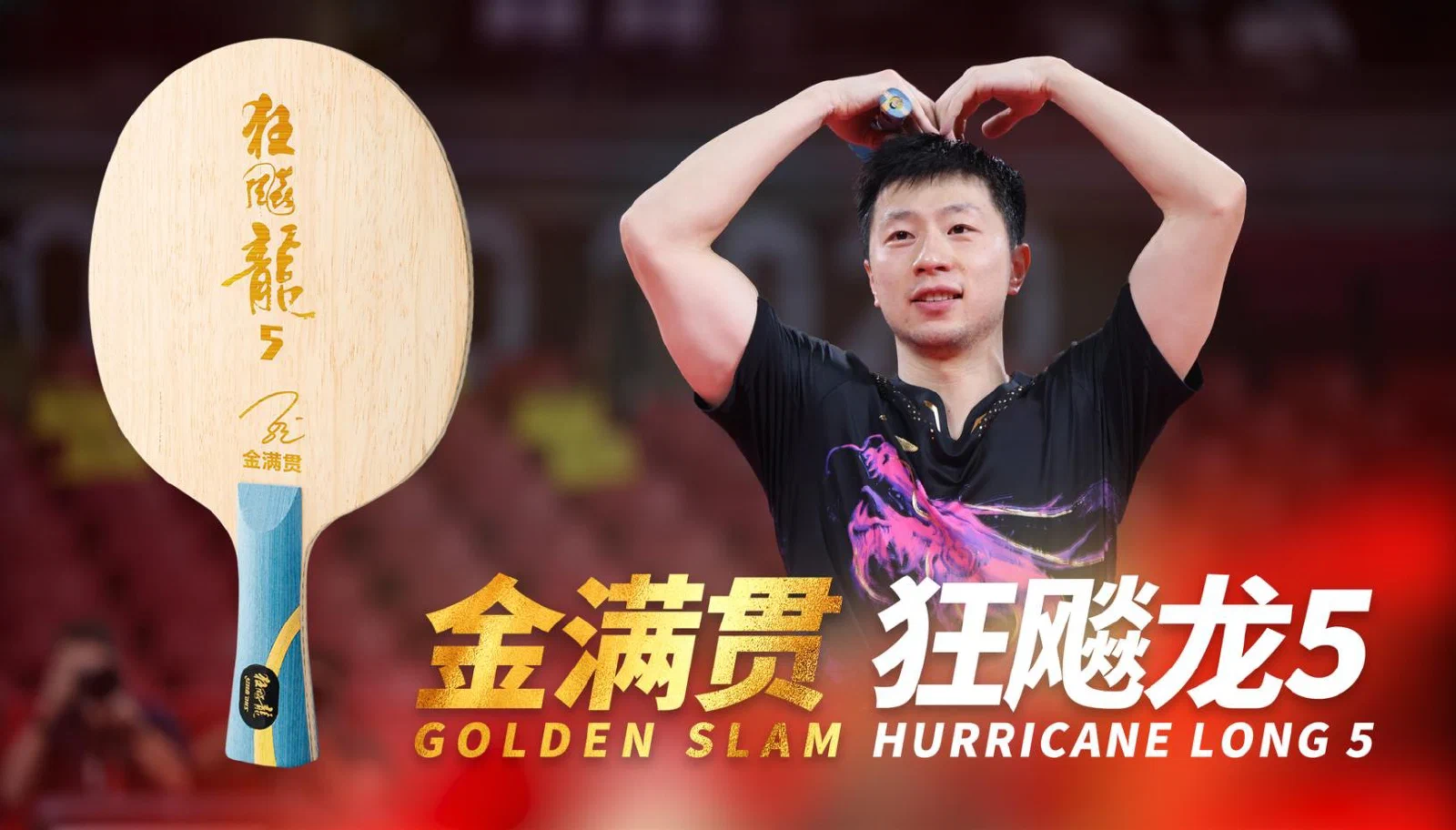
I covered that evolution, and what it teaches about changing blades, in the post Ma Long’s Lesson. In 2015, with the Long 5 and Hurricane 3 on both sides, he won the World Championships, the World Cup and the Grand Finals. In 2021, in Tokyo, with the same setup, he completed the Olympic, World Championship and World Cup singles titles for the second time, the “golden grand slam”, and was the first player ever to do it.
Meanwhile, the ball changed again. In 2011 DHS announced a ball made of a new material, and the ITTF decided to retire celluloid, which had been used for more than a hundred years. The change took effect on July 1, 2014. Besides changing the game, it solved a practical problem: celluloid catches fire easily and was shipped as dangerous goods; the plastic ball travels by air without restrictions. DHS’s first new ball was the official ball of the World Championships and the Rio Olympics; in 2017 came the ABS plastic ball that led to the DJ40+, the Tokyo ball.
The figures DHS publishes about the Chinese team and the market show how big this is. They are the brand’s own data, from 2022, but they are impressive:
The handbook also shows a lesser-known side. In 2010, the top four in the men’s singles at the World Championships all played with DHS equipment. In 2017, the brand launched the Gold Arc 5 and Gold Arc 8, non-tacky, European-style rubbers, made in Germany by ESN and tested by Wang Liqin and Ma Long. And, in 2022, the colored Hurricane 9, after the ITTF allowed colored rubbers. On the backhand, DHS rubber also gained ground with the 40+ ball: 32% of the team’s backhands in 2022.
From Paris 2024 to today
The handbook dates from 2022, so from here on the sources are the ITTF and the specialized press. At Paris 2024, DHS was the official supplier of the tables and nets for the Olympic and Paralympic tournaments, with a table made for the Games based on the Rainbow II. It was the seventh Olympic Games in a row with DHS equipment, from Sydney to Paris.
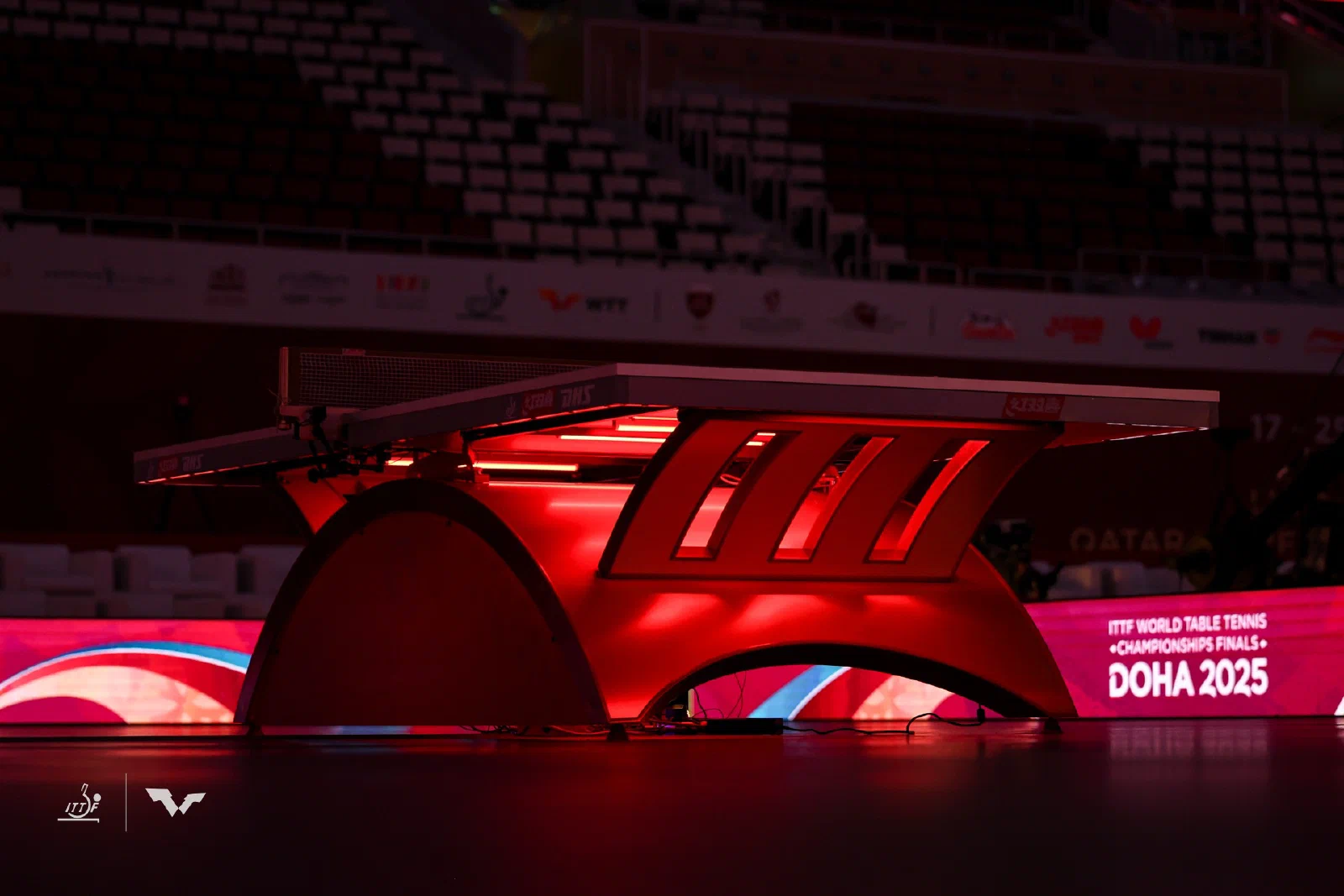
In April 2025, the ITTF renewed DHS as the official table supplier for the World Championships Finals from 2025 to 2028, starting in Doha, with the Rainbow table. It was on that table that Hugo Calderano reached the World Championships final, the best result ever by a Brazilian.
🏓 Curiosities from the handbook
- The 44 mm ball: in 2003, DHS launched a bigger ball, slower and with less spin, for recreation and beginners. Today it is used in physical education classes in Chinese schools.
- The racket gauge: the device that measures rubber thickness at racket control in international competitions is supplied by DHS.
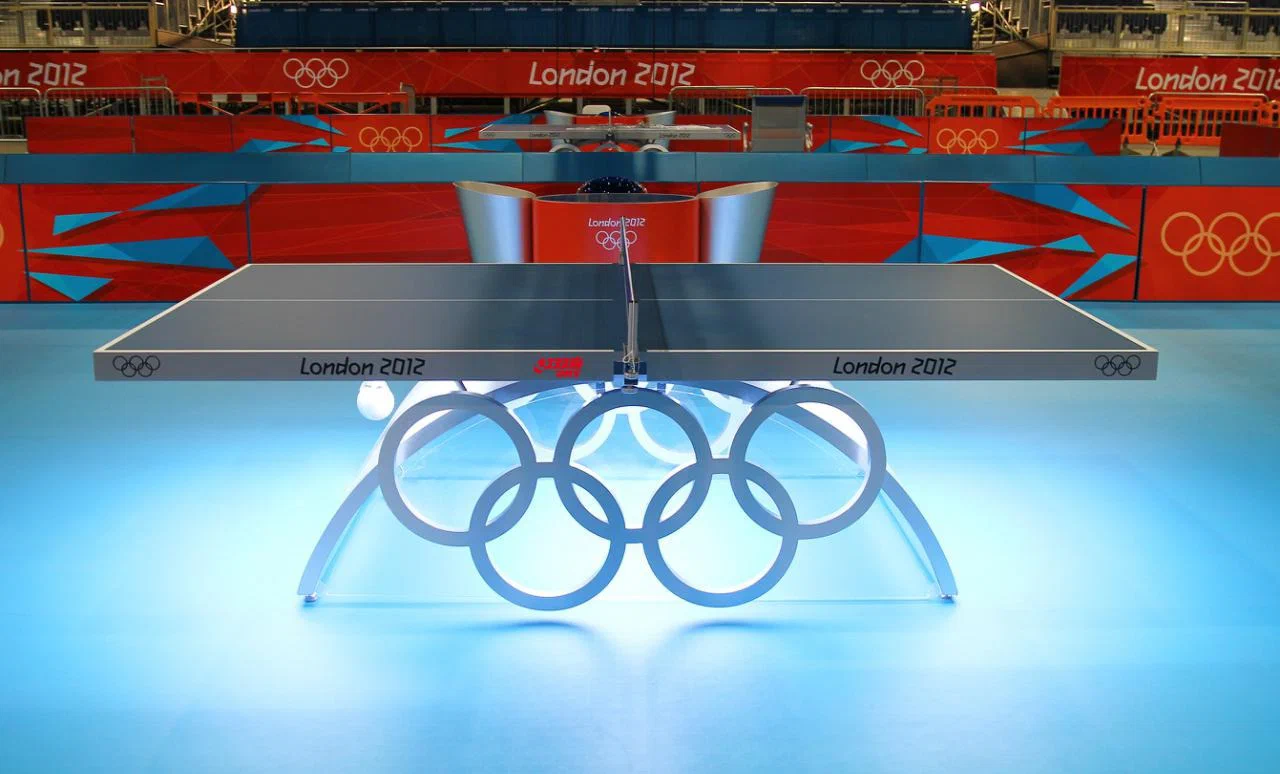
- A museum table: the Rainbow table from the London 2012 Games, with arches shaped like the Olympic rings, was kept permanently by the International Olympic Committee at its headquarters in Switzerland.
- The Beijing table: the table for the 2008 Olympics was designed from the Chinese character for Beijing, 京.
- The two-color ball: in 2014, DHS and the Chinese federation tested a two-color ball, which makes spin more visible on TV and for the receiver.
- The World Championships trophies: each of the 7 titles has a trophy with its own name, such as the Swaythling Cup (men’s team) and the Corbillon Cup (women’s team). They are made of silver and pass from champion to champion: the winner only gets to engrave their name.
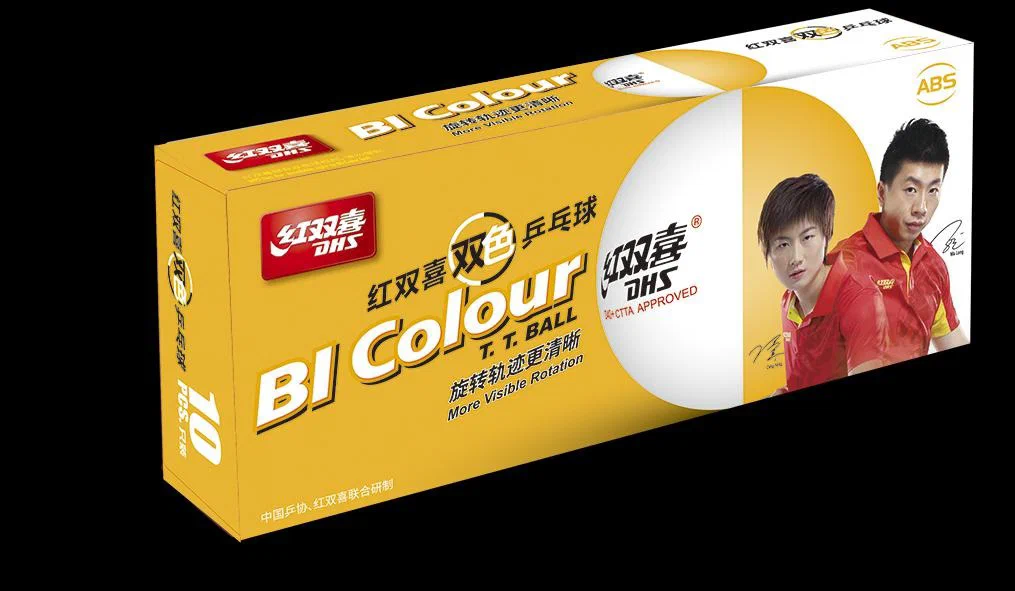
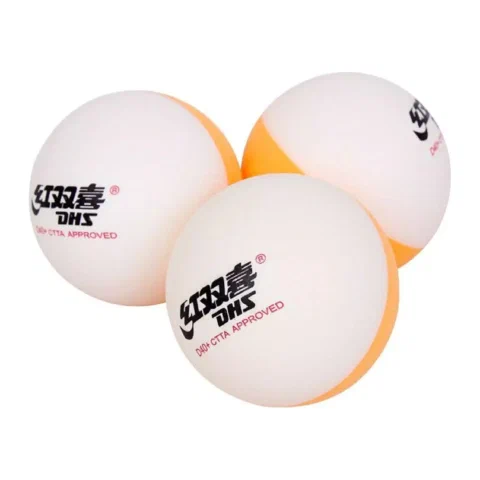 DHS D40+ ABS Bi Colour ball (box of 10)The two-color version of the D40+: you can see the spin as it rotates, great for training how to read spin.
Visit the store →
Leaf through the handbook
For those who want to see the original, here are some pages from the DHS handbook: the cover, the nine timeline pages this post is based on, the page on Ma Long’s blades and the one on the history of the balls. Click any of them to enlarge it.
 Cover
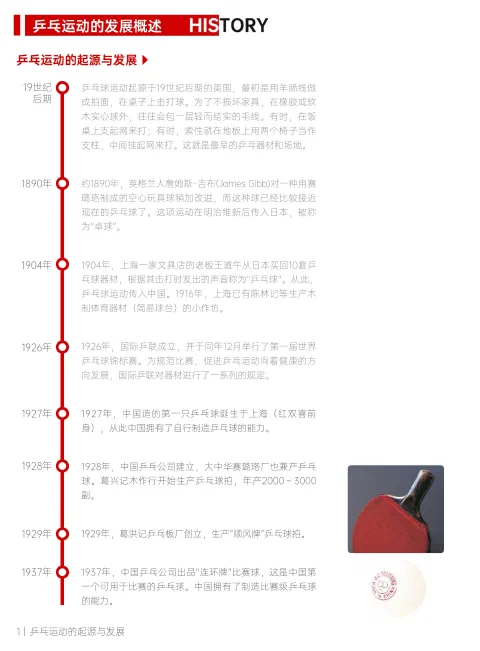 1890–1937
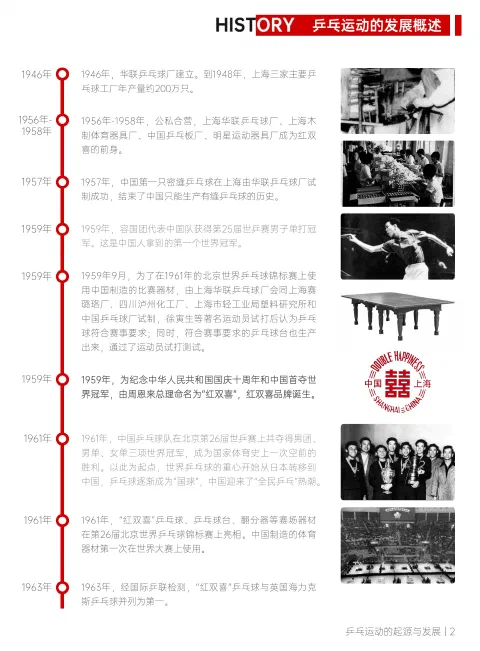 1946–1963
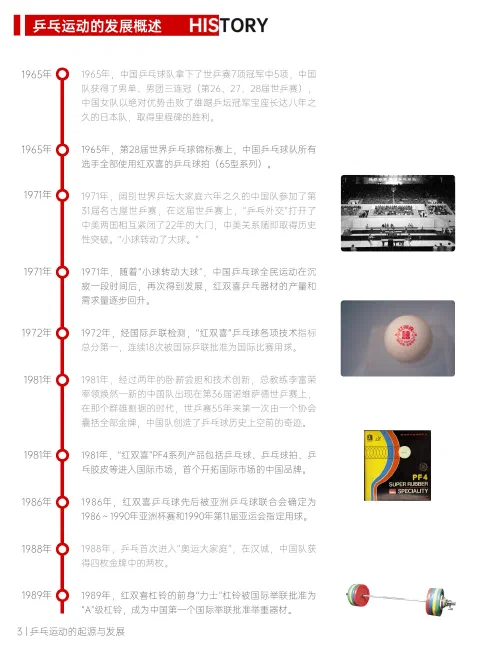 1965–1989
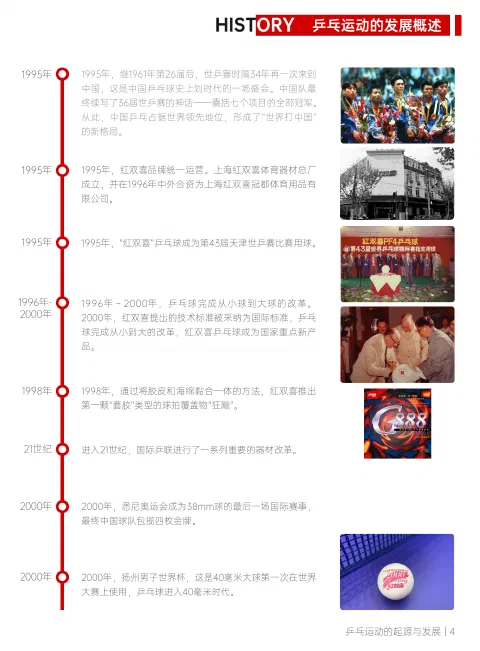 1995–2000
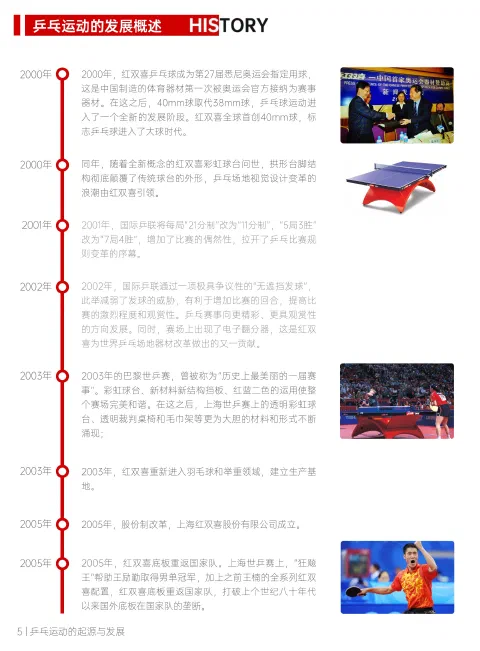 2000–2005
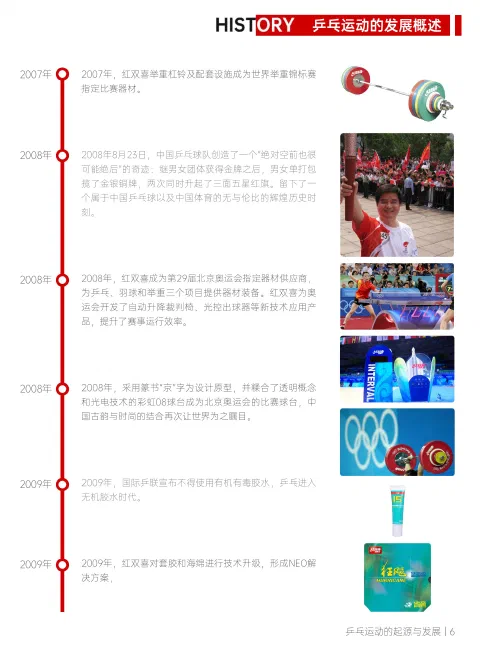 2007–2009
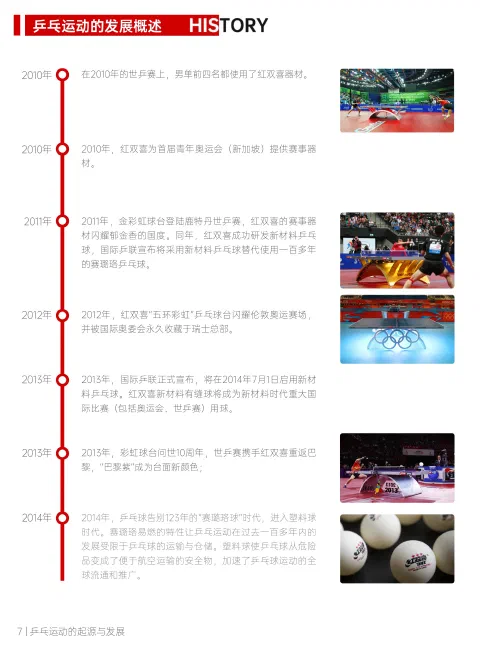 2010–2014
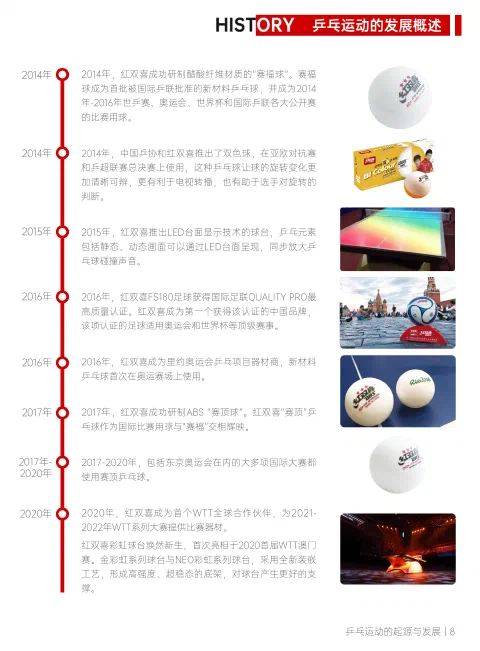 2014–2020
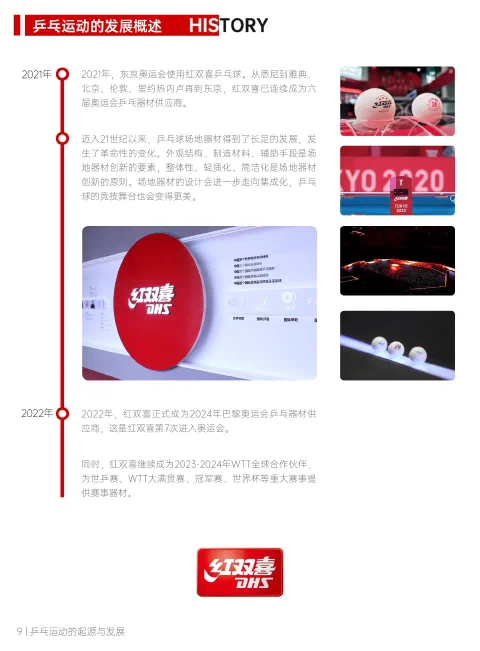 2021–2022
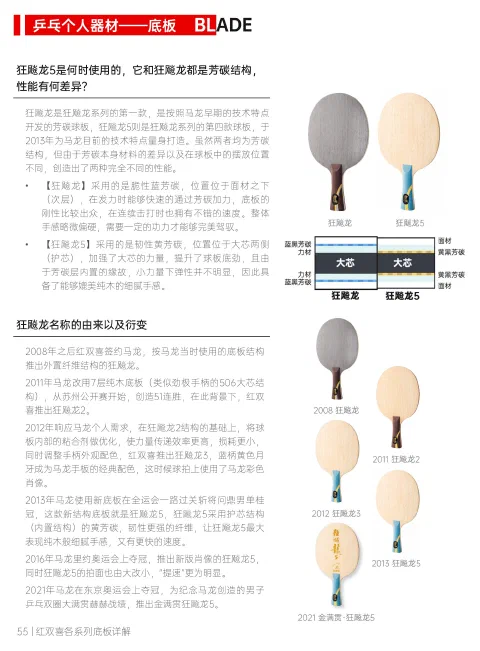 Ma Long's blades
 History of the balls
What this story teaches players
🤓 360TT technical view
Reading the whole timeline, one thing stands out: equipment changes because the rules change. The 40 mm ball, the end of speed glue, the plastic ball: every ITTF change forced manufacturers to rework rubber, sponge and blade. DHS had the advantage of being inside those decisions and of testing everything with the strongest team in the world before it reached the shop.
That is why Chinese rubber is the way it is. The Hurricane, tacky and hard, was born for the Chinese style, which generates speed and spin through technique: technique is what puts real energy into the hard sponge. With little energy, the rubber feels slow; with technique, it becomes practically two rubbers in one, with control on passive balls from the tacky topsheet and power from the hard sponge. I explained this in detail in So, which rubber should you use? The null hypothesis method, where I also tell how the rest of the world adopted tacky and hybrid rubbers, driven by the German company ESN, the same one that makes the DHS Gold Arc.
The other lesson is simpler: what the Chinese team uses is available in the shop, with differences in quality control between versions (I explained this in the Hurricane 3 guide). Since 2023, 360TT has been the official DHS distributor in Brazil, and it was as a distributor that we received from DHS the handbook this post is based on.
Now I want to hear from you: what was your first piece of DHS equipment? A PF4, a Hurricane, a box of balls at the club? Did you know this story? Tell me in the comments.
double hapiness · red double happiness · dhs shanghai · chinese manufacturer · dhs brand history
Read also
From the 38mm Ball to 40+: A Complete Guide to Choosing Yours
From 38mm celluloid to ABS plastic: understand how the ball changed table tennis and find out which DHS 40+ ball is right for your level of play.
Ma Long's Lesson!
Ma Long's career teaches a valuable lesson about blade progression in table tennis. Find out why your equipment should evolve along with you.
So, which rubber should you use? The null hypothesis method
Catalog speed and spin, "tried it and liked it", your idol's rubber: see why almost all of it misleads and how to choose your table tennis rubber methodically.

Comments
Comment with your account (email or Google). Every comment is reviewed before it appears.