So, which rubber should you use? The null hypothesis method

In this post6 sections
I wrote the first version of this article a few years ago. I sent it to a few WhatsApp groups, told anyone who wanted to share it to go ahead, and it traveled all over Brazil. One day I was asked to publish it on an official Brazilian table tennis website, as long as I first made an infographic summarizing everything, because “it’s too long, nobody will read it”. I didn’t make the infographic. If nobody was going to read it, there was no point in publishing it.
Since then, something I argued for in 2022, when almost nobody was talking about it — that tacky and hybrid rubbers would change the game — has become what you see on any broadcast from the world circuit. That was the push I needed to rewrite the text, now with numbers and with a real case of a hypothesis tested on a worldwide scale. It’s still long. But it’s the first post on this new blog, and I think it’s fair to start with the subject that causes the most confusion, wasted money and regret in table tennis: so, which rubber should you use?
The short answer: probably not the one you’re thinking of buying. The long one is coming.
TL;DR: “tried it and liked it” is a clinical trial without a control: the novelty effect fools you, and the right starting point is the null hypothesis — the new rubber is not better than yours until proven otherwise. In Butterfly’s own catalog, spin and arc follow sponge hardness in an almost straight line (correlations of 0.97 and 0.98). So choose by method: throw angle, hardness, thickness, cost per month of use and your current technical level. Tacky and hybrid rubbers are the real case of a hypothesis tested by the whole world. And, once you’ve chosen your rubber, stop switching: it takes 60 to 90 days of training for it to pay off.
Note
I don’t mean to judge anyone who likes testing equipment. Back when I played, I made my rubbers last until they were worn out, and then used them a few more days. Today, now that I can afford it, I also buy things just because I like them or out of curiosity. But the scope here is different: what does or doesn’t help you win more points and more matches. And that doesn’t depend on our curiosity.
For years I’ve followed opinions and recommendations about equipment with a certain unease. Many come from smart, honest people, some of whom I know well. What bothers me isn’t the opinion itself: it’s how easily rationality collapses in the face of a shallow argument, with no technical or logical basis, bordering on mysticism. Without a minimum of method, we become hostages to “tried it and liked it”, to fashion, to the recommendation of the influencer of the moment or to the rubber that so-and-so from the national team uses.
The clinical trial of your racket
Start with a hypothesis: “rubber X, regardless of brand, price, weight or hardness, is the best for athlete Y to win more matches”. Note: it’s not about landing more drives in training. It’s about winning more matches.
That hypothesis is born with a very low probability of being right. The obvious combinations, like “famous rubber used by a famous player”, were picked long ago: they’re the low-hanging fruit. What’s left is high up in the tree, more expensive and more laborious to reach.
And the tree is huge. In October 2019, the ITTF celebrated a record: more than 1,600 rubbers on the list of authorized racket coverings (LARC). On September 21, 2026, I checked the official list: there are 1,716 approved rubbers from 150 brands. In the meantime, many dropped off (approvals expire, manufacturers discontinue models), but even more came in. The funnel keeps growing.
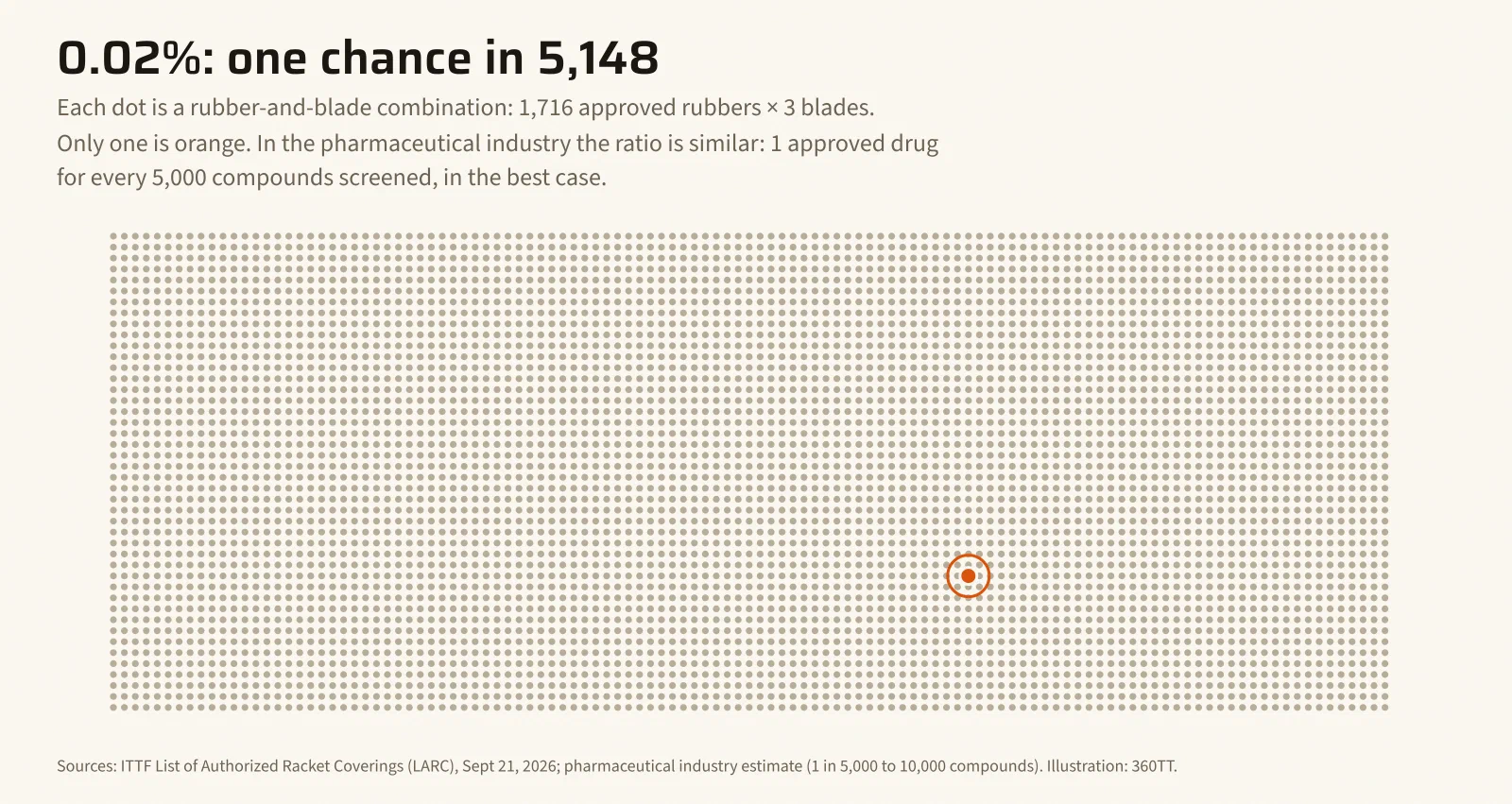
On top of that, each rubber behaves differently on each blade. Simplifying a lot, with just three blades from the same brand (defensive, allround and offensive), you already have 5,148 combinations: a 0.02% chance of getting it right at random. And that math is generous, because it assumes a single rubber per racket, when the forehand and backhand usually carry different rubbers.
Keep that number in mind, 0.02%. It will show up again somewhere very different.
🔎 The cover challenge
In fact, it has already shown up once: this post’s cover image has 5,148 rackets, one for each combination, and only one is orange. Missed it? Scroll back up and take a good look. Found it? That’s your chance of getting it right by luck.
I went digging in a field that isn’t mine, to draw a parallel. Before a drug reaches the pharmacy, it goes through a randomized, double-blind, placebo-controlled clinical trial. Patients are randomly split into two groups: one gets the drug, the other gets a pill with no active ingredient at all (the placebo). “Double-blind” means that neither the patient nor the doctor doing the assessment knows who is in which group until the end of the study.
All that care exists because of a real, well-documented phenomenon: the placebo effect. A significant share of the people who take the sugar pill, thinking it’s medicine, report improvement, out of expectation, extra attention, the ritual of “being treated”. It’s an effect strong enough to contaminate any assessment done without a control.
That’s why the starting hypothesis of every clinical trial, the null hypothesis, isn’t “the drug works”. It’s the opposite: “this treatment is no better than the placebo”. You run the study, compare the groups and ask: if the drug did nothing, what would be the chance of seeing a difference this size or larger just by chance? If that chance falls below 5% — the famous “p < 0.05” that shows up in any serious study — the null hypothesis is rejected. And even then, regulatory agencies usually require more than one study before approving anything.
The funnel is relentless. The most quoted estimate in the pharmaceutical industry is 1 drug approved for every 5,000 to 10,000 compounds examined in the discovery phase. In the best case, 1 in 5,000: 0.02%. And of those that make it to human trials, fewer than 1 in 10 is approved (7.9%, according to the most recent survey by BIO, the US biotechnology industry association, covering 2011 to 2020).
Did you notice? 0.02% is practically the same as the chance of picking the right rubber-and-blade combination at random. A numerical coincidence, of course. But the logic is the same: when the search space is huge, a guess almost always misses.
Now, your reality. You buy a new rubber, train two or three sessions, like it and conclude: “this is the one”. Statistically, you’ve just run a clinical trial with a single patient, no control group, no blinding and an enormous expectation bias. You knew it was new, you paid more attention to your fundamentals, you trained with more motivation, you’d already paid a lot for it (and nobody likes admitting they wasted their money), and you were still riding the manufacturer’s marketing or the social media hype. It’s the placebo effect, applied to the racket.
And there’s one more ingredient, maybe the most treacherous: almost nobody switches rubbers during a good spell. We switch after a bad run, and bad runs pass on their own, with or without a new rubber. In statistics, that’s called regression to the mean. At the table, it becomes “the new rubber fixed it”.
“Tried it and liked it” is not evidence that the rubber is better. It’s exactly what a clinical trial exists to filter out.
That’s why the right stance is to keep the null hypothesis by default: the new rubber is not better than yours until proven otherwise, with enough time to separate the real effect from the novelty effect. In practice, that time is around 60 to 90 days of training. Not out of pessimism. Out of method.
One detail makes all the difference: in statistics, the null hypothesis is never “proven”. At most, a study fails to reject it. Nobody proves that “rubber X doesn’t work”; what exists is an absence of evidence that it works, which is quite different. That’s why the burden of proof always lies with whoever claims it works, never the other way around.
Now you start to understand why there are so many rubber models and so much marketing around them. And why it’s so tempting to use your favorite player’s rubber.
The next Waldner and the silent graveyard
Your 10-year-old cousin plays far above his training partners and is always praised by the coach. Could he be the next Waldner? He could. Is it likely? No: there are thousands of kids like him around the world, and most will never turn pro. When one of them finally reaches the top 20, the coach says he “always knew”. That’s hindsight bias: once the result shows up, memory rewrites the past and everything seems to have been predictable, while hundreds of other coaches thought the same about their own pupils. For a neutral observer, back at the start, the logical thing was the null hypothesis: that boy will probably become a driver, a lawyer, a dentist, and most promising talents stay just that, promising. Whoever sells or manufactures something shouldn’t fall in love with their own creation, which is exactly what a mother does when she swears her son is the next Waldner.
The same happens with the champion’s rubber: you only see the ones who made it. In the business world they say the graveyard is silent: companies that went bust don’t give keynote talks. Nassim Taleb calls this silent evidence. There’s no list of the thousands who used the same rubber and got nowhere, and nobody sees the years of training that made that rubber work in the champion’s hand.
And there’s the opposite path. Everyone knows the athlete who, when he loses, finds the culprit: the equipment, the lighting, the ball, the floor, the air conditioning. The philosopher Karl Popper had a name for this: ad hoc hypothesis, an explanation invented after the fact, just to save a belief that reality was knocking down. With rubbers, it sounds like this: “the rubber is great, I just wasn’t having a good day”, “it only works when boosted”, “it didn’t match my blade”. Each of those sentences protects a belief instead of testing it.
The antidote has existed since the Scientific Revolution and the Enlightenment, which pulled us out of magical explanations and the authority of tradition. Your smartphone exists because of chemistry, not alchemy: nobody got to the lithium battery by mixing substances at random and making up excuses for every mix that went wrong. But when it comes to equipment, we’re still very medieval. The method is clear: assume it doesn’t work, leave the burden of proof with whoever claims it does, and don’t make up excuses when the null hypothesis wins.

What the catalog itself reveals
Among rubbers in the same hardness range, most of the differences that marketing advertises are just sales pitch. Unfortunately. Or fortunately! And the proof comes from the most unlikely place: the manufacturer’s own numbers.
Before going on, a clarification: what follows is not a criticism of Butterfly. Quite the opposite: they’re incredible products, and I always say the Dignics 09C is the best Butterfly rubber of all time. I use their numbers precisely because the catalog gives indexes for an entire line, all measured the same way, and that makes the math possible.
And a technical caveat. Butterfly doesn’t publish “control” as a metric. It publishes Speed, Spin and Arc, all relative indexes, measured in its own tests (the numbers here are from the 2026 catalog). Arc, by Butterfly’s own definition, measures how easily the rubber produces a high trajectory on the topspin. In other words, it mixes the ball’s throw angle with the effect of spin on the curve. I’ll say more about that later; here, I keep the name from the table.
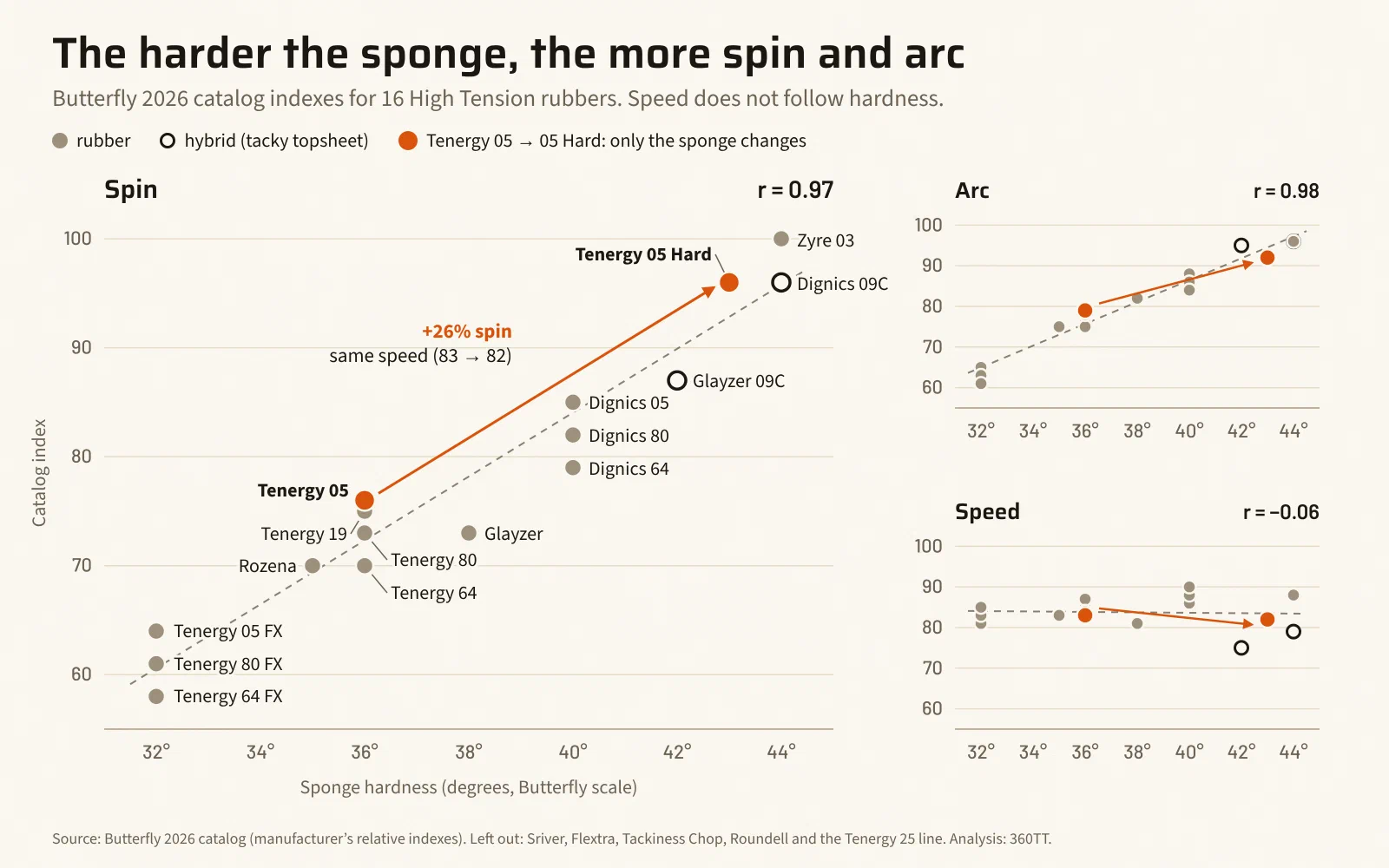
I cross-referenced the three indexes of 16 rubbers from Butterfly’s High Tension generation: Tenergy, Dignics, Zyre, Glayzer and Rozena. I left out the ones that predate that technology (Sriver, Sriver EL, Flextra and Tackiness Chop), the Roundell, well below the Tenergy line in performance and in use, and the Tenergy 25 family, which barely circulates in Brazil.
The result: spin and arc follow sponge hardness with correlations of 0.97 and 0.98, respectively. Almost a straight line. Speed, on the other hand, tracks nothing: it sits between 75 and 90 for all of them.
And the catalog throws in a lab test for free. The Tenergy 05 Hard is, by Butterfly’s own text, the Tenergy 05 with a harder sponge (from 36° to 43°). Spin goes up 26%, arc goes up 16%, and speed doesn’t budge (83 and 82). Only the hardness changed, and performance jumped the way that, in theory, it should only jump with a whole new line. The Tenergy 05 Hard ties on spin with the Dignics 09C, which costs a third more, and even comes close to the Zyre 03, the most expensive of all, launched years later. The name changes, the price changes, the sponge gets harder, and the result follows the hardness, not the name of the technology.
How much of the “generational leap” is repackaged hardness?
There’s one exception that confirms the rule instead of breaking it: the two slowest rubbers in the group aren’t the softest. They’re the only hybrids in the catalog, Glayzer 09C (speed 75) and Dignics 09C (79), both with a tacky topsheet. And the catalog gives you a second test that looks free but has a catch: the Dignics 09C and the Zyre 03 use the same sponge, the 44° Spring Sponge X. The tacky one comes out at speed 79; the non-tacky one, at 88. But the topsheet isn’t the only difference: the Zyre 03 has a thinner topsheet and, to make up for it, a thicker sponge (2.5 or 2.7 mm, versus 1.9 or 2.1 mm on the Dignics 09C). Part of that speed is less tackiness; part is more sponge. There, hardness doesn’t act alone: the tackiness holds the ball longer on contact, steals speed and gives back trajectory. It’s no coincidence that the two hybrids are among the highest-arc rubbers in the group (95 and 96). Butterfly doesn’t say how it measures speed, but the number is what you’d expect from a low-energy test, in which the hard sponge doesn’t even get activated. It’s the same “slowness” many people feel when they try a Chinese or a hybrid rubber, and that disappears when technique puts real energy into the stroke.
And here comes a variable almost no manufacturer explains: sponge thickness. When the catalog says rubber X has speed Y, it doesn’t say which thickness it measured, and most likely it’s the thickest in the line. With regular sponges, the rule is simple: the thicker, the faster. The Zyre 03 illustrates this: it isn’t faster than the Dignics because its sponge uses a different technology, but because it has more of the same sponge. The relationship only flips with absorbing sponges, made to deaden the ball, like those of the Sauer & Tröger Blackout and the Dr. Neubauer A-B-S 3 Pro anti-spin rubbers: with them, the thicker the sponge, the more it absorbs, and the slower the rubber.
And with hybrids, the story gets more interesting than a catalog number: the throw angle changes with the stroke. Contact dominated by the topsheet (more tack, more dwell time on the rubber) produces a high throw angle. Contact dominated by the sponge (a drier touch, with less tack coming into play) produces a much flatter trajectory. It’s the same rubber with two behaviors, depending on execution: the “2 in 1” I talk about further on, now applied to the trajectory.
Sponge hardness, by the way, is the most glaring example of how each manufacturer creates its own ruler. Rubber hardness is measured with a durometer, on the Shore scales: within the same scale, the higher the number, the harder. But there are different Shore scales, with no simple conversion between them, and many manufacturers don’t really use a standardized scale at all. The “degrees” on the package are usually the brand’s internal ruler. A “40° DHS” and a “40° ESN” don’t necessarily represent the same physical hardness. The chart above only works because it compares rubbers from a single brand, on the same ruler.
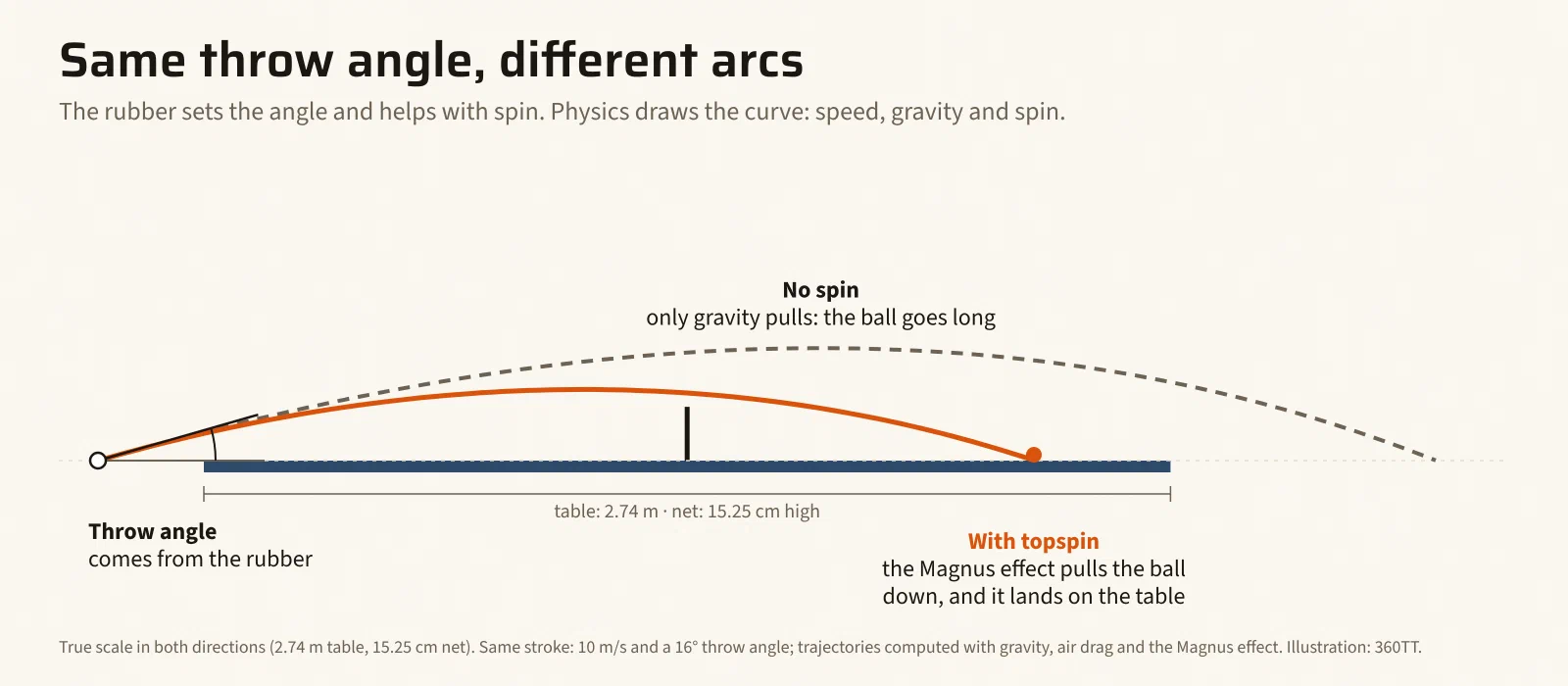
Another subject that has become a fad is the so-called arc of the ball, poorly understood and “sold” in a strange way. The arc is the curve the ball draws in the air, and what draws that curve is physics: the angle and speed at which the ball leaves the racket, gravity pulling down, and spin. On a topspin, the Magnus effect pushes the ball down and closes the curve. The rubber plays a part in two ways: in the throw angle (which depends on sponge hardness, topsheet grip and pimple design) and in how much spin it lets you generate. But what generates the spin is your technique. Without enough spin, the ball comes out high, makes a long, open parabola and goes past the table. Throw Angle is not arc: it’s just its starting point.
About control, which I consider subjective: if rubber speed were always linear, control would just be a function of speed. It isn’t. Soft rubbers react more with little energy applied and give the false sensation of being fast. Hard rubbers (like Chinese ones or the Tenergy 05 Hard itself) are more direct, and if you can’t apply enough energy to activate the sponge, you’ll get the false sensation that they’re slower than soft ones. Tacky-topsheet rubbers with a hard sponge, by the way, give a much greater sense of control on passive balls (serve, receive, push, block) and are very fast on high-power attacks, when your technique activates the sponge. Keep that in mind for a little later.
Some conclusions:
- Choosing by catalog speed is almost useless: the manufacturer doesn’t say which thickness it measured, and the difference between models is small and doesn’t even track hardness. What would help is an index per thickness, something like 1.7 mm: speed 7; 1.9 mm: 8.5; 2.1 mm: 10 (numbers just for illustration). Then it would make sense.
- So is choosing by catalog spin: it practically repeats the sponge hardness. Look at the hardness and you already know almost everything that number tells you.
- Choosing by the stated control is useless: control isn’t just a function of speed, and it’s subjective.
- The catalog “arc” says little about your game: it depends on your ability to generate spin, and even the blade contributes. What’s worth looking at is the throw angle; I’ll get there.
- Choosing the famous player’s rubber is completely useless: what he does with it is the fruit of a technique you probably haven’t developed yet, built over years of training with that equipment. It’s correlation mistaken for causation.
- Choosing because a friend “tried it and liked it” is just as useless. Most people test by hitting drives in a controlled setting, when they should test in real matches, and only after adjusting their muscle memory to the rubber. Then the opinion would have some method behind it.
How to choose by method
With the null hypothesis as a premise, how do you choose a rubber?
Method 1 — Middle Ages precepts: catalog arc, spin, speed and control, marketing descriptions, fashion, “tried it and liked it”, “my favorite player uses…”.
Method 2 — Enlightenment precepts: throw angle, sponge hardness, overall perceived hardness, sponge thickness, cost per month of use and, above all, your current technical level.
A good drug doesn’t come from testing a thousand substances at random hoping one will reveal itself. It comes from criteria for choosing the compound and fine-tuning the dose. With rubber it’s the same: choose by Method 2 and, once you’ve chosen, adjust your technique to it.
Throw angle: rubbers that lift the ball a lot on topspin push low and, if the sponge is soft, tend to be more sensitive to the opponent’s spin (they “eat” more spin): it gets harder to receive a heavy backspin serve, but easier to open up against backspin. Examples: Butterfly Tenergy 05 and Donic Bluefire, M line. Rubbers that lift the ball less push higher, are less sensitive to the opponent’s spin, and their topspins arrive faster and deeper, making the counterattack harder. Examples: Butterfly Tenergy 64, Donic Acuda Blue, P line, and hard Chinese rubbers like the DHS Hurricane 3 National Blue Sponge (the line Ma Long uses on his forehand).
Sponge hardness: there’s no reliable general table; each manufacturer uses its own ruler, as we saw. If you don’t have refined technique or an athlete’s fitness, and don’t train every day, avoid very hard rubbers, like Butterfly’s 44° ones, those at 52.5° or more on the ESN scale or a DHS Hurricane 3 above 39°. You’ll probably find these “cannons” heavy and slow.
This also explains a phenomenon that confuses a lot of people: a rubber considered “medium hardness” two decades ago may feel soft today, without the sponge having changed one millimeter. The ball has become bigger and more demanding. In 2000, it went from 38 mm and 2.5 g to 40 mm and 2.7 g. In 2014, it switched from celluloid to plastic (the 40+ ball), which is stiffer; and, from 2017 on, came the ABS generations that dominate today (I tell that story here). A bigger, heavier, harder ball engages the sponge more and demands more from it to return the same response. Add to that the end of speed glue, in 2008 (the full story is here), and the market pushed the ruler upward: so-called “dynamic” sponges appeared, firmer and more reactive. The middle of the scale shifted. What used to be “medium”, compared with today’s catalog, falls into the range we call soft. It’s not that the rubber got weaker; it’s that the ruler moved.
A good starting point is an intermediate hardness: 45° to 47.5° on the ESN scale, 37° to 38° on DHS (except Gold Arc 5 and 8) and 36° to 38° on Butterfly.
Overall perceived hardness: what you feel in your hand is the combination of sponge and topsheet, and it can be quite different from the sponge’s nominal hardness, besides being tremendously influenced by the blade. Donic’s Bluestorm line has a good example: the Z1 and the Z2 have the same 47.5° sponge, but the Z1 feels harder because of the topsheet. The DHS Gold Arc, even with a sponge considered medium (42.5° or 47.5°), is reported by many players as “harder than it looks on paper”, an effect of its firm, non-tacky topsheet.
Sponge thickness: when you buy, the manufacturer usually offers three choices: color (one side black and the other colored, as the rules require), hardness (not every brand offers more than one) and thickness. That last one matters a lot, and hardly anyone thinks about it. The physics is simple: the sponge works like a spring. The thicker it is, the more room the ball has to sink in and the more energy it gives back, so the rubber gets faster. The thinner it is, the sooner the ball reaches the wood: the feel gets firmer and more direct, speed drops, but spin doesn’t drop with it. Relative to speed, you get even more spin, and the ball dips more onto the table. The thick one only wins on a very hard stroke, where the thin sponge bottoms out. In Brazil, it became the rule to always buy the thickest, as if thickness meant quality. It doesn’t. When I trained seriously, I used Max on the forehand and 2.0 mm on the backhand. And thick sponges are nothing new: in the ’90s I played with Yasaka Mark V 2.5 mm and speed glue, which swelled the sponge even more; it was surely already at the Zyre 03’s 2.7 mm. This habit costs everyone: since the Brazilian market rejects thin sponges, importers avoid bringing them in, and the players who need them are left without options.
Cost per month of use: the most expensive rubber on the market won’t make you win more matches, believe me! (Yes, I’m a terrible salesman…) As we saw in the numbers, the price follows the name of the technology, not the result. And there’s a calculation almost nobody does: durability. Traditional Chinese rubbers, like the DHS Hurricane 3 National Blue Sponge, are among the most durable on the market: a dense sponge and a tough topsheet lose tack and response much more slowly than most of the latest-generation European and Japanese rubbers. A cheaper rubber that also lasts more months of hard training comes out much cheaper per month of use than an expensive “technology” rubber with a short lifespan. Before comparing list prices, ask: how many months of training does each option really deliver?
Current technical level: perhaps the most applicable suggestion of all. I don’t like the idea that an athlete’s performance is something fixed: saying “so-and-so is better than such-and-such” ignores that both are constantly evolving. At 360TT we use a dynamic assessment report, filled in by the athlete and the coach, that compares how each of them sees the athlete’s current technical level. And that reference changes as the athlete evolves: a topspin rated 8 against state-level players may be worth a 3 at a Pro Tour, because the reference changed. It’s the same logic as the hardness ruler that moved. In general, with more technique and better fitness, harder rubbers start being put to better use.
The world changed its mind about tacky rubbers
I’ve been championing Chinese and hybrid rubbers for years, because of the huge advantage they give. They’re practically two rubbers in one: power from the hard sponge, a sense of control on passive balls from the tacky topsheet, and more spin generation. China has always used hard, tacky rubber on the forehand, and later on the backhand too (why the Chinese elite carries the Hurricane 8 on the backhand). When hybrids started to appear, it was clear that Western manufacturers were trying to combine the power of European and Japanese rubbers with the advantage of the Chinese tacky topsheet.
I even posted about it on 360TT’s Instagram, in January 2022, when we were still reselling other brands, before becoming the official DHS distributor. The 5 reasons I pointed out still hold, now with an extra layer of evidence, mass adoption by professionals:
- a hybrid makes it easier to keep the ball short (the topsheet’s grip “holds” the ball);
- it gives more spin on the serve, without the ball shooting off, making the opponent’s receive harder;
- it gives a greater sense of control on passive balls (push, block, serve receive), making it easier to put the ball where you want;
- it allows attacks with more spin, making up for the loss of spin with plastic balls without losing speed, thanks to dynamic sponges;
- it helps refine technique: with a greater sense of control, you hit relaxed, not tense, and still gain speed.
.")
Back then, though, hybrids still fell well short of pure Chinese rubbers, like the Hurricane 3 National Blue Sponge itself. And the market, at first, didn’t really understand how they worked: it labeled hybrids as “slow”, the same way it had always labeled traditional Chinese rubbers. In reality, they were less slow than pure Chinese rubbers, but they felt slow for the reason I explained above: the false sensation of slowness for those who can’t apply enough energy to a hard sponge and overcome the tack of the topsheet.
Want to check it? Put a rubber protector film on your “slow” Chinese rubber (it isolates the tack) and bounce the ball. Then tell me whether it died (as it does without the protector) or bounced high.
With players’ gradual adaptation and the evolution of tacky topsheets, driven mainly by the German company ESN, which manufactures for practically everyone (Donic, Tibhar, Stiga, Andro, Joola, Gewo, Xiom, among others, including DHS’s Gold Arc 5 and 8 line), the advantage that was almost exclusive to the Chinese started to shrink. Never have so many Chinese and hybrid rubbers been used around the world as today.
A good “home-grown” example for us Brazilians is Hugo Calderano. He had already switched to hybrid rubbers some time before: I noticed it in his game before the market talked about it, I even brought it up in the WhatsApp groups I’m part of, and Xiom itself confirmed it the same week I mentioned it. The trajectory of passive balls on a tacky rubber is very distinctive, and his passive game improved a lot: serve, receive and so on. The power of his counterattack also increased. 2025 brought the biggest results of his career. On April 20, he won the World Cup in Macao, beating Tomokazu Harimoto in the quarterfinals, Wang Chuqin in the semifinal and Lin Shidong in the final, and became the first World Cup champion from outside Asia and Europe. A month later, at the World Championships in Doha, he beat Liang Jingkun in the semifinal and only lost in the final, against the same Wang Chuqin. Far be it from me to reduce any player to the equipment he uses (I know very well how much training it takes to get the most out of any tool), but the tools are, without a doubt, more capable.
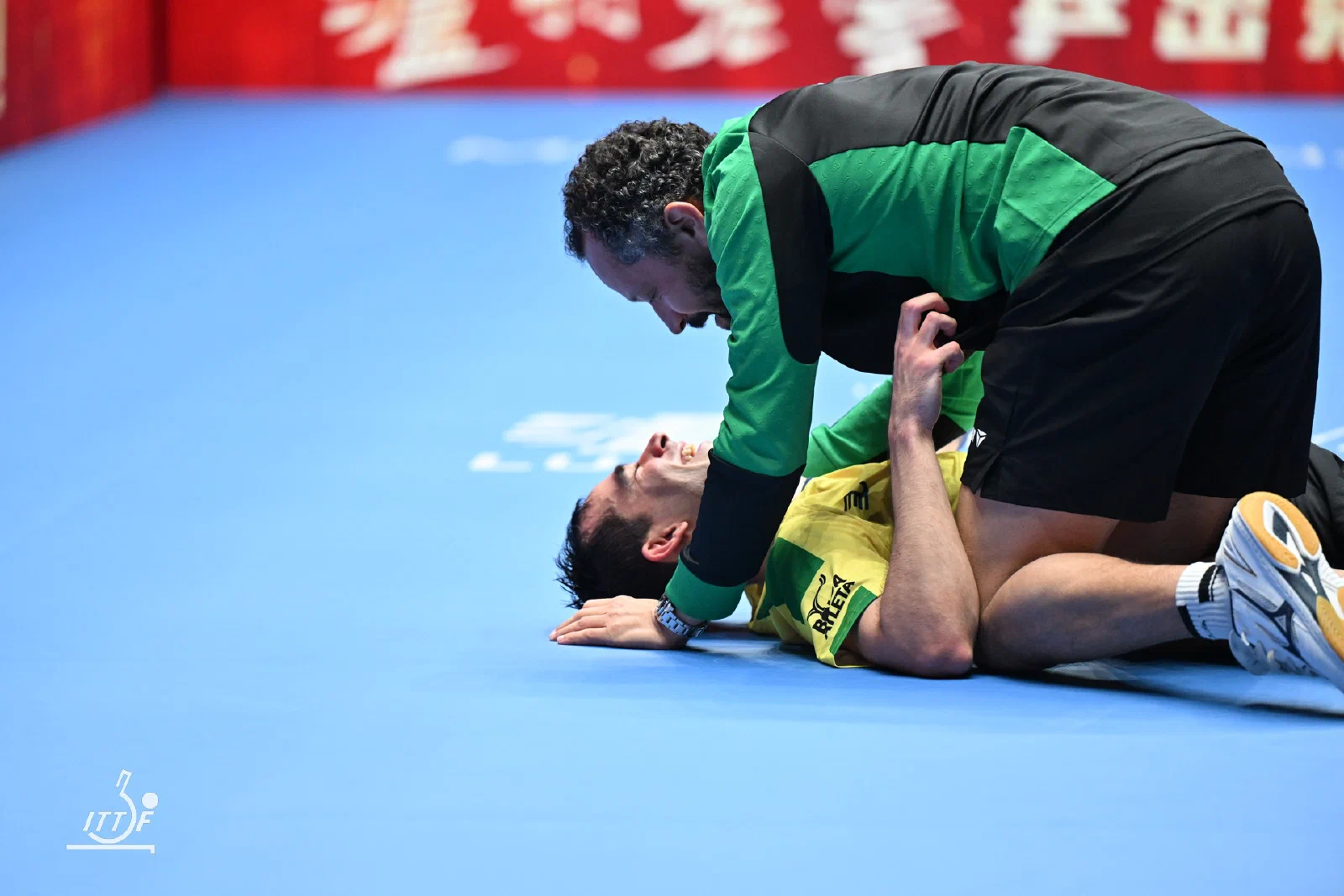
China, for its part, is going through a strange moment. In the men’s world ranking at the start of October 2026, number 1 is a 19-year-old Japanese player, Sora Matsushima, and only two Chinese players appear in the top ten: Wang Chuqin, in 4th, and Lin Shidong, in 9th. Days later, at China Smash, in Beijing, the men’s final was between Matsushima and Lin Yun-ju, from Chinese Taipei, without a single player from the Chinese national team. On the women’s side, the dominance continues: six Chinese players in the top 10, and the title at that same China Smash went to Wang Manyu. The signs had been there for a while. Three days after Calderano’s title, on April 23, 2025, Liu Guoliang stepped down as president of the Chinese Table Tennis Association, which he had led since 2018 (officially, to ease the transition to Los Angeles 2028). Months earlier, Fan Zhendong, Chen Meng and Ma Long had dropped out of the world ranking, at odds with the WTT rule that fines players who skip mandatory tournaments. And at the 2026 World Team Championships in London, the men’s team lost twice in the group stage, to South Korea and to Sweden. It still recovered and won the title (I told the story of that turnaround here), but with a struggle that didn’t exist before. None of this is explained by a single factor. My hypothesis, and it is a hypothesis, subject to the same method as this article, is that the worldwide adoption of tacky and hybrid rubbers narrowed a gap that China enjoyed almost on its own.
Since the world truly adopted Chinese and hybrid rubbers, the balance of forces in table tennis seems to have shifted, including on the women’s side, and we’re all relearning how to play. In the end, it’s a real case, on a worldwide scale, of the mechanism I’ve been defending throughout this article: a hypothesis (“Chinese and hybrid rubbers are slow”) was held for years, until the accumulated evidence knocked it down. And notice the difference: it’s not “the champion uses it, so it works for you”. It’s an entire population of players, of every level, migrating over years. That’s evidence that the equipment works for those who learn to use it, not that it will work on its own in your hand. And, of course, among Chinese and hybrid rubbers there are friendlier, more forgiving ones and hard-to-handle, very hard ones. Choose according to your current technical level.
Transparency: 360TT is the official DHS distributor in Brazil. What I say about it is worth what any seller’s claim is worth, and the burden of proof is mine.
If you want to feel this in your own hand, DHS, a traditional maker of tacky rubbers, today has a lineup too complete to ignore: from the old-school tacky of the DHS Hurricane 3 National Blue Sponge, through the hybrids DHS Hurricane 3-50, DHS Skyline 3-60, DHS PF4-50 and DHS Hurricane 8-80, the latter at a much more demanding level, all the way to the non-tacky, European side, made by ESN itself: the DHS Gold Arc line.
And here’s a personal claim, almost a new hypothesis under test: the DHS PF4-50 would comfortably serve a huge share of Brazilian table tennis players, from beginners up to Brazil’s national “Absolute B” division, maybe even “A”. But look closely: it’s exactly the same kind of claim I made about hybrids back in 2022, still without any statistical proof. Hypothesis launched, not yet refuted. Time (and your own hand) will tell.
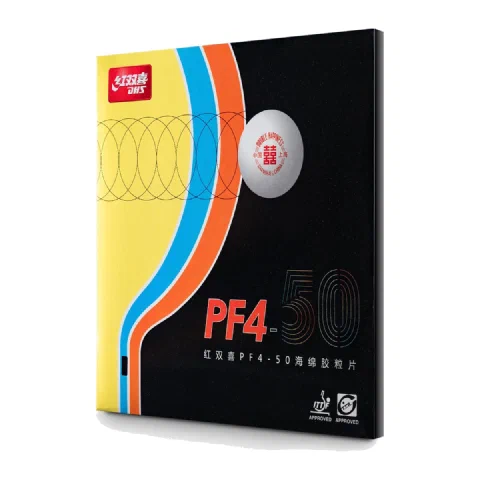 DHS PF4-50Hybrid rubber with a tacky topsheet and an elastic, soft #50 sponge: spin on the serve and the drive, with control.
Visit the store →
Made your choice? Now stop switching
I usually tell athletes that technique and muscle memory adapt to new equipment in 60 to 90 days of training. It varies a little from player to player, but in general that’s it. If the change in equipment isn’t radical, the adjustment takes much less time, as when you replace 6-month-old rubbers with new ones of the same model. The same goes if you switch your forehand rubber for one with a different throw angle: it may bother you today, but in 60 to 90 days you’ll be adapted, beating the people you used to beat and losing to the people you used to lose to. Once the equipment is chosen by logic, winning matches won’t depend on brand or model. It will depend on you being properly adapted to it.
“Don’t switch” doesn’t mean never switch. Replacing a worn rubber with the same model is maintenance. Moving up to a harder sponge when your technical and physical development starts to call for it (and allow it) is a dose adjustment, made on sound criteria; it’s exactly what “current technical level” is about. What doesn’t make sense is switching because of a new release, a fad or because a friend liked it.
Want to test anyway? Run a single-patient trial
Medicine has a name for this: an “N-of-1” trial, with just one patient, but with a control.
- Define beforehand what “better” means: tournament results, ranking points, percentage of receives that land on the table. “The ball felt livelier” doesn’t count.
- Write down where you stand today, with your current rubber: it’s your control group.
- Change one thing only. New rubber and new blade at the same time = impossible to know what did what.
- Give it time: 60 to 90 days of training before judging.
- Compare with what you defined in step 1 and, if you can, ask your coach for an assessment before and after.
If the difference doesn’t show up, the null hypothesis won: stick with the one you had and invest the money in training.
Once the compound has been chosen by criteria, and not at random, switching medicine every week isn’t treatment, it’s anxiety.
Adjust the protocol: train, refine your technique and get the most out of the equipment you already have. Happy training, everyone!
Now I want to hear from you: what was the last rubber you switched to, and why? Can you say, with any data, that you won more matches with it? And, if you play with the PF4-50, tell me down below: does my hypothesis pass your test? On the old blog I couldn’t reply to comments; here I can. So feel free to disagree, preferably with evidence. The burden of proof applies to me too.
best rubber · which rubber to buy · sticky rubber · tenergi · dignix · hurricane3 · rubber for intermediate players · tacky vs tension
Read also
DHS Hurricane 3 NEO: The Guide to the World's Most Famous and Most Used Rubber
Commercial, Provincial, National or Player Edition? See what changes in the DHS Hurricane 3 NEO, which hardness to pick and how to avoid counterfeits.

Double Happiness: the story of DHS, the brand intertwined with Chinese table tennis
From China's first ball in 1927 to the Paris 2024 tables: the story of DHS, the brand that grew up alongside the Chinese national team. See how it began.

Hurricane 8 on the Backhand: The Secret Weapon of Wang Chuqin and Sun Yingsha!
Discover why Sun Yingsha, Chen Meng and Wang Chuqin use the DHS Hurricane 8 on the backhand. See 360TT's technical take on the elite's new trend.
Comments
Comment with your account (email or Google). Every comment is reviewed before it appears.