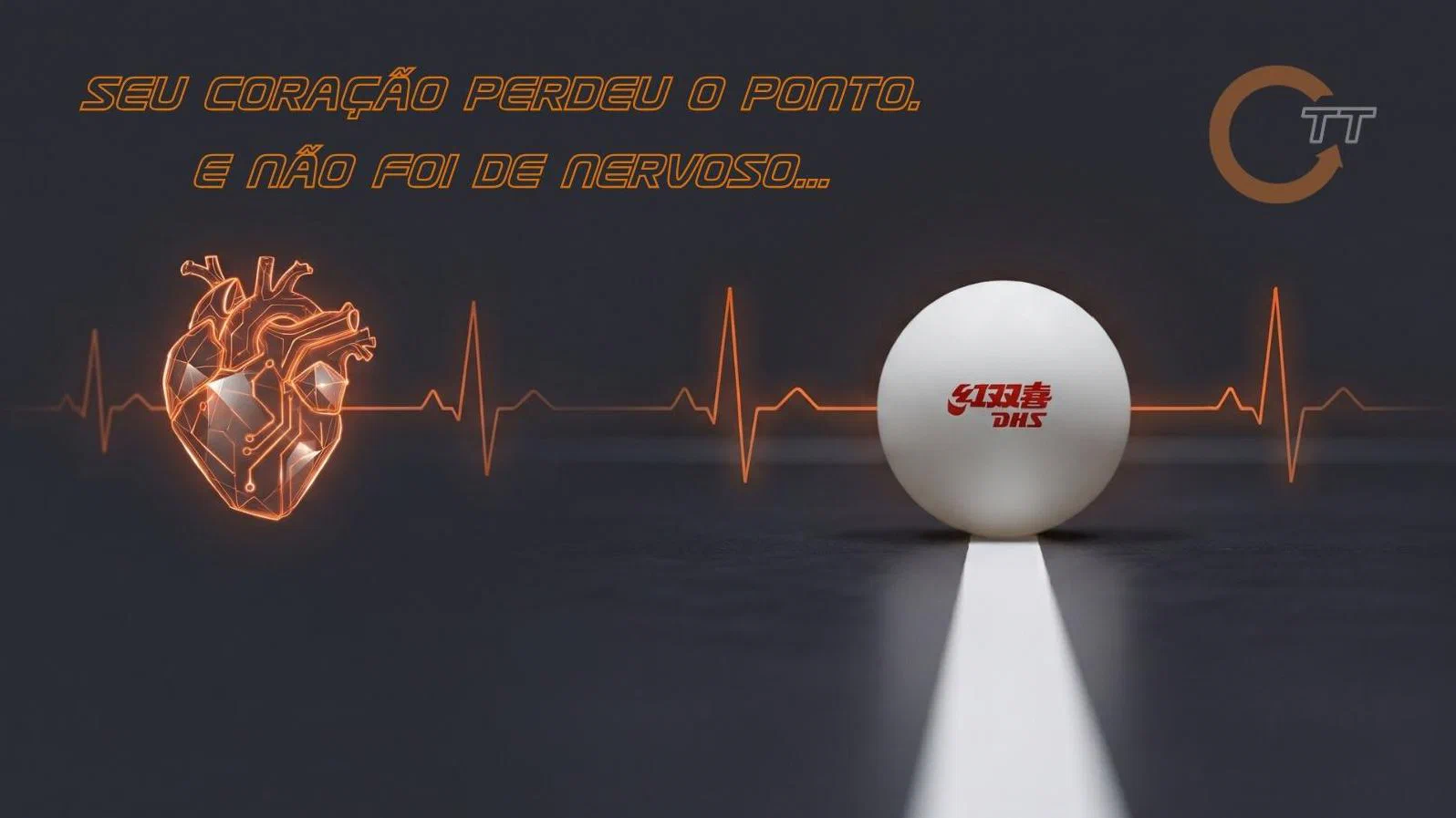
Your heart lost the point. And it wasn't nerves...
In this post10 sections
As many of you already know, since my hip replacement I haven’t gone back to coaching table tennis. I keep studying and advising players, friends and a few coaches, all informally, just to help out, pass on knowledge and learn a bit more. Every time I teach, I learn.
On September 26 and 27, 2026, a stage of the state championship took place here in Belo Horizonte. I went to support the tournament and see my friends. At one point, I saw from a distance a 360TT player losing the first set by a wide margin, already close to the end, against an experienced and good penhold player. I got up and went to try to help. What happened next seemed important enough to become a post.
TL;DR: nerves speed up your heart and your breathing, and the player loses precision even with the right plan in hand (what happened in the match and why). Above a certain heart rate, which is yours alone and changes with your fitness, the easy-ball mistakes begin. You can find your threshold with a smartwatch, use the 8 to 10 seconds between points to breathe, and train this away from the table.
The match
I got to the table practically on the last point of the set, and our player lost it. For context: both are right-handed. Our player is very tall, almost 2 meters, always plays close to the table and uses OX long pips on the backhand. The penhold player uses a square-headed racket and, although he has a rubber on the backhand side, he practically never uses it.
When he came over to me, I asked how the match was going. He said he was far more tense and nervous than usual and was trying to calm down. He was sweating a lot and was quite out of breath. I gave him a simple strategy, with only 3 instructions:
- On serve: use a single serve, short backspin to the forehand, because the penhold player was expecting a very wide serve to the left, almost off the table. If the ball came back to the forehand, attack the third ball down the line. If it came back anywhere else, push with the pips to his backhand, as wide as possible. That would be the serving plan until the opponent adapted.
- On receive: if the serve was long to the forehand, attack with a topspin. In any other case, receive with the pips, pushing to the opponent’s backhand, even if the serve was short to the forehand.
- In the rally: if the point went on, always play to the penhold player’s backhand, except when attacking.
He went back to the match breathing better, calmer, and quickly built a lead by following the plan to the letter.
When the plan started to slip
Suddenly, a serve that was supposed to be short went long. The penhold player, who was behind on the scoreboard, attacked and won the point. On the next point, the penhold player served long to the middle, angled toward the backhand. Instead of following the plan (pushing with the pips to his backhand), our player did a half pivot, tried to attack and missed. The lead shrank.
Then the penhold player served short to the forehand. Our player pushed crosscourt with his inverted rubber, got hit by a third ball he didn’t even see go by, and the match was even again. Once more, he didn’t follow the plan.
Then came the 6-point mark, when players are allowed to use the towel, and the penhold player went to dry off. Our player didn’t. He got angry and shouted at himself to stick to the strategy. That only made things worse, as I explain below.
On the first serve after that, very short to the forehand, the opponent pushed short to the middle, our player pushed with the pips to his backhand and won the point outright, as he did EVERY time he used that play. On the next serve, the same problem: the serve went long, the penhold player attacked and won the point. At 9–9, with two serves in hand, the penhold player closed out the set.
Between sets
At the change of ends, our player came over to me out of breath, more than at the first break. I barely talked about technique anymore. I had identified that the biggest problem was the nerves combined with fast breathing through the mouth. I told him:
“Breathe more between points, always go to the towel so you have time to breathe and think. Don’t rush.”
He went back for the third set, and every time he applied the plan, he won the point. But his decisions weren’t always good: he attacked balls he shouldn’t have, couldn’t serve short anymore, lost his precision and started missing simple balls.
When the match ended, he was frustrated, because he knew he had lost to himself. The plan worked. If his breathing had been balanced, with oxygen and carbon dioxide at the right levels, he would have been thinking clearly, and following the plan would have been much easier.
The heart
We table tennis players say that big matches are decided “with the heart”, with emotion.
But the heart that lost that set was the muscle, the real one.
Nerves were the trigger, but what cost him the points was what they did to his body. Nerves release adrenaline, and adrenaline makes the heart beat harder and faster. That’s the first push. Along with it comes short, fast breathing through the mouth, and the whole thing turns into a cycle:
- Breathing too fast flushes carbon dioxide out of the body. It sounds strange, but breathing very fast doesn’t “give more air” to the brain. The resulting imbalance reduces the blood flow that reaches the head. This is the most likely hypothesis for what I saw: I didn’t measure our player, but everything I observed is consistent with it.
- The head pays the bill. The result shows up where the game demands the most from the brain: reading spin, precision of touch, split-second decisions.
- Frustration closes the cycle. When our player gets on his own case, shouts or fills up with tension, more adrenaline comes, the heart speeds up even more and breathing gets worse. That is exactly what happened with his shout.
The result is what we saw: our player knows what to do, but loses the precision to execute it. A short serve becomes a long serve, a ball meant for a pips push becomes an attack, an easy ball becomes a mistake.
It wasn’t voluntary tactical disobedience, nor a lack of will. It’s the body sending the bill, and that can be trained.
Table tennis is like interval training
You could say table tennis is like interval training (HIIT): the effort lasts a few seconds and then comes a short break. The time between points averages 8 to 10 seconds, and in big tournaments it can be even longer. That interval is your greatest ally for the body to recover. But when your heart rate is already too high, 8 to 10 rushed seconds recover nothing, and the player goes into the next point already “in debt”.
A note so as not to exaggerate: a study of the sport’s demands showed that table tennis is mostly aerobic and that lactate stays low during matches. In other words, the problem isn’t always “tired legs”. It’s heart rate, breathing, brain oxygenation and tension.
Your threshold changes with your fitness
Since I started wearing a smartwatch in my matches and training sessions, I’ve noticed something: above 150 beats per minute, the phenomenon shows up in my game (I start missing easy balls and making worse decisions). Below that, I keep thinking clearly. That number is mine. Yours may be higher or lower, and it isn’t fixed: as your fitness improves, it changes quite a bit.
By the logic of effort, the less fit you are, the faster you get close to your limit at the same intensity of play, and the longer it takes to come back down. Studies on recovery show that fitter people have a lower resting heart rate and recover faster after exertion. It’s reasonable to expect the same in table tennis: fitter players tend to recover more between points.
Mini method: find your threshold with a smartwatch
The idea is to use a smartwatch (or a chest strap) as a training tool, to learn where your heart rate is when you lose precision. A chest strap usually gives a more reliable reading than the wrist, especially when the effort is high. The smartwatch already helps a lot to see the trend.
- Record the session. In practice matches with a real score (sets that count), keep the smartwatch or strap recording.
- Mark the moments you lose precision. Ask someone to note down, or note it yourself afterwards, the score when you missed an easy ball, when the short serve went long, or when you attacked a ball you shouldn’t have.
- Cross-check with the graph. After the session, open the heart rate graph and see which range you were in at those moments.
- Repeat over a few sessions. After 3 or 4 sessions, a range shows up. That is your alert zone.
- Set your “yellow light”. Just before that range is when you trigger your between-points routine (below).
Once you know your limit, you can glance at your watch between points and see your heart rate in real time. Check first whether your competition’s rules allow it. In training, checking in real time is a good way to connect the feeling of fatigue to the number. For anyone who needs to keep their heart rate under control, it’s also a safety matter.
Without the watch, your body also warns you. Signs that your heart rate has gone too far: breathing through the mouth, shoulders rising, feeling your heart pounding, the urge to serve quickly and grab the ball in a hurry, hands tense on the racket.
Once you find that limit, you can play or train while monitoring your breathing and heart rate and, if you notice it getting out of control, trigger your between-points routine right away.
How to make the most of the 8 to 10 seconds between points
When your heart rate is racing, the break between points is your tool. A short routine that fits in the time:
- At the start of the break: take a step back or look away from the table and drop your shoulders.
- One full breath: breathe in without rushing, ideally through the nose, and breathe out slowly, longer than the inhale. A simple rule is to breathe out for twice as long as you took to breathe in. One cycle like that fits in 8 to 10 seconds. If two fit, even better. Also make use of the longer breaks, like when the ball goes far away or the umpire talks to your opponent: they’re extra pauses to breathe.
- A mental cue, not spoken: talking uses up breath, so think it, don’t say it. A good phrase is “stick to the plan”.
- Avoid: breathing fast through the mouth and grabbing the ball any old way. Rushing speeds up your heart. If you have to fetch the ball from far away, go slowly. Remember: not rushing also spares your heart.
At the towel, which comes every 6 points, use it without guilt and without skipping it: do 2 or 3 breathing cycles and pick ONE instruction from the plan. In the 1-minute break between sets, breathing comes first, and only then technique. Avoid drinking a lot of water at once: while you drink, you don’t breathe, and afterwards you’re out of breath. Drink in small sips.
An honest warning: breathing with a long exhale has been tested in studies of daily practice (about 5 minutes a day), and it reduced tension and improved mood. Using it between points is my own application, based on observation and experience. Test it and practice breathing this way before using it in an important match. If you’re not used to breathing through your nose under effort, you may feel short of breath at first, so build up gradually. Ideally, you shouldn’t have to keep thinking about controlling your breathing: with training it should become automatic, so you can focus only on the game.
How to train this away from the table
- Fitness: the better your physical conditioning, the higher your threshold and the faster you recover. Work on it with table-tennis-specific sessions, like intense multiball with short breaks. A good strength and conditioning coach or personal trainer can help a lot.
- Breathing: practice long-exhale breathing for a few minutes a day, ideally at a fixed time.
- Match routine: practice the between-points routine in every practice match, so it becomes automatic when the pressure arrives.
- Mindset: when you miss, focus on getting back to the plan and to your breathing, not on shouting. Getting on your own case out loud speeds up your heart and can release more adrenaline.
About shouting, from my experience as a coach, there are two kinds. The relief shout, which releases tension and can leave you calmer afterwards, is fine. The self-scolding shout, the “I have to make this!” kind, tends to speed your heart up even more. Use the first one wisely, so the effect isn’t the opposite.
Important warning
If you feel any chest pain, strong dizziness or unusual shortness of breath during exercise, see a doctor before you keep training. What’s here is table talk, not medical advice.
At the end of the day
The winner is whoever can keep a clear head under pressure the longest.
And the head only commands the racket if the body knows how to breathe.
Now I want to hear from you: what’s your routine between points? Have you noticed at what heart rate your clear thinking starts to suffer? Have you ever used a smartwatch to find out? Tell me in the comments: I’ll reply, and I’ll learn along with you.
heart rate · bpm · smart watch · nerves · anxiety · pressure
Read also
SpongeBob, Waldner and Taleb: Table Tennis Lessons
Why resilience isn't enough in table tennis: what SpongeBob, Waldner and Taleb teach about pressure, mistakes and growing from every loss.
How Technological Passivity Hurts Your Game
Short videos and AI picking your racket? See why shortcuts hurt your table tennis progress, plus 5 practical tips to help you win more matches.
Train to Play: The 360TT Rational Guide to Periodization
Train like a lion but play like a kitten? Discover the 360TT 50/30/20 periodization method and turn your training into results at the tournament.
Comments
Comment with your account (email or Google). Every comment is reviewed before it appears.