How Technological Passivity Hurts Your Game
In this post4 sections
Table tennis is, at its purest, a sport of “friction”. Technical progress, reading spin and calibrating a stroke demand cognitive effort and motor memory built at the table. And yet we are living through a silent epidemic in the clubs: problems appear when convenience turns an active process into an essentially passive one. Real learning needs “friction”.
The illusion of the shortcut
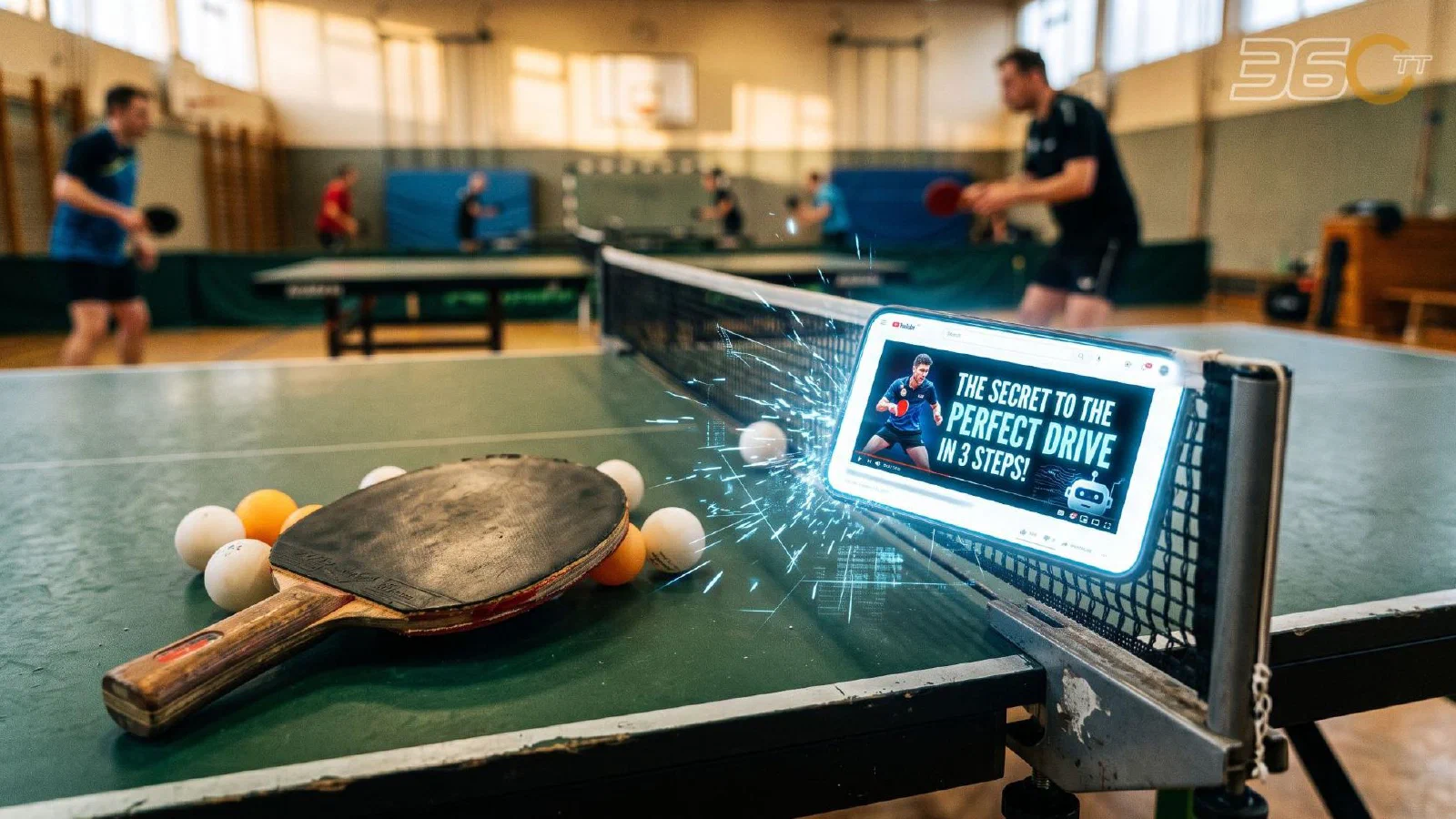
Today there is a flood of instructions and near-miraculous promises on YouTube and TikTok that claim to shorten your path to improvement. The player watches a 30-second clip on how to hit a perfect drive against a chopper and gets a false sense of intellectual mastery. But table tennis happens in fractions of a second. At the table, what reacts is the body that actively repeated the movement, not the brain that consumed the video lying on the couch.
The “Coach GPT-y” and the cost of illogical gear
Passivity affects not only technique, but above all the choice of equipment. Here at 360TT, we often meet frustrated customers who threw a lot of money down the drain. They show up with extremely stiff rackets and hyper-fast, uncontrollable rubbers, completely incompatible with their own playing style.
The reason? They asked a generic Artificial Intelligence (our “Coach GPT-y”, a Brazilian pun on ChatGPT) “what is the best setup to attack” or copied an Olympic champion’s racket after watching a video. They outsourced a process that should be about “table time”.
AI can read technical specifications, but it doesn’t know how long your back-swing is, how fast your wrist accelerates or how humid the gym where you train is. Testing gear at random based on loose tips is a trap that drains the player in three ways:
- Financially: spending a lot on the wrong rackets.
- Physically: throwing the body off balance while trying to compensate for a badly tuned setup.
- Cognitively: the constant anxiety of not knowing whether the mistake came from your arm or from your racket.
It is infinitely cheaper (financially, physically and cognitively) to choose a gear combination that is simply “logical” for your current technical moment and to commit actively (table time) to adapting to it. Real progress is not in the next click; it demands the practical “friction” of serious training.
5 practical tips to leave passive mode and win more matches
If you want to take active control of your development and stop outsourcing your progress to screens, apply these five real fundamentals at the table:
- Serve: practice your serve every day. The serve is your first attack, and its basic goal is to make your opponent return the ball the way you want. The better your serve, the more trouble you cause your opponent.
- Blade: use a slower blade than your current one. Most players use blades faster than ideal for their technical level and tighten up their arm when hitting. Every racket will feel faster at the end of a game tied at 10-10.
- Where you attack: where you attack matters more than how hard you attack. Attack where your opponent isn’t or, if he is standing close to the table, toward the elbow of his racket arm. Well-angled attacks, to the right or to the left, are very effective at pulling your opponent out of position.
- Strategy: study your opponent and look for weaknesses to exploit. When you find one, exploit it without mercy. You will shake his confidence and have a better chance of winning the game. Also map his strengths and do whatever you can so that he can’t use them.
- Relaxed stroke: hitting with a relaxed arm generates more power (force + spin). The more force you put into the stroke, the lower its speed and, consequently, the less power. The secret to a truly strong ball is not force but relaxation.
The sport demands sweat
Table tennis demands that you deal with difficulty, make mistakes, adjust and come back stronger. Digital tools and videos are great starting points to open your mind, but they should stop there. They don’t replace the bucket of balls, the sweat and the expertise of those who live the sport firsthand.
Now I want to hear from you: have you ever bought gear because of a video or an AI answer? How did it go? Tell us in the comments!
Now that you’ve reached the end of the text and have already exercised your brain actively with so much reflection, how about stopping by our store and investing in something logical for your game? Don’t let artificial intelligence choose your racket. Gear of guaranteed origin and real support is what you find at 360TT! 🏓🔥
chat gpt · youtube tutorials · tiktok · how to choose a racket · practice hours · ping pong · gepeto · stuck at same level
Read also
For Sale: Pixie Dust for Equipment Junkies
An expensive racket won't fix your game. Find out what an Equipment Junkie (EJ) is, the cycle of mediocrity and how to go back to basics and really improve.

Your heart lost the point. And it wasn't nerves...
Lost the set with the right game plan? See how a racing heart costs you precision, and how a smartwatch and the breaks between points help you regain control.

Train to Play: The 360TT Rational Guide to Periodization
Train like a lion but play like a kitten? Discover the 360TT 50/30/20 periodization method and turn your training into results at the tournament.

Comments
Comment with your account (email or Google). Every comment is reviewed before it appears.