What If Table Tennis in Brazil Had the USATT Rating System?
In this post5 sections
If you play table tennis tournaments in Brazil, you have surely heard — or taken part in — a heated debate about the real level of the players. Who hasn’t seen someone entered in a theoretically lower category surprise everyone and take the title, while players from different states find huge technical gaps even though they sit in the same division?
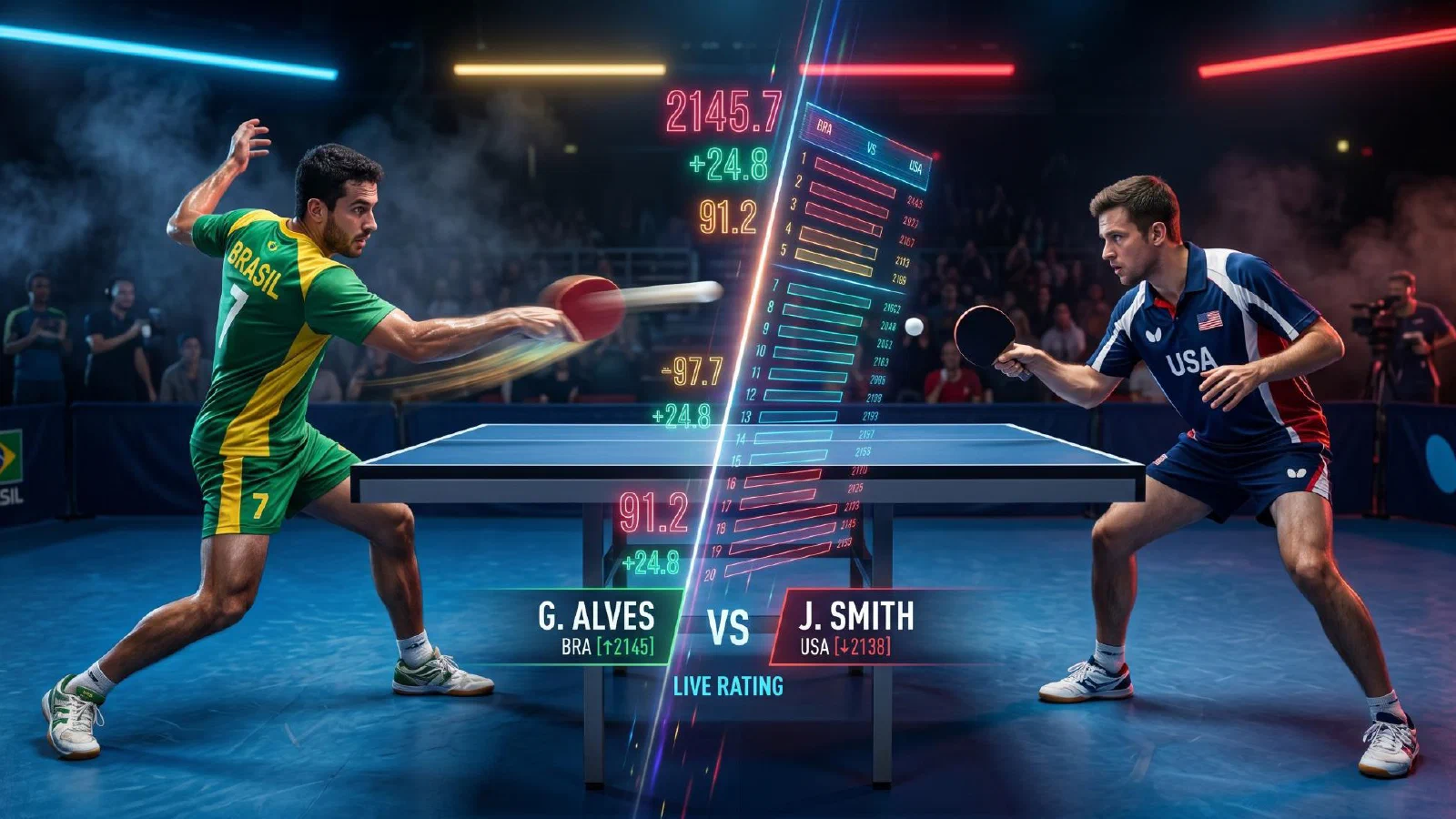
In Brazil, the technical organization of our sport is dictated by the CBTM (the Brazilian Table Tennis Confederation) Manual, which structures the National Rating into static letter “drawers”. But on the North American circuit, the culture is completely different thanks to the USATT (USA Table Tennis) model. There, players don’t say they play in “Absolute C” or “Bronze Series”; they proudly introduce themselves with their exact number. You simply hear: “Nice to meet you, I’m a 1650 player” or “I’m training to break 1900”.
As a coach, I like to analyze systems that drive improvement. So let me invite you to think: what would happen if Brazil adopted a “living score” system like the American one?
In the United States, the rating is not just a label on a piece of paper; it dictates who you train with, which tables you can challenge at the club, and it defines your progress point by point.
TL;DR: in Brazil, the CBTM rating uses letters and fixed point bands, and a tournament’s weight counts for more than consistency. In the USATT model, the rating is a number that changes with every match: an upset earns many points and a favorite who wins earns none. A living score like that would give players a clear improvement goal, like a golf handicap. But whatever the system, the players who improve are the ones who train and study the game.
The current picture: how rating works in Brazil (CBTM 2026)
To draw a fair parallel, we first need to understand our current system precisely. The official CBTM regulation organizes players by technical level through fixed point bands. For men, for example, Rating A covers anyone with 3,300 points or more, Rating B runs from 2,800 to 3,299, going down the alphabet until Rating O, for those with up to 250 points.
When singles matches take place at official events on the national calendar — such as the Winter National Championship, the Summer National Championship, or the stages of the Brazil Cup Gold Series and Silver Series — the points you win or lose are calculated from a fixed table of “Expected Wins” (when the favorite wins) and “Unexpected Wins/Losses” (when the famous upset happens).
The core of our model is that the points earned in the basic table are always multiplied by the political and technical weight of the event. It works like this:
- Winter National / Summer National: Weight 18.
- National Selection: Weight 12.
- Brazil Cup Gold Series: Weight 9.
- Brazil Cup Silver Series: Weight 6.
- State events: Weight 3.
- Regional tournaments / Leagues: Weight 1.
Although this model protects the institutional importance of the big tournaments, it has a side effect: a player’s ranking depends heavily on how many expensive trips they can afford to play high-weight events (like a weight-18 Summer National), and less on their day-to-day consistency against the players in their own region.
The USATT model: the living-score algorithm
In the United States, the system removes the letters and the political weights of tournaments. The rating is a continuous, floating number (usually from 100 to 2900+). The calculation runs on a pure points-exchange algorithm based only on the mathematical difference (the so-called differential) between the two opponents before the match starts.
If a 1400-point player faces a 1410-point player, the difference is small and the match yields few points to the winner. But the real engine of American engagement is the upsets. If a focused, fast-improving 1400-point player surprises and beats an experienced 2000-point opponent, the algorithm punishes the favorite and injects a massive 50 points at once into the underdog’s pocket. On the other hand, if the 2000-point favorite wins, they gain exactly zero points, because the system understands that victory was merely a statistical obligation.
The psychological impact: a more logical line of progression
The great advantage of a dynamic, unified score in Brazil would be its direct impact on player motivation, especially for beginners and intermediate players. Instead of being stuck behind category barriers that depend on how many people entered on the day of the tournament, the player gets a clear, continuous individual line of progression.
The focus stops being purely a medal in a circumstantial knockout bracket and becomes a measurable improvement goal. The sport gains a sense of progress much like online game rankings or golf handicaps: you know exactly where you stand on the national table tennis map and how much you need to improve to reach the next step. Your opponent stops being just an unknown rival and also becomes a clear mathematical challenge.
Whatever the system, progress happens at the table
Of course, a change of this magnitude would bring gigantic logistical challenges for the CBTM to manage in a country of continental size like Brazil. But while the political backstage debates formulas, spreadsheets and tournament weights, the hard reality of table tennis stays the same everywhere in the world: whoever doesn’t train seriously and doesn’t study the game stays stuck.
In the end, whether you are counting the little letters of a static rating or climbing numbers in a living algorithm, the only real way to improve is to stay focused on refining your movements and sharpening your tactics.
We want to hear from you!
Now the table is yours: do you prefer the current CBTM system, based on well-defined letter bands (divisions) and weights by championship importance, or do you think a living-score algorithm like USATT’s would bring more fairness and motivation to Brazil’s amateur players? Leave your comment below and join the debate!
PS: Now that you’ve reached the end of the text and exercised your brain with so much theory, how about dropping by our store to make sure your equipment is as sharp as your tactical mind? There’s no point having a Ma Long rating if your rubber is slicker than a bar of soap! 🏓🔥
rating · points · cbtm ranking
Read also
Who Is the GOAT of Table Tennis? 100 Years of History and Magic
The ITTF released a documentary on its 100 years (1926-2026). See the Sweden, China and Brazil recap and find out who the coach picks as table tennis GOAT.
From VHS Tapes to 'Bashing': A Reflection on Table Tennis Today
A veteran compares 1990s table tennis with today's game. Find out why men's play turned into bashing and why the women's game is more creative.

Eyes, ears and the size of the hall: the science of reading the ball
Why we react to the sound of the hit before the image, how the ear reads spin and why the ball seems slower in a big hall. Learn how to train both senses.

Comments
Comment with your account (email or Google). Every comment is reviewed before it appears.