Waldner's 10 Tips | Special Content
In this post11 sections
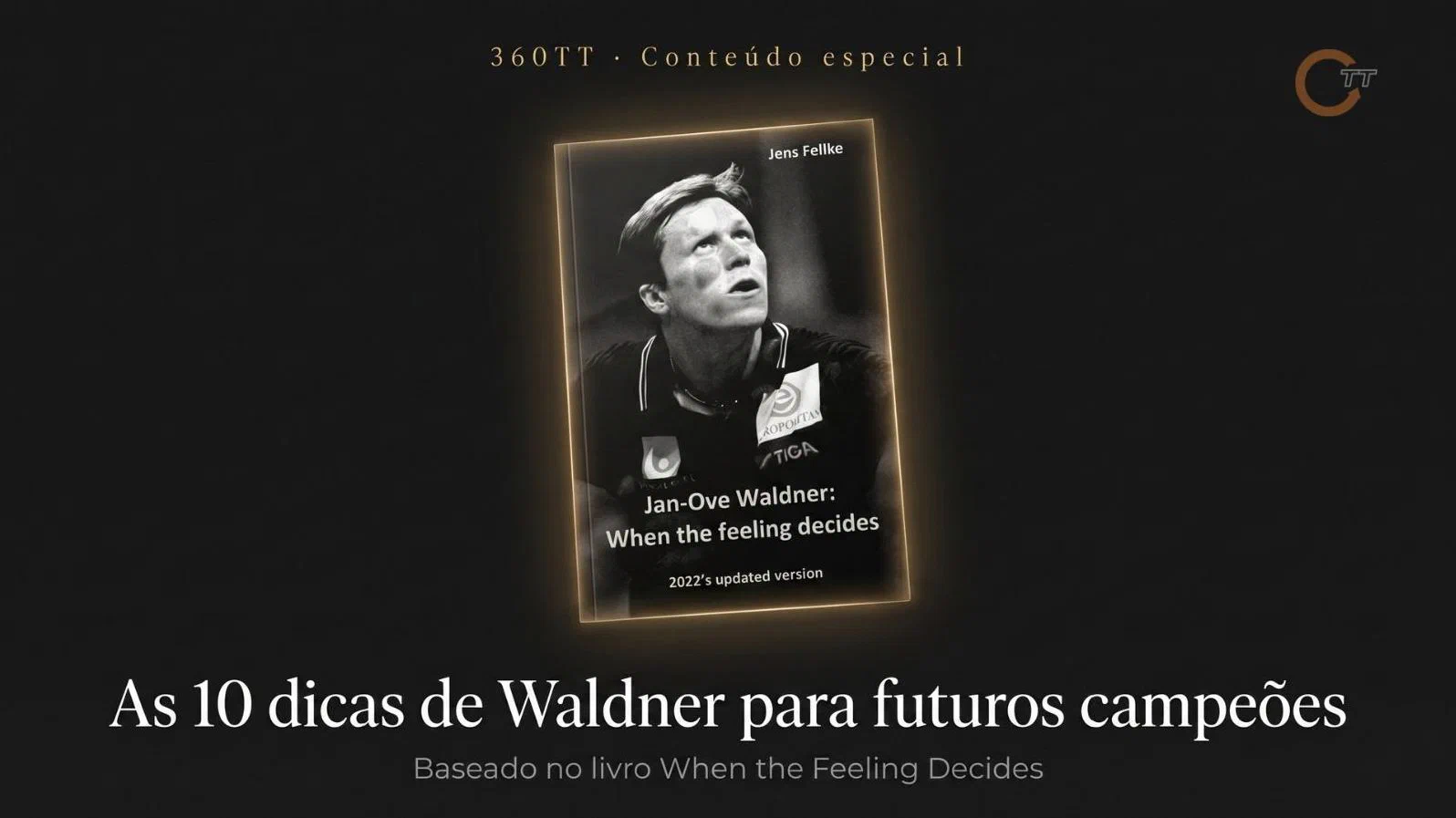
Jan-Ove Waldner is considered by many to be the greatest table tennis player of all time. In When the Feeling Decides, written by Jens Fellke, Waldner closes the book with a special chapter: 10 straight-talking pieces of advice for anyone who wants to reach the top. We translated and commented on each one for you.
TL;DR: Waldner’s 10 pieces of advice mix technique, tactics and mindset. At the table: be a complete player, have weapons that win points, play relaxed and master the three distances. To keep improving: play a lot while you are young, study good players and analyze your opponents. And above all, use your head, be respectful and think long term.
1. Become a complete player
To win big titles, you need to master the game against every style of opponent. That is why it is essential to train and compete regularly against different profiles. The most important styles to master are loopers (maximum topspin), attackers (maximum speed) and choppers (maximum backspin).
Another fundamental aspect is learning to play against left-handers. Keep in mind that both right-handers and left-handers spend 85% of their playing time facing right-handers. So being successful against both types takes a well-developed technique and very sharp balance.
Waldner says he had the advantage of training a lot with left-handers from his very first club, Spårvägen, where he played with Mikael Appelgren and Ulf Thorsell. Later, on the Swedish national team, left-handers were well represented: Appelgren again, Stellan Bengtsson, Erik Lindh, Ulf Bengtsson, Thomas von Scheele and Peter Nilsson.
360TT view
How many times do you avoid playing against a style that bothers you? The discomfort in training is exactly what prepares you not to be surprised in competition. Go looking for the tough opponents, not the easy ones.
2. Develop weapons that win points
Table tennis is a tough sport, played under a lot of pressure. Many times you have to play several matches in a single day. That is why it is important to be able to win points simply and quickly.
Waldner could always count on his serves, which were often decisive and won the point outright. On top of that, he worked hard to complement his serves with a varied and unpredictable forehand. He recommends taking time to analyze which point-winning weapons you already have, and remembering that new weapons can always be developed.
360TT view
Every weapon starts with a conscious choice to develop it. Have you ever stopped to analyze what your current strengths are and what new weapons you could build? This self-assessment exercise is well worth it.
3. Develop a relaxed technique
Table tennis demands an enormous amount of practice. Always try to play as relaxed as possible. This increases your chances of keeping your quality even in tough situations and, at the same time, lowers your susceptibility to injury.
Waldner says that he personally managed to avoid injuries throughout his career, and he believes this is one of the reasons he was able to stay at the top for so many years.
360TT view
Tension is the enemy of technique. If you notice that you freeze at decisive moments, the problem is rarely a lack of skill, it is too much tension. Working on relaxation in training is as important as working on the stroke itself.
4. Play a lot while you are young
Table tennis demands advanced motor coordination and dexterity. That is why it is essential to learn as much technique as possible before the age of 13. As long as it is fun, train and compete as often as you can.
Use your imagination by constantly trying new strokes, even during matches. Try a new strategy in the middle of a game. Treat a 10-10 in the deciding set as a challenge to test your most effective serve or a new kind of serve return.
Remember that a table tennis career is quite long. When you feel bad about a loss, try to think about the next tournament and how you can improve.
360TT view
Parents and coaches, this tip is especially for you. A free, exploratory play environment in childhood is fundamental, but be careful: fun and seriousness have to go together. Playing with a light heart is essential, but without real commitment to development, the young athlete does not move forward. The balance between the two is what makes champions.
5. Master the three distances / timings
Many players dominate the game from only one or two distances. Waldner’s recommendation is that you consciously practice playing at all three distances after the ball bounces:
- Distance 1 (timing 1), rising ball: you must hit the ball before it reaches its highest point after the bounce. You need to learn to use short, fast strokes with little backswing.
- Distance 2 (timing 2), ball at the top of the bounce: you must learn to use a relaxed technique when hitting the ball exactly at its highest point after the bounce. A wide variety of strokes can be applied successfully at this distance.
- Distance 3 (timing 3), falling ball: you hit the ball after it has reached its highest point, already on its way down. This distance calls for a technique with a big forearm movement before impact.
360TT view
Playing well at only one timing is a blind spot that any experienced opponent will exploit. And here is a fundamental principle: if you do not decide when to touch the ball and do not position yourself for it, your opponent decides when you touch the ball. Consciously choosing your timing is part of the tactical game, not just the technical one.
6. Study good players
Watch as much table tennis as you can. Study recordings of yourself and of high-level players. Waldner used to study the Hungarian player Tibor Klampar, whose wrist movements and ball striking were of extraordinary quality. By studying Chinese players, he learned to value the importance of developing effective serves.
Try to imitate certain players to better understand the advantages and disadvantages of different playing styles, grip types and movement patterns. On the Swedish national team, the squad always had a lot of fun imitating opponents over the years, and Erik Lindh was a master at imitating them.
360TT view
It has never been so easy to access high-level videos as it is today. The question is: do you watch as a spectator or as a student? Change the lens and you will notice how much you learn.
7. Analyze your opponents
Only when you face a player for the first time can you get a real sense of the quality of, say, their forehand loop. So rely on the help of teammates who have already played against that opponent. Bring every relevant detail into the conversation. Remember that there are many ways to win in table tennis. The more prepared you are, the better your chances. The margins in this sport sometimes seem tiny, but it is always the more complete and professional player who benefits from them.
360TT view
Tactical preparation is not cheating, it is competitive intelligence. At tournaments, arrive early, watch the matches of your possible opponents and write down what you notice. That information is worth its weight in gold when the moment comes.
8. Use your head
Mental strength is a vast and extremely important topic, and perhaps the hardest quality to develop through training. Over the years, Waldner developed a way of thinking and acting that he believes fits his personality. For him, the starting point has to be yourself.
Mental strength is based on experience and accumulated knowledge about your sport. Listen to the advice of people you trust, but remember that, in the final analysis, you have to trust your own judgment.
When he was younger, Waldner studied great Swedish athletes in detail, such as Björn Borg (tennis) and Ingemar Stenmark (alpine skiing), and was impressed by their calm during competitions. Over time, he learned to analyze his losses and forget them as quickly as possible. On the other hand, he carries the memories of his victories with him to strengthen his self-confidence.
360TT view
There is no universal formula for the mind, but there is practice. Working on the mental side is as legitimate as working on your backhand. Meditation, visualization, talking with a good coach or sports psychologist: all of it counts.
9. Be respectful
A table tennis match is decided in a short time, and underestimating your opponent can be costly. It is essential to accept defeats with grace and show respect for your opponent. Waldner’s strategy, regardless of the result, was always to keep a low profile.
360TT view
Respect, at the table and away from it, is a trademark of the greats of the sport. It is no accident that Waldner is revered all over the world not only for his talent, but for the way he always carried himself. That is a lesson too.
10. Think long term
To conclude, Waldner stresses that becoming a good table tennis player takes a long time. There will always be new things to learn. Try to think long term and avoid focusing too much on results while you are still young.
If you aspire to compete with the best, you will have to walk a narrow path. Only a large volume of training, and hard training, will get you to your goal. This principle applies just as much to training at the table as to physical conditioning.
But do not forget, every now and then, to have fun and experiment a little. Eventually, you will discover something that will be useful in competitive play.
360TT view
This is perhaps the hardest tip to follow in the age of social media, where everything seems instant. But champions are built over years, not weeks. Trust the process.
Conclusion
Ten pieces of advice from one of the greatest geniuses our sport has ever produced. What stands out most is that Waldner does not talk only about technique: he talks about mindset, process, respect and curiosity. These are lessons that work for players at any level, from the beginner to the experienced competitor.
At 360TT, we believe exactly that: that development in table tennis goes far beyond hitting the ball. It is a path of self-knowledge, dedication and love for the game.
Now I want to hear from you: which of these tips best fits where you are right now in the sport? Tell us in the comments, we love learning from our community!
jan ove waldner · waldner advice · champion advice · how to become a champion · training tips · mental game · mozart of table tennis · playing against lefties
Read also
Train to Play: The 360TT Rational Guide to Periodization
Train like a lion but play like a kitten? Discover the 360TT 50/30/20 periodization method and turn your training into results at the tournament.

The Counterintuitive Tactic: The Power of the Long Serve at the Elite Level
The long serve is a counterintuitive tactic. See how elite players (Harimoto, Faraji) use this "bait" to set up the third-ball attack and win the point.
Table Tennis Serve: 5 Tips to Surprise Your Opponent (and the Equipment That Helps)
Turn your serve into an attack! See 5 expert tips to surprise your opponent and discover the ideal equipment to power up your game. Check them out.
Comments
Comment with your account (email or Google). Every comment is reviewed before it appears.