The Antifragile China: From Chaos to the World Title
In this post6 sections
Analysis · 2026 World Championships
The antifragile thrives and grows when exposed to chaos, volatility and stress.
Nassim Nicholas Taleb spent years developing a concept that goes far beyond what most people call “resilience”. Being resilient means withstanding the shock and returning to the same state. Being antifragile is different: it means coming out of the shock stronger than you went in. The antifragile needs stress in order to improve.
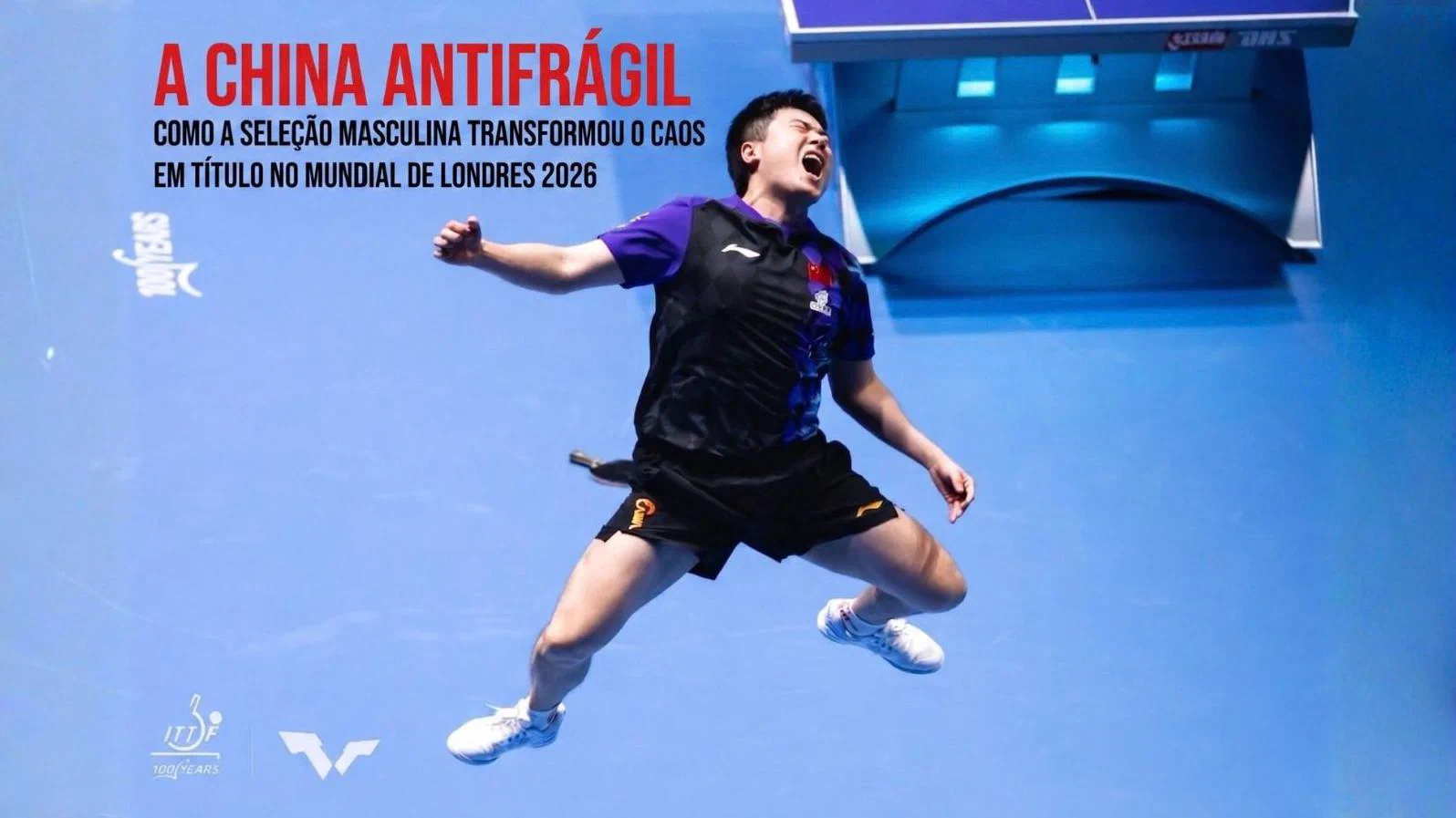
At the 2026 World Table Tennis Team Championships, held at the OVO Arena Wembley in London, China’s men’s team gave the world a practical, unforgettable lesson in what it means to be antifragile. Two defeats in the group stage. A 26-year legacy thrown to the ground. And then: a dramatic semifinal against France, a dominant final against Japan, and the 24th world title in history.
This post tells that story, with all the real data, match by match.
TL;DR: China arrived in London with 26 years without a defeat in the tournament and lost twice in the group stage (South Korea and Sweden). It reacted with revenge on Korea, a comeback semifinal against France, in which Liang Jingkun came back from 0-2 down after a talk from coach Wang Hao, and a 3-0 over Japan for the 24th title. For the author, it is a real case of Taleb’s concept of antifragility: the team that needed the chaos to show what it is made of.
The unthinkable: the two group stage defeats
To understand the magnitude of what happened in London, you first have to understand the size of the myth that had to be torn down.
Since the final of the 2000 World Championships in Kuala Lumpur, when China lost to Sweden, the Chinese men’s team had built one of the most impressive streaks in the history of any team sport: 83 team matches without a defeat, involving 262 individual matches and only 13 sets lost in 26 years. Eleven consecutive world titles. An unbeaten run that felt more like a philosophy than a result.
In London, that myth died twice in two days.
1st defeat: China 1 × 3 South Korea (group stage)
The first blow came on Saturday, May 2. South Korea, with a bold strategy and a calculated team lineup, beat China 3-1, breaking a 26-year streak of Chinese wins in the tournament.
The most telling detail: the world No. 1 and reigning champion, Wang Chuqin, was rested. The Chinese delegation had underestimated the opponent. In his place came Zhou Qihao, 29 years old. South Korea took advantage and won with authority.
The reaction from the Chinese media and fans was immediate and brutal: questions about the team’s decline, about the quality of the squad, about the end of an era. In just 48 hours, what had been seen as the most dominant team in the history of table tennis became a question mark.
2nd defeat: China 2 × 3 Sweden (group stage)
If the first defeat was a shake, the second was an earthquake.
On Sunday, against Sweden, Wang Chuqin came back and was brilliant, winning both of his matches with authority:
- Wang Chuqin (No. 1) 3×0 Anton Källberg (No. 33): 11-8, 11-5, 11-6
- Wang Chuqin (No. 1) 3×0 Elias Ranefur (No. 70): 12-10, 11-6, 11-4
But it wasn’t enough. Sweden adopted a brilliant strategy: they entered Truls Möregårdh, world No. 2 and silver medalist at Paris 2024, as the team’s third player, avoiding a direct clash with Wang Chuqin. Möregårdh played only one match and sealed the deal:
- Elias Ranefur (No. 70) 3×2 Lin Shidong (No. 6): 9-11, 6-11, 11-3, 11-6, 9-11
- Anton Källberg (No. 33) 3×1 Lin Shidong (No. 6): 12-10, 10-12, 11-8, 11-8
- Truls Möregårdh (No. 2) 3×2 Liang Jingkun (No. 21): 11-7, 9-11, 11-9, 3-11, 12-10
China finished third in Group 1. For the first time in its modern history, it did not finish in the top two of a group stage at the World Team Championships.
The WTT broadcast commentator spoke with the legendary Ma Long, considered the greatest table tennis player of all time, who had traveled to London to watch the matches. Asked about his presence, he simply answered:
I came to learn.
A sentence that summed up the moment of a nation.
The turnaround begins: the round of 16 and the quarterfinals
Before the semifinal, China had to get through two knockout rounds. And the signs of recovery began to appear.
In the round of 16, against Romania, China won 3-1, but not without scares. Romania’s Eduard Ionescu (No. 41 in the ranking) beat Liang Jingkun in straight sets, one more reminder that nothing was guaranteed. Wang Chuqin, unbeaten in the tournament, closed out the match.
In the quarterfinals, China met exactly the South Korea that had beaten it in the group stage, and this time delivered a categorical revenge: 3-0, in a match that lasted only 2 hours and 56 minutes. Wang Chuqin, Lin Shidong and Liang Jingkun all played. The message was sent.
China had secured its 32nd medal in 34 appearances in the history of the tournament. But the big story was still to come.
Semifinal against France: the night the myth was reborn
With Ma Long in the stands of Wembley Arena, China stepped up to the table on Saturday, May 9, to face France, the only unbeaten team in the men’s event up to that moment, which had knocked out Brazil in the quarterfinals 3-0 with a devastating performance from the Lebrun brothers and Flavien Coton.
What followed was the match that defined the spirit of the whole tournament.
Wang Chuqin came in as the absolute favorite. Coton, just 18 years old, a former world cadet champion, wanted none of it. The Frenchman played fearlessly, pushing Wang to the limit. In the first set, Coton gave nothing away: Wang had to get to 15-13 just to win the opener. France turned it around in sets 2 and 3. Wang reacted, but needed a deciding set to confirm the win. Wang remained unbeaten, but had been taken to a fifth set for the first time in the tournament.
Félix Lebrun, 19 years old, Olympic bronze medalist at Paris 2024 and world No. 4, was relentless. With his sharp counter-attacking game, he dominated Lin Shidong in 3 straight sets. Team match tied.
This was the heart of the semifinal. And probably one of the most dramatic moments in team table tennis in years.
Alexis Lebrun, 22 years old, European champion and world No. 12, dominated the first two sets in crushing fashion, conceding only 4 points in total. Liang Jingkun looked finished. China was on the edge of the cliff.
That was when the team’s coach, Wang Hao, himself a three-time individual world champion, stepped in during the break between the second and third sets with words that mixed technique and mental release. The talk was caught by the WTT cameras:
🎙️ Wang Hao, China's coach, during the timeout
“On the serve receive, you have to have the attitude of going firmly into the ball, of taking his serve on head-on. Don’t overthink things, take the weight off your head.
If you go on the attack, go all in. After you flick the receive, stay very sharp. If you open the rally with the flick, he’s going to block quickly in your direction, so you have to be ready to defend or counter-attack that ball coming back.
There’s no room to count on luck now, there’s no free ball.
Play as if you’ve already lost, go all or nothing. Let your arm go without fear of missing! Value every chance you get on the table. Believe in your game, you can turn this around. Let’s go!”
It was, at the same time, a precise technical instruction and an act of psychological release. The key was in the central sentence: “play as if you’ve already lost.” Taleb would call this removing the downside: when there is nothing left to lose, fear disappears and the player can act with total conviction.
And that is exactly what Liang did. The third set went to 15-13 in Liang’s favor. In the fourth, he opened 10-3; Alexis fought back and tied it at 10-10. Liang closed it out. In the fifth set, it was quickly 9-2, and he finished it at 11-2.
Wembley Arena exploded.
With China ahead and Liang Jingkun having rekindled the team’s flame, Wang Chuqin returned to face the best French player in a classic of world table tennis. The rallies were of a high level from the start. But Wang, energized by Liang’s reaction, grew progressively and closed it out in four sets.
What Liang showed tonight moved me. Seeing him fight back from that position made me believe more when I went back to the table.
Final against Japan: the 24th title and the 12th in a row
In the final on Sunday, May 10, in front of more than 7,000 spectators in a packed Wembley Arena, China faced Japan, which had reached its first men’s World Team Championships final since 2016, after beating Chinese Taipei 3-0 in the semifinal.
It was the seventh time the two countries had met in a men’s final in this tournament. China had won all six previous ones. This time, the story was different from what many expected, not because of the margin, but because of the protagonists.
Sets: 8-11 / 4-11 / 11-9 / 13-11 / 11-8 (comeback from 3-8 in the decisive set)
Harimoto, 22 years old and world No. 3, won the first two sets. In the fourth, he had match point. It looked as if the semifinal comeback had been an isolated flash.
But Liang Jingkun, the man who had risen from the dead in the semifinal, was not willing to die again. In the decisive break, Wang Hao gave the instruction and calibrated without stirring things up:
🎙️ Wang Hao, China's coach, in the deciding set
“Keep exactly this rhythm. Overall, there’s no need to rush and speed up the game.
When you attack, pull the ball more toward the middle of his side of the table, got it? Go a bit more measured and focus there in the middle.
If you use the forehand, play heavy, right in the middle of him. If it’s the backhand, since he steps up to the table, turn the ball to the other side.
Very good. That’s it, total focus now. One point at a time. Hold his game. You don’t need to try to force impossible balls, just pin him down.
In this final stretch, you have to believe in yourself. If you go on the attack and sink your teeth into the game, he’s the one who will get desperate and panic. Okay? Go.”
Where before Wang Hao had freed Liang from fear, now he rebalanced him: control, patience, faith. Two timeouts. Two completely different registers. One same principle: put the player in the right mental state for the moment.
Liang Jingkun listened. He came back from 3-8 in the deciding set. He closed it out at 8-11, 4-11, 11-9, 13-11, 11-8.
Two matches in a row. Two epic comebacks. One same man.
Sets: 8-11 / 12-10 / 11-2 / 11-9
Wang Chuqin maintained the solidity and leadership he had shown throughout the tournament. He lost the first set to the talented young Matsushima, but responded with authority in the next three. Wang finished the tournament unbeaten in every individual match he played, a historic performance.
Sets: 11-9 / 11-5 / 7-11 / 11-9
Lin Shidong had been China’s most inconsistent player in the tournament: he had lost four matches, including to the Swedes Ranefur and Källberg in the group stage. He was the big unknown of the Chinese team.
In the final, when it was time to close out the championship, he was the one who sealed the conquest. China is a twelve-time consecutive world champion (12x), with 24 titles in total, double Hungary, the second-biggest winner in history with 12.
The organizers raised the Swaythling Cup. Ma Long smiled in the stands.
The parallel with antifragility: why this is more than sport
Taleb describes three categories of systems: the fragile, which breaks under pressure; the robust, which resists without changing; and the antifragile, which gets stronger with chaos. China’s men’s team in London 2026 was a perfect case study.
Principle 1 · defeats as a stimulus
When a team that went 26 years unbeaten loses twice in two days, the natural response would be panic and a defensive reorganization. China did the opposite: it used the defeats as information. It identified vulnerabilities (Lin Shidong inconsistent, Liang Jingkun in poor form) and exposed those players to the fire of competition, instead of protecting them.
Principle 2 · individual stress, collective strength
Liang Jingkun lost matches against South Korea, Sweden and Romania. On any fragile team, he would have been rested. On China, he was picked for the most important match of the tournament, and responded with a comeback that defined the championship. The accumulated stress converted into extraordinary performance exactly when it mattered most.
Principle 3 · the psychology of legends
Ma Long “came to learn”. Xu Xin was in the stands. Coach Wang Hao freed Liang from fear with the paradox “play as if you’ve already lost” and then, in the final, rebalanced him with tactical calm: “one point at a time, don’t try to force it”. Two timeouts, two completely different registers for the same player in different situations. Accepting defeat removes the pressure of avoiding it and allows you to act with total conviction.
Principle 4 · the system is bigger than the parts
Lin Shidong, the player with the most defeats in the tournament, closed out the championship. Liang Jingkun, the one who suffered the most, was the hero of the semifinal. Wang Chuqin, the most brilliant, was the anchor and finished unbeaten. None of them, alone, tells the complete story. The team was the system. Taleb writes that antifragile systems need skin in the game (real exposure to the consequences). China had that in London.
The difference between dominating and winning
There is a difference between a team that dominates because the others are weak and a team that wins because it is, structurally, capable of growing under pressure.
During 26 years of being unbeaten, China piled up titles with relative ease. In London 2026, for the first time in decades, China was forced to find out what it is made of when the comfortable scenario disappears.
The answer was the clearest demonstration of antifragility that team table tennis has ever seen.
They did not survive the chaos. They needed it.
Now I want to hear from you: what did you think of this final? Would you have bet on China to win the title after the group stage defeats? What did you think of Liang Jingkun? And of Wang Hao’s talks during the timeouts? Tell me everything in the comments, I’ll love reading it!
ping pong world championships · wtt team worlds 2026 · china national team · china loses group stage · anti fragile · anti-fragility · wang hao speech
Read also
SpongeBob, Waldner and Taleb: Table Tennis Lessons
Why resilience isn't enough in table tennis: what SpongeBob, Waldner and Taleb teach about pressure, mistakes and growing from every loss.

Who Is the GOAT of Table Tennis? 100 Years of History and Magic
The ITTF released a documentary on its 100 years (1926-2026). See the Sweden, China and Brazil recap and find out who the coach picks as table tennis GOAT.
Double Happiness: the story of DHS, the brand intertwined with Chinese table tennis
From China's first ball in 1927 to the Paris 2024 tables: the story of DHS, the brand that grew up alongside the Chinese national team. See how it began.

Comments
Comment with your account (email or Google). Every comment is reviewed before it appears.