The Invisible Enemy of Your Drive
In this post5 sections
Picture the scene: you practice your forehand perfectly in front of the mirror. On the robot or in basic multiball drills, the stroke flows with flawless weight transfer. But when real match play comes, reality knocks on the door: you spray the ball, catch it on the edge or miss the shot completely.
The first reaction of 99% of table tennis players is to blame the equipment or the mechanics of the body. You think the rubber lost its “grip” or that your arm is shrinking. But what if I told you the real culprit may not be your arm or your racket?
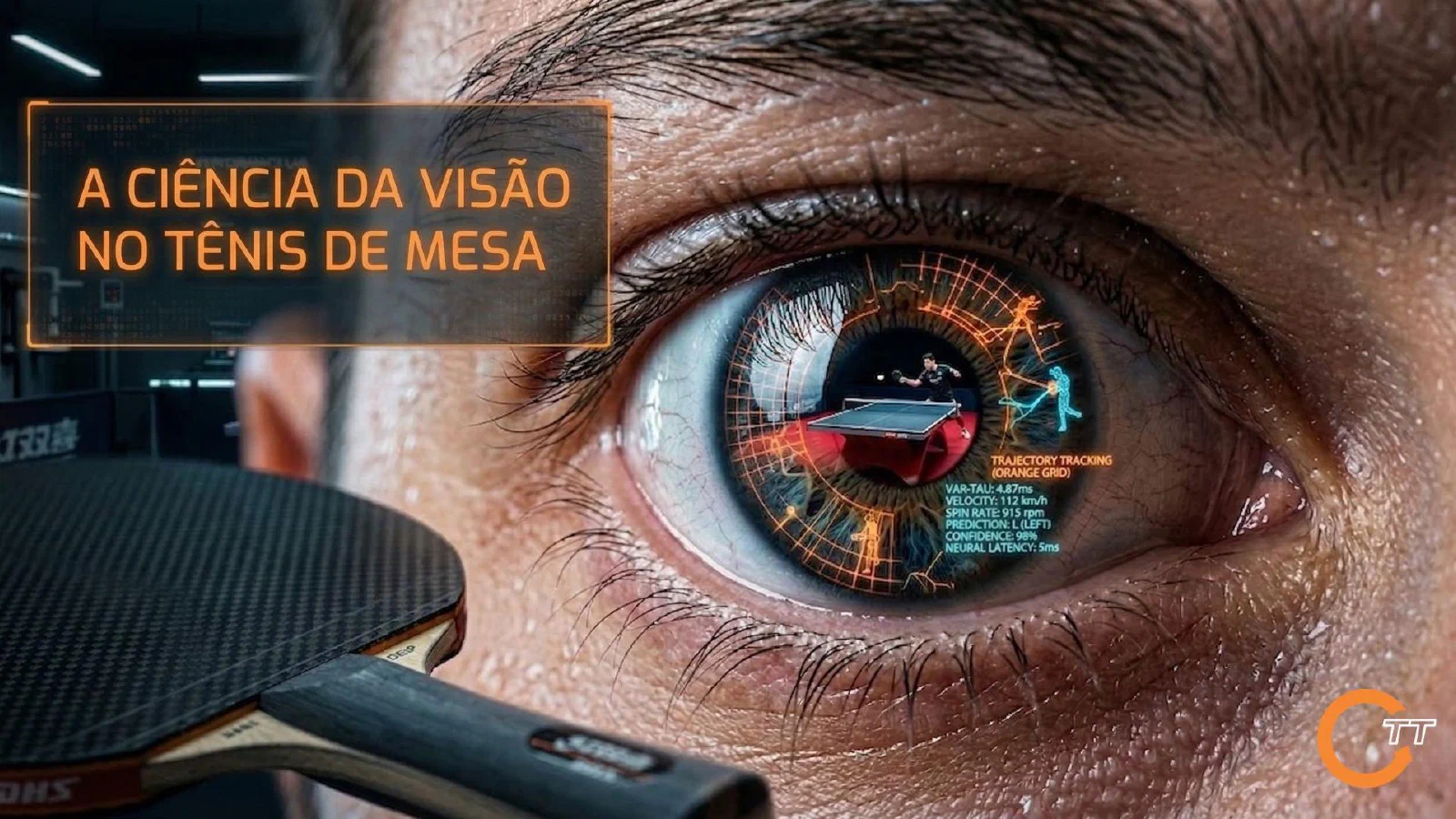
The problem is that your brain may be receiving the information late. Before being a motor sport, table tennis is a sport of extreme visual perception. And science has already proven it with relentless numbers.
TL;DR: the elite player is not a robot: he corrects the stroke in mid-flight, which scientists call compensatory variability. To do that, the brain reads the ball through the Tau factor and has to nail the impact within a window of just a few milliseconds. Any vision problem, from astigmatism to aging eyes, steals that time, and your distance from the table changes what the eye has to do. After seeing an eye doctor, you can help yourself with low-light training and with choosing the right blade.
The “robot” myth and the magic of compensatory variability
For a long time, it was believed that the elite player was like a robot that simply repeated the same memorized movement (a motor program). To test this, scientists Reinoud Bootsma and Piet van Wieringen analyzed the biomechanics of professional Dutch athletes attacking balls at more than 60 km/h.
The discovery changed the sport: the elite player is not a robot. Their precision at the moment of hitting the ball was much greater than at the moment they set up the stroke. How? Through compensatory variability.
The table tennis player’s brain makes micro-adjustments during the stroke. If he misjudges the ball and starts the stroke late, the brain sends a signal to brutally accelerate the arm and compensate. They don’t blindly repeat the same stroke; they correct it in mid-flight.
How the brain reads the ball: the Tau factor and the 5-millisecond window
Our brain doesn’t calculate speed in km/h and distance in meters like a traffic radar. Our eyes use an optical variable called Tau. They read the “relative rate of dilation” of the ball, that is, how fast the outline of the ping-pong ball is growing and expanding on your retina. It is this expansion that tells the nervous system how many milliseconds are left before impact.
The relentless math: the 5.2º angle and the impact window
To give you an idea of how demanding this is visually and motorically, the study placed a 55 cm diameter target about 2.5 meters from the racket’s contact point. For the ball to land inside that target consistently (hitting it at least 75% of the time), the direction of the racket’s movement could not vary more than 6 degrees from the center of the target.
Statistically, this means the standard deviation of the racket’s direction at the exact moment of impact cannot exceed an absurd 5.2 degrees. It is a margin of error invisible to the naked eye!
Now combine that angle with arm speed: at the moment of contact, the angular velocity of an elite athlete’s racket reaches 800 degrees per second. When you divide the 5.2º margin of error by that dizzying 800º/s, the math is merciless: the player has to time the moment of impact with a maximum precision of 6.5 milliseconds, and the ideal window is 2 to 5 milliseconds. Blinked, or your vision blurred? The racket goes past the correct angle and the ball ends up in the net or in the barrier.
Vision saboteurs and the veterans’ challenge
This is where the invisible enemy strikes. An athlete’s visuomotor delay (the time between the eye seeing and the brain correcting the arm) is about 110 milliseconds. But if your vision is not perfect, that time increases, and you lose your 5-millisecond window.
- Astigmatism and myopia: if you have “just half a diopter” and think it doesn’t matter, know that it distorts the edges of the ball. If the outline is not 100% sharp, the brain can’t calculate the rate of dilation (Tau) quickly. The arm receives the command late.
- The veterans’ challenge (presbyopia): with age, the eye’s natural lens loses elasticity (aging eyes). The ability to quickly switch focus from a distant object (the ball leaving your opponent’s racket) to a near one (the ball bouncing in front of you) plummets. That is why veteran athletes need to make up for the loss of biological “hardware” by developing much greater tactical anticipation and reading the opponent’s movement before he even hits the ball.
The geography of the game: distance from the table vs. vision
Your distance from the table doesn’t just change the tactics, it changes the physics of your vision.
- Close to the table: the angular velocity of the ball relative to your eye is extremely high. The Tau factor changes violently in fractions of a second. It demands absurd reflexes and visual acuity (which is why playing right up against the table later in life is so hard).
- Medium/long distance: when you take a step back, the ball has more room to travel and the angular velocity drops. The optical rate of dilation becomes smoother. You “buy” neurological time to read the Tau but, in exchange, you have to cover more physical ground with your legs.
The 360TT verdict: practical solutions to shield your game
Perfect technique demands perfect neurological data. As a coach, I recommend three immediate actions if you are struggling with the timing of the ball:
1. Immediate vision correction: the “hardware” adjustment
I’m not a doctor
An essential warning: I am a table tennis coach, not a doctor. Only a qualified ophthalmologist can make your clinical diagnosis and prescribe the exact corrective lens for the anatomy of your eye.
That said, remember that, together with great training and the choice of the ideal racket, you need to make sure your eyes are working in your favor, so go see an eye doctor! In practice, optometry and sports science point to very clear paths on the best types of correction for ultra-high-speed sports:
- Soft contact lenses (the gold choice): sports vision studies show that the preference for contact lenses among athletes is up to four times higher than in the general population. For table tennis, soft lenses (especially silicone hydrogel or daily disposables) are considered unbeatable. The biomechanical reason is simple: since the lens conforms to the cornea and moves together with the eyeball, it delivers the real size of objects (preserving exact depth perception), doesn’t fog up with sweat and, most important of all, eliminates prismatic distortion in peripheral vision and the blind spots caused by frames.
- Sports glasses with aspheric lenses (the technological alternative): if you simply can’t adapt to contact lenses, using your regular everyday prescription glasses will sabotage the reading of your Tau on balls to the sides. Science recommends curved sports frames (wraparound) equipped, without exception, with aspheric lenses. The aspheric design is flatter and thinner, which drastically minimizes aberrations and distortions at the edges of the lens when you look out of the corner of your eye. In addition, demand lenses with very high impact resistance (such as polycarbonate) and a premium anti-reflective coating to neutralize the glare caused by the artificial lights on gym ceilings.
2. Training “in the dark”: manipulating constraints
This is a high-level tactic. Deliberately train a few times in places with low contrast, reflections in the background or slightly dimmer light. Why? It forces your brain to stop trying to focus on the ball perfectly and start using peripheral vision, raising your level of attention to your opponent’s body language. When you go back to a top-level gym, the ball will look huge and slow.
3. The equipment adjustment: sweetspot and usable area
If your vision delays your impact by 1 millisecond, the ball will catch the edge of your traditional racket. To compensate, rackets with larger heads (semi-large models or defensive size) increase your physical margin of error. Having a bigger sweetspot (ideal hitting area) also saves that late stroke. But be careful: there’s no point in having a huge sweetspot if the racket is an uncontrollable “triple-bottom stainless steel frying pan”. Look for blades with soft inner fibers or improved control.
In table tennis, the precision of your drive starts long before the racket touches the ball. It starts the instant your eyes lock onto the target.
Now I want to hear from you: have you noticed how the lighting in certain gyms completely destroys your rhythm? Or felt that, over the years, the timing of the ball seems to have changed? Leave your comment below telling us about your experience!
eye exam · optometrist · reaction time · can't see the ball · dark gym · mistiming · edge hit · blurry vision
Read also
Eyes, ears and the size of the hall: the science of reading the ball
Why we react to the sound of the hit before the image, how the ear reads spin and why the ball seems slower in a big hall. Learn how to train both senses.
Double Happiness: the story of DHS, the brand intertwined with Chinese table tennis
From China's first ball in 1927 to the Paris 2024 tables: the story of DHS, the brand that grew up alongside the Chinese national team. See how it began.
From the 38mm Ball to 40+: A Complete Guide to Choosing Yours
From 38mm celluloid to ABS plastic: understand how the ball changed table tennis and find out which DHS 40+ ball is right for your level of play.
Comments
Comment with your account (email or Google). Every comment is reviewed before it appears.