DHS Hurricane 3 NEO: The Guide to the World's Most Famous and Most Used Rubber
In this post7 sections
Historically, rubbers like the Butterfly Sriver and the Yasaka Mark V dominated the 80s and 90s. In the modern era, the Tenergy 05 carries enormous weight. But when we talk about absolute volume of users (driven by the gigantic base of players in China) and undisputed dominance on the world pro circuit, the DHS Hurricane 3 (and its NEO version) is, without a shadow of a doubt, the most iconic, famous and winning rubber in contemporary table tennis.
With the arrival of the era without speed glue (VOC-free), DHS introduced the NEO version, which comes with a factory semi-activated sponge to make up for the loss of speed, while keeping the famous “tackiness” and the aggressive ball trajectory.
But when a table tennis player decides to buy this rubber, they run into the market’s biggest question: what is the real difference between the DHS versions? Is there a secret ingredient?
TL;DR: the Commercial, Provincial and National versions use the same recipe; what changes is the precision of quality control, and you can tell each one apart by its corner cuts. The tackiness of the more expensive versions is more extreme, which is not an advantage for most players. Choose the hardness for your level (37° to 39° for most), count on booster and buy from someone with a proven source so you don’t fall for a counterfeit.
The big secret: same recipe, different precision
Let’s get straight to the point that surprises people the most: according to DHS’s own technical manuals, the Commercial, Provincial and National versions use exactly the same formula and manufacturing recipe. The real difference is not in the material itself, but in the precision of the technical tolerance (quality control).
The version X-ray and the “corner rule”
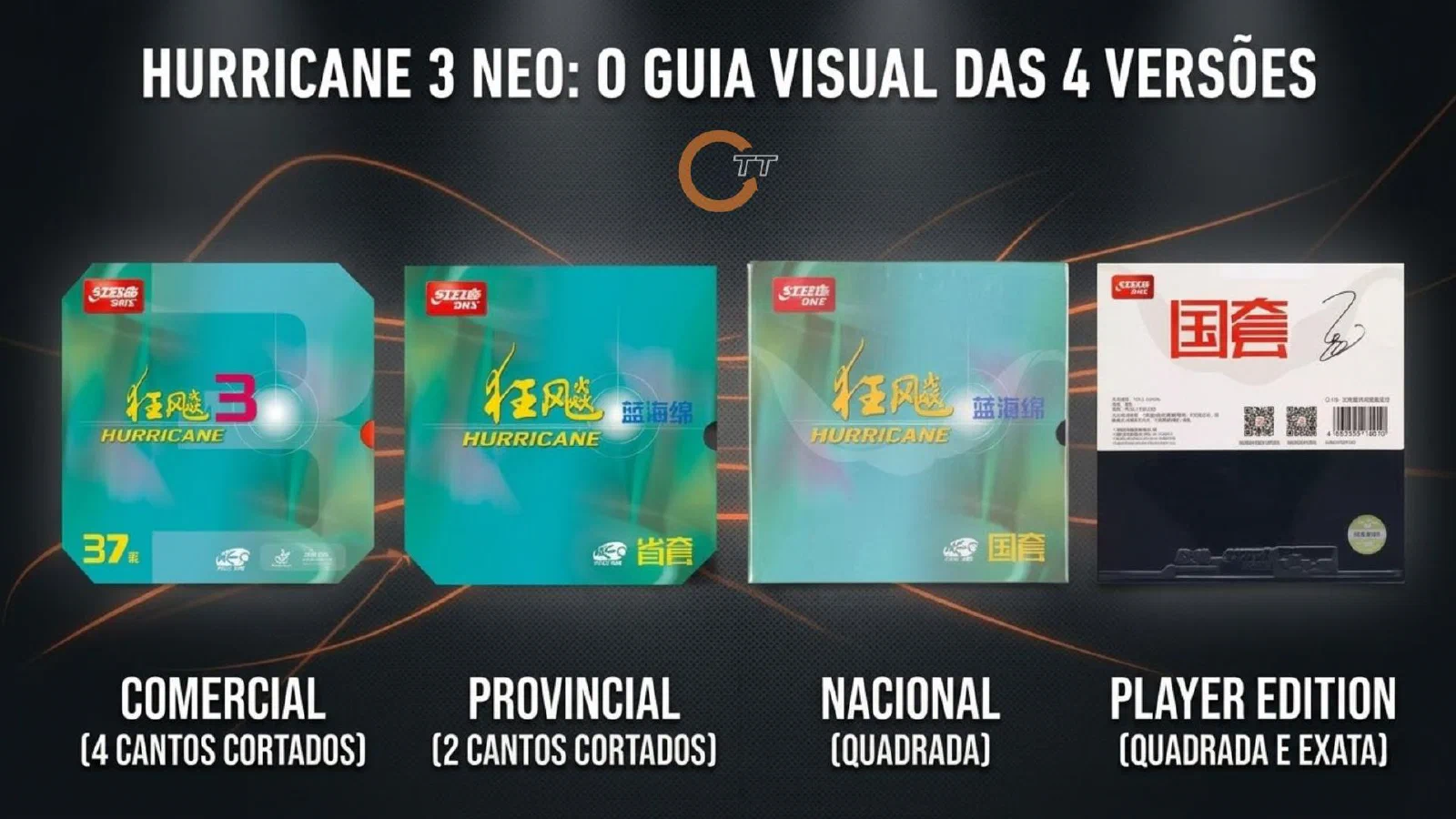
To stop counterfeiters from selling commercial rubbers at elite-version prices, DHS established a strict geometric rule. In practice, when you look at the rubber outside the packaging, identifying the cuts visually is very simple (as you can see in the cover image):
- Commercial level (4 corners cut): the rubber comes with all four corners of the square cut off. It is the mass-produced version, with a wider tolerance margin at the factory, which makes it much more affordable. It offers excellent value for anyone who wants to step into the world of Chinese rubbers.
- Provincial level (2 bottom corners cut): only the two bottom corners are cut. Aimed at professional teams from the Chinese provinces, the quality control is much stricter, ensuring consistent performance from one batch to the next. This is where you start to get frequent access to the famous blue sponge.
- National level (no cuts, square): the rubber comes whole, perfectly square and with no cuts. It is DHS’s standard “cream of the crop”. The tolerance is absurdly tight: sponge hardness is accurate to within 0.5 degree and thickness to within 0.05mm. Restricted supply and a very high price.
- Player Edition: like the National, it also comes perfectly square and with no cuts. It is a step above the National! These are rubbers made to measure, with the exact specifications required by the elite athlete whose name is on the packaging. For example: Ma Long and Liang Jingkun use 42°, while Wang Chuqin is the best example of an extremely specific setup, demanding exactly 41.5°. On the women’s circuit, where the vast majority use 40°, the star Sun Yingsha stands out using 41°. Your “Player Edition” will come with exactly the personal setup of the athlete you choose.
The truth about the “stickiness” (tackiness)
A common question is whether the more expensive versions “stick” to the ball more.
Thanks to the millimeter-level tolerance, the National version reaches the absolute peak of tackiness on its top layer (topsheet). However, “stickiness” that extreme demands monumental physical effort, flawless technique and perfect footwork to get the ball moving. If you don’t have the explosiveness of an Olympic athlete, the ball will end up in the net.
That is why the Commercial and Provincial versions have a slightly more moderate tackiness. This is not a flaw or a shortcoming, but rather an enormous technical advantage for the general public. They deliver the famous, devastating “Chinese spin”, but with a more friendly response, allowing smoother play without requiring you to be a professional at the table.
Understanding hardness: the Chinese scale vs. the rest of the world
In the DHS universe, sponge hardness changes everything. Since the Chinese scale is different from European (ESN) and Japanese (Butterfly) rubbers, we created this approximate reference table to guide you:
- 37° (approx. ESN 45
47° / BTY 3536°): the big ace up your sleeve. Extremely efficient for the backhand, but also the ideal starting point for the forehand of beginners and intermediates, since it lets you activate the rubber’s sponge without brute force. - 38° and 39° (approx. ESN 48
50° / BTY 3740°): the gold standard for most amateur and advanced competitors on the forehand. Interestingly, professional Chinese players often use up to 38° on their backhand for extra reactivity. - 40° (approx. ESN 51
52° / BTY 4142°): high hardness, it requires excellent weight-transfer technique to be used, usually on the forehand. - 41° and 42° (approx. ESN 53°+ / BTY 43°+): rubber “bricks”. Reserved for players with massive strength and impeccable technique, usually the Player Edition setups and, in that case, practically exclusive to the forehand.
Blue sponge, orange sponge and the reality of booster
Make no mistake: the Hurricane 3 NEO was made to be used with booster. The reality of high-performance sport is undeniable: virtually 100% of the world-class athletes who use the Hurricane 3 NEO apply booster to activate the sponge’s tension and maximize the catapult effect.
The coveted blue sponge has a structure that makes it absurdly more responsive to booster than the orange sponge. To activate this rubber the right way, a high-tech enhancer such as our SpeedUp boosters is the key to unlocking the Hurricane’s “turbo mode” without damaging the material.
Global dominance: far beyond China
The Hurricane 3 NEO is not exclusively Chinese. The table tennis world has realized that spin (hard Chinese rubbers are bad for smashing) dictates the modern game, and non-Chinese stars from many national teams have built their careers trusting DHS material.
Current players
- South Korea women’s team: the absolute domination of DHS. Stars such as Shin Yu-bin, Jeon Ji-hee, Joo Cheonhui and Kim Na-yeong use the tacky rubber to guarantee heavy attacks and set the pace with spin variations.
- Hina Hayata (Japan): the current big star and ace of the Japanese team built her top-level game using the Hurricane 3 on the forehand to generate huge arcs and absurd spin.
- Jang Woo-jin and An Jae-hyun (South Korea): very strong names on the South Korean men’s side who adopted the Hurricane 3 Blue Sponge on the forehand, dramatically increasing the weight of their first attacking balls.
- Nicholas Lum (Australia): a young talent (currently top 34 in the world) who has been shocking the world circuit, recently beating big names such as Darko Jorgic, using the power of the Chinese rubber.
- Doo Hoi Kem (Hong Kong): one of the rare athletes in the world elite who used tacky rubber on both sides (forehand and backhand). She recently switched.
- Zeng Jian (Singapore): a strong name on the Singapore team who trusts the Hurricane’s precision for her offensive game.
- Fu Yu (Portugal): the experienced penholder who represents Portugal shows that the Hurricane 3 is lethal even for an adapted traditional European style.
- Andreas Levenko (Austria): an excellent example from the current European circuit who trusts the power and massive spin of the Chinese material.
Retired legends
- Kasumi Ishikawa (Japan): one of the most beloved players in the world, Kasumi was one of the main people responsible for popularizing the Hurricane 3 on the forehand outside China. She proved that the classic Japanese speed-based playing style benefited enormously from the arc and the “weight” generated by the Chinese rubber.
Counterfeits and the 360TT verdict
As we saw, the geometric rule (the sponge corners) helps, but the “parallel market” improves its replicas every day, forging holographic seals with a frightening resemblance.
The only way to be sure you are playing with the real material is its source. We at 360TT are official DHS distributors in Brazil. When you buy from us, you can be absolutely certain of getting a 100% original rubber, free from the Russian roulette of counterfeits on the internet.
Which version should you choose?
- Beginners and intermediates: start with the Commercial (38° to 39° on the forehand; 37° at most on the backhand).
- Advanced players and competitors: go with the Provincial (with sensible use of booster).
- Professionals and collectors: National or Player Edition for the peak of precision.
The millimeter precision and technology of the Chinese National Team are at your disposal, but it is your sweat in training that will make the ball land on the other side of the table.
Don’t stop at curiosity! Get your Hurricane 3 NEO with the security of 360TT, glue it onto your blade and test it at your next training session.
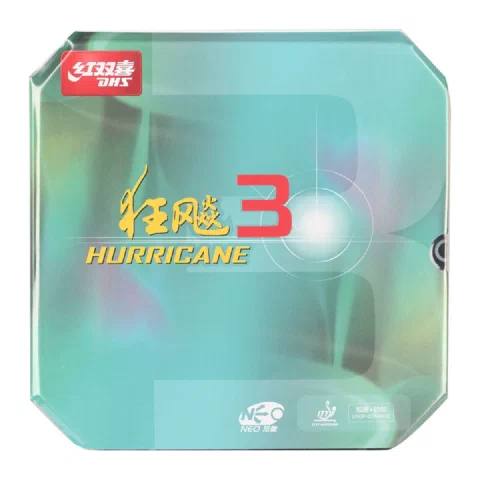 DHS Hurricane 3 NEOThe most iconic rubber in table tennis, with a factory semi-activated sponge and DHS's classic tackiness. Commercial version 39°; other versions and hardnesses in the store.
Visit the store →
The table is the only place where the truth shows up!
Now I want to hear from you: are you already on Team Hurricane, or do you still play with traditional tensioned rubbers? Tell me in the comments!
hurricane iii · h3 neo · tacky chinese rubber · chinese rubber hardness · dhs counterfeit · genuine dhs rubber · hurricane 3 neo blue sponge · fake hurricane
Read also
So, which rubber should you use? The null hypothesis method
Catalog speed and spin, "tried it and liked it", your idol's rubber: see why almost all of it misleads and how to choose your table tennis rubber methodically.

Hurricane 8 on the Backhand: The Secret Weapon of Wang Chuqin and Sun Yingsha!
Discover why Sun Yingsha, Chen Meng and Wang Chuqin use the DHS Hurricane 8 on the backhand. See 360TT's technical take on the elite's new trend.
Let's Talk About Boosters?
What booster is, how to apply it, what the ITTF rules allow and why rubbers already come with factory booster. See the benefits and when to reapply.
Comments
Comment with your account (email or Google). Every comment is reviewed before it appears.