You Don't Need Your Idol's Rubber (and Clóvis de Barros Explains Why)
In this post4 sections
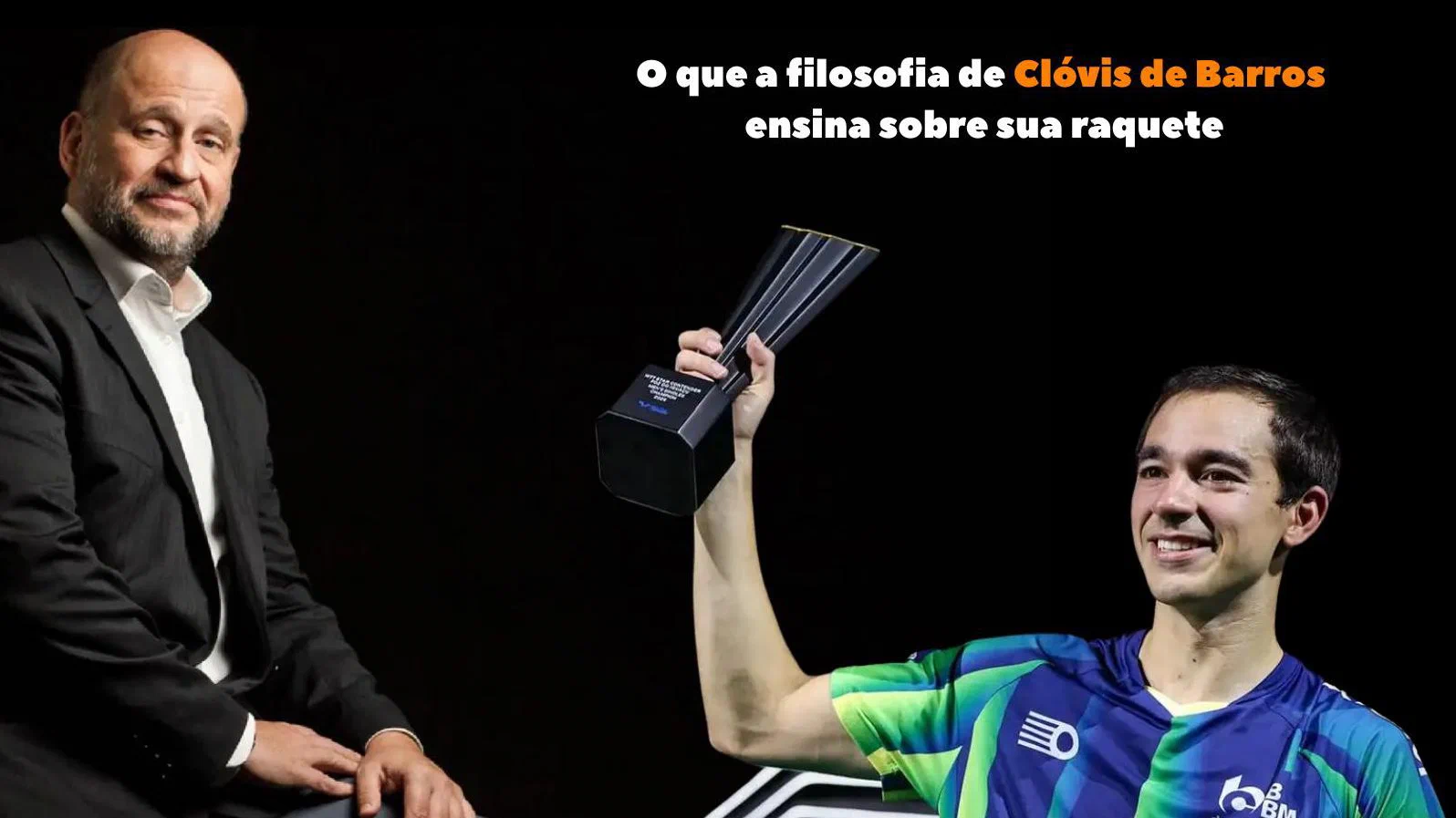
I’m a huge fan of Professor Clóvis de Barros Filho. Recently, watching a video of his about values and decisions, my mind blew up and went straight to table tennis. The philosophy is his, but the analogy here is mine, and it explains exactly why choosing equipment hurts so much.
Choosing equipment is agonizing. You walk into our store and see rubbers at R$ 80.00 and rubbers at R$ 800.00. The natural tendency is to think: “If the R$ 800.00 one is what Hugo Calderano uses, it must be the best. If I want to be good, I need it.”
The problem is that, thinking this way, you fall into a classic “context” mistake.
The wrong “answer key”
Professor Clóvis explains that, to give value to something (an exam grade, a soccer player), we need to compare it with a reference, an ideal “answer key” (the gabarito). If we say Neymar is a star, it’s because we compare him with the idea of a perfect player.
The problem with the amateur table tennis player is that he usually uses the wrong answer key.
You look at Hugo Calderano or Ma Long as your “perfect 10” reference. Automatically, you conclude that the “perfect 10” equipment is what they use.
Note
When I say “Calderano’s rubber,” take it as a metaphor for any elite equipment used by your idols. The point here is not the brand, it’s the concept of using professional material without having the professional “touch.”
You buy the fastest, most expensive rubber on the market thinking you’re making the best possible choice (“the chocolate cake,” as Clóvis says), but you forget to look at where you’re going to eat that cake.
Army vs. nursing home: where do you play?
Here comes the brilliant part of the reasoning, which I adapted for us. Clóvis compares two places with opposite values: the army and the nursing home.
In the army, the supreme value is discipline. If the bugle sounds at 5 a.m., the right thing is to get up. In the nursing home, on the other hand, the supreme value is rest. If the bugle sounds at 5 a.m., nobody hears it, and that’s fine. The good life there is the peaceful life.
(Before moving on, a heads-up: when I say “nursing home,” I’m not making a reference to old age, but to the concept of a place where the supreme value is rest and tranquility, as opposed to military rigidity.)
Now, bring that to the table:
- Your idol’s context (the army): he trains 8 hours a day, has an elite physique and perfect technique. The value there is maximum speed and surgical precision. His rubber charges that price: it demands absolute technical discipline. If your movement is late by milliseconds, the ball goes into the wall.
- Your context (the nursing home/club): you play two or three times a week, you want to improve and have fun. The supreme value here is not suicidal speed; it’s control, consistency and forgiveness.
Using “your idol’s rubber” at your current level is like waking up at 5 a.m. blowing a bugle inside a nursing home. You have the “right” attitude (top-end equipment), but in the wrong place (a technical and physical level that doesn’t match). The result is chaos: balls in the net, balls blasted into the wall and frustration.
The realistic solution
Table tennis, just like life, doesn’t have a single answer key. For our context of learning and improvement, the “perfect 10” is not the Tenergy or the Dignics. It’s the rubber that talks to your current technique.
As the official DHS distributor in Brazil, I use the PF4-50 as my example. There are countless other rubbers on the market that would fit this analogy, but I mention this one because I see many players ignore it out of prejudice, often just because it’s cheap, thinking that, because it costs little, it’s a slow, bad or “dead” rubber.
That’s not true. Being very realistic: a rubber like the PF4-50 supports you comfortably up to the Absoluto B level in Brazil, maybe more…
It combines the best of both worlds: it has the tacky (sticky) top sheet to generate plenty of spin on the serve and the drive, but it also has the #50 sponge, which is elastic and soft, and that makes it a hybrid rubber. It delivers speed when you attack, but offers the control that the professional rubber denies you.
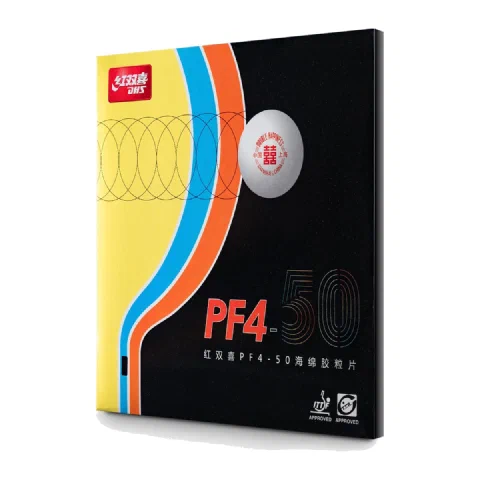 DHS PF4-50Hybrid rubber with a tacky top sheet and an elastic, soft #50 sponge: spin on the serve and the drive, with control.
Visit the store →
For an amateur, this rubber has more practical value than a R$ 500.00 rubber, because it gives you the confidence you need to do the most important thing: win the point.
The illusion of “magic”
To wrap up, I’m going back to Clóvis. He pokes fun at those self-help books that promise “50 tips to be happy forever.” Obviously that doesn’t exist, but we buy the illusion.
In table tennis, buying the most expensive rubber on the shelf thinking it will fix your drive and win you the game is exactly the same illusion. It’s trying to buy success without going through the process.
As the professor says when he closes: “we are handing back to you the task of taking the reins of your own life”.
Take the reins of your own improvement. Stop trying to “buy” Calderano’s game.
Tenha Brio! (Roughly: “Have spirit!” Did you catch the reference?)
Choose equipment that is consistent with your level, train for real and improve within your reality. When you’re “in the army” (advanced level), then yes, we’ll swap the ammunition.
Now I want to hear from you: which rubber are you using today? Does it talk to your current technique, or is it your idol’s? Tell us here in the comments.
Reference: video “As Decisões Dependem Dos Valores | Clóvis de Barros” (watch here).
cheap rubber · best rubber for beginners · which rubber to buy · professional rubber · choosing a rubber · hybrid rubber · pf4 · tacky rubber
Read also
So, which rubber should you use? The null hypothesis method
Catalog speed and spin, "tried it and liked it", your idol's rubber: see why almost all of it misleads and how to choose your table tennis rubber methodically.
Why Is Your Glue Water-Based Today? The "Speed Glue" Crisis
Why is your table tennis glue water-based? Discover the story of speed glue, the famous "click", the gas masks and the ban on solvents. Read on.
Table Tennis Serve: 5 Tips to Surprise Your Opponent (and the Equipment That Helps)
Turn your serve into an attack! See 5 expert tips to surprise your opponent and discover the ideal equipment to power up your game. Check them out.
Comments
Comment with your account (email or Google). Every comment is reviewed before it appears.