The Counterintuitive Tactic: The Power of the Long Serve at the Elite Level
In this post4 sections
In modern table tennis in 2025, the short game has become an obsession. Players of every level train relentlessly on the short receive, the “chiquita” and the “flip” over the table. And it is exactly because of that predictability that the fast, long serve has become the most effective and unexpected pattern break in the game.
Many amateurs see the long serve as a mistake or an act of desperation. For the elite, it is a coldly calculated trap. The goal of the professional long serve is not the ace. The goal is to force a predictable, rushed receive, handing the initiative of the point on a silver platter to whoever served.
The proof: the masters of the tactic
If the long serve didn’t work, we wouldn’t see it in the hands of the best. But it is there, at crucial moments.
- The “old guard”: players like Ma Long or Dimitrij Ovtcharov save this variation for pressure points. They use the long serve to steal the initiative, break the opponent’s “autopilot” and force a tactical error.
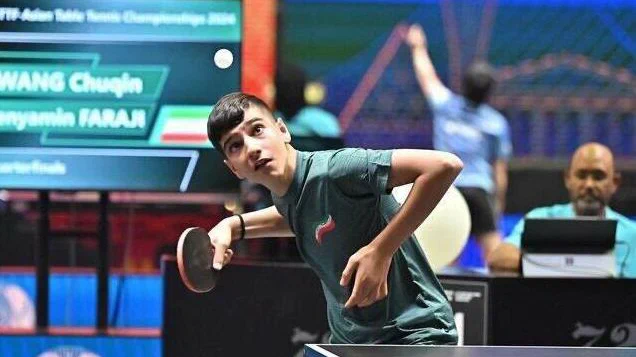
- The new generation: nobody uses the pattern break as effectively as the Iranian players. Following in the footsteps of the unpredictable Noshad Alamiyan, the young prodigy Benyamin Faraji shocked the world recently by beating the best Chinese players. Part of his success comes from that tactical courage: he mixes fast, long serves in unexpected moments, breaking the rhythm of opponents (who are used to the short game) and drawing uncomfortable replies.
The 3-beat tactic: from serve to counterattack
The long serve is not a one-beat move; it is the start of a rehearsed three-beat combination. You don’t serve and wait; you serve and anticipate.
- Beat 1 (the bait): you execute the fast, long serve (either a pendulum serve to the backhand or a straight one down the forehand line). The ball must be fast and deep, bouncing as close as possible to the opponent’s end line.
- Beat 2 (the forced reply): your opponent, caught by surprise and already “stepping into the table” for a short serve, is forced to back away and play a rushed topspin. There’s no time to set the body, put maximum power on the ball or vary the angle. They just get the ball on the table.
- Beat 3 (the execution): here is the secret. You, the server, didn’t stand still. Right after serving, you already took half a step back, positioning yourself not to receive, but to counterattack (counter topspin). You served knowing exactly what kind of ball would come back, and now you have total control of the point.
When to use this weapon (the psychological analysis)
Besides being a tactical move, the long serve is a psychological tool. There are two perfect moments to use it:
- To break the rhythm: when your opponent is too comfortable, “guessing” all your short serves and attacking with confidence. The long serve breaks that comfort and forces them to respect the whole table.
- To increase the pressure (the scare tactic): this is an expert use. Use the long serve when you open a lead on the scoreboard (e.g., 7-4 or 8-5). The opponent, already behind, is caught off guard, loses an “easy” point and gets mentally shaken. From that moment on, they will spend the rest of the game afraid, wondering whether the next serve will be short or long. You win the mental control of the match.
360TT expert analysis
Stop thinking of the long serve as a “shot in the dark”. Start training it as the first step of your strongest third-ball attack combination. The true counterintuitive tactical weapon is not the serve itself, but being 100% positioned for the counterattack that follows. It is a rehearsed move, a tactical “bait” used by the best in the world to dictate the point.
Now I want to hear from you: is the long serve part of your arsenal? Have you ever used this “trap” to win a match? Tell us about your experience in the comments!
deep serve · surprise serve · serve tactics · serve and attack · pattern breaker · third ball · short game
Read also
Table Tennis Serve: 5 Tips to Surprise Your Opponent (and the Equipment That Helps)
Turn your serve into an attack! See 5 expert tips to surprise your opponent and discover the ideal equipment to power up your game. Check them out.
Waldner's 10 Tips | Special Content
Jan-Ove Waldner closes the book When the Feeling Decides with 10 pieces of advice for future champions. See each one, translated and explained by 360TT.

Train to Play: The 360TT Rational Guide to Periodization
Train like a lion but play like a kitten? Discover the 360TT 50/30/20 periodization method and turn your training into results at the tournament.

Comments
Comment with your account (email or Google). Every comment is reviewed before it appears.