Table Tennis Serve: 5 Tips to Surprise Your Opponent (and the Equipment That Helps)
In this post4 sections
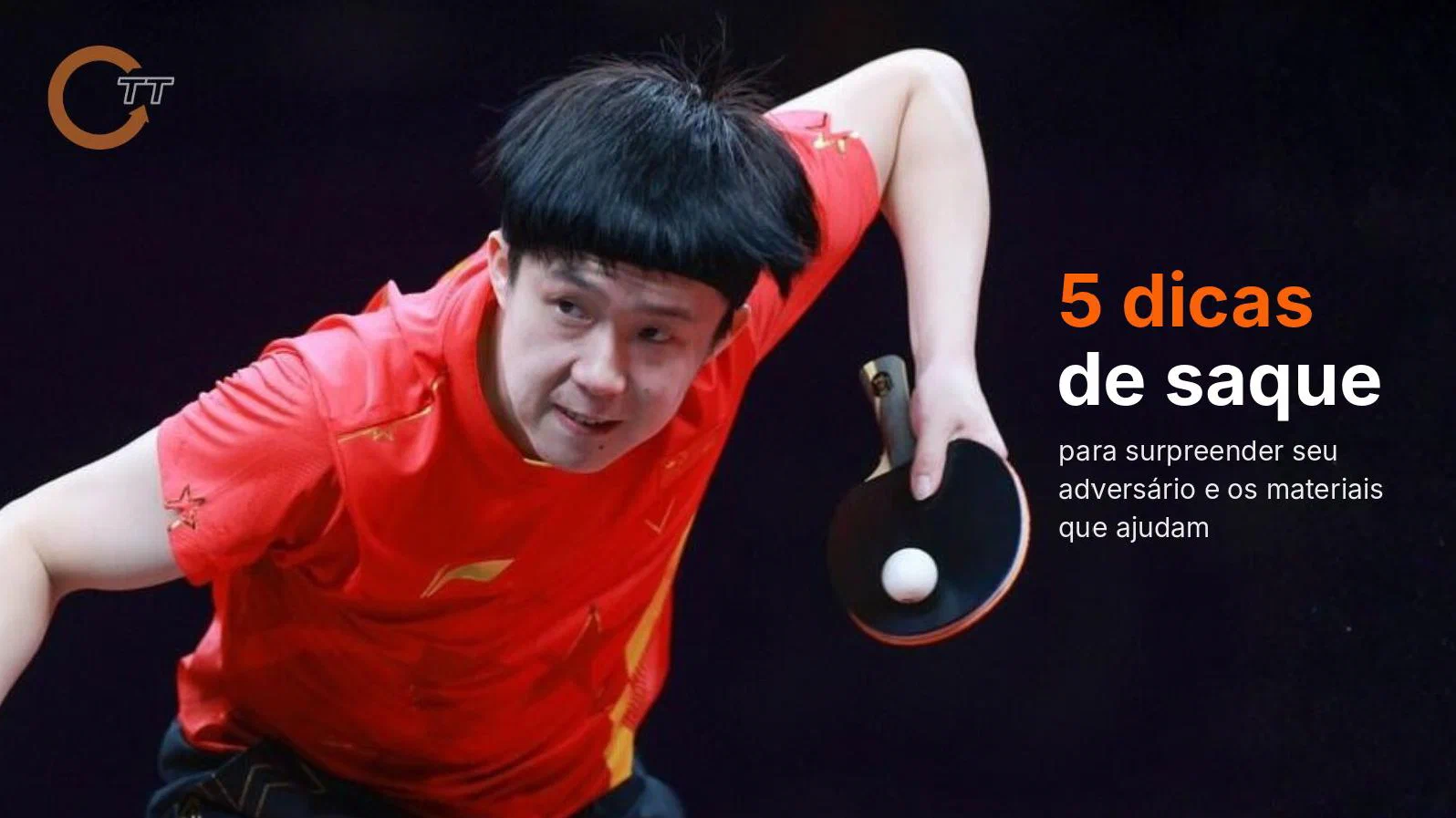
The serve in table tennis is your first attack and the most controlled stroke a player has. Unlike any other moment of the game, you have complete control over it, with no interference from your opponent.
The main goal of a good serve is to disrupt your opponent, pulling them out of their comfort zone and, ideally, either winning the point outright or setting up a decisive attack. If you can turn your first attack into a powerful play, your whole game becomes much stronger, because your opponent will constantly worry about what you’ll do next.
Here are 5 essential tips to improve your serve and catch your opponent by surprise.
TL;DR: the serve is the only stroke you fully control, and surprise comes from disguising the spin, varying the height of the toss and forcing your opponent to move. Since most points are decided in the first three balls, set up the next attack and keep the no-spin serve as a lethal weapon. The right equipment amplifies spin and control, and training with targets and multiball completes the package.
5 tactical tips to surprise your opponent
1. Master the art of disguise (variation is key)
The essence of a surprising serve is illusion. A serve that is always obvious and telegraphed won’t fool experienced players, making your opponent’s return easy.
The secret is to make your serves, even with different spins and speeds, look identical until the last second. Use a semicircular motion (down, sideways and up) and accelerate into the contact. That way, your opponent won’t be able to tell which part of the arc the contact happened on, making it harder to read the spin (backspin, sidespin or topspin).
Of course, an “obvious” serve can be used on purpose, to set your opponent up for a variation on the next play. What can’t happen is for it to be obvious because of a lack of technique.
360TT tip
Exaggerate the racket’s follow-through in the direction opposite to the intended spin (for example, finish downward for a topspin serve, or upward for a backspin serve).
2. Use a high toss to break the rhythm
Although the rule requires a minimum toss of 16 cm, there is no maximum height. Varying the height of the toss is a powerful tactic to confuse your opponent’s timing.
A serve with a high toss can take a few seconds for the ball to come down. If you repeatedly use a high toss and suddenly serve with a minimum toss, your opponent, who expected more time, may have muscles unprepared for the quick movement. Besides, a higher toss makes the ball fall faster, which can be turned into extra spin and speed at contact.
3. Mix short and long, aiming at the extreme points
Ball placement is a crucial tactical element. The goal is to force your opponent to move, pulling them out of their comfort base. Even if it’s just one step, that forced movement already hurts the quality of the return.
One of the best combinations is to alternate between short serves to the forehand and deep serves to the backhand (the extreme points of the table), since it’s hard for the receiver to prepare for both.
- Short serves: the bounce should land close to the net, making a full-motion attack difficult.
- Long serves: fast and aimed at the corners, they are effective as a surprise.
360TT tip
One particularly effective placement, which contrasts with the extremes, is to aim at your opponent’s middle (the elbow of the racket hand). When the ball is played there, your opponent is forced to make a quick decision (use forehand or backhand), which hurts the consistency of the stroke.
4. Set the stage for a fierce attack
Remember: in high-level matches, the majority of all points are won in the first three balls. The serve and the first return are the most important shots.
Your serve will be ten times more threatening if it is followed by a vigorous attack. If your playing style is offensive, short serves let you apply a topspin (attacking stroke) on the next ball, taking the initiative and preventing your opponent’s first offensive action.
5. Master the no-spin serve
The no-spin serve (with no spin on the ball) is a lethal variation. You can imitate the motion of a backspin serve but, instead of brushing the ball, make contact close to the handle (where the surface moves more slowly) and simply push the ball gently.
Your opponent, expecting backspin, will probably lift the ball, handing you an easy attack. If they expect topspin and close the racket, the ball goes straight into the net.
How the right equipment improves your serve
Technique is fundamental, but to get the most spin and control, the right equipment works as an amplifier. Based on the tactics above, here is what you need to know:
1. To generate maximum spin (tips 1 and 4)
You need rubbers with a tacky top sheet (upper surface). Chinese rubbers are famous for this trait, letting you “grab” the ball and generate extreme rotation, essential for disguising the spin or executing the no-spin serve.
- Our recommendation: take a look at the DHS Hurricane or the PF4-50 lines, which are masters at generating spin.
2. To keep the serve short and low (tip 3)
Control is everything. Rubbers that, by nature, help keep a lower and deeper ball trajectory (especially harder Chinese rubbers) make it easier to execute serves that are hard to counterattack. Combined with a blade with good feel (control), you’ll have the sensitivity needed to make the ball “die” on your opponent’s side of the table.
- Our recommendation: explore our 5-ply or 7-ply blades that prioritize control and sensitivity.
3. To ensure consistency (the “do it yourself” factor)
The quality of your gluing directly affects the feel of your racket. Using a quality glue, like 360TT EasyGlue, ensures an even layer and the perfect adhesion so that the rubber performs exactly as expected.
- Our recommendation: learn to glue your own racket. Check out our EasyGlue glue and the SpinUp Cleaner to keep your equipment at competition performance.
Bonus: tools for focused training
Improving your serve takes repetition.
- Targets (target zones): use tape or markings on the table to define specific areas (lines, corners, elbow). Mastering placement is what separates high-level players.
- Multiball training (robots or basket): this is the best way to train serve and receive technique. With a basket of balls, you can focus 100% on executing the motion, refining speed, spin and direction without interruptions.
Conclusion: practice and surprise
A good serve is built with repetition and intention. Start by choosing one or two of these tactics to train in a focused way. You’ll see how, in a short time, your confidence to start the point will grow and your opponents will get more and more uncomfortable.
Now I want to hear from you: which of these 5 tips will you train first? Leave a comment below!
serving · no spin serve · dead serve · ball toss · serve disguise · serve spin · serve practice · multiball
Read also
Why Is Your Glue Water-Based Today? The "Speed Glue" Crisis
Why is your table tennis glue water-based? Discover the story of speed glue, the famous "click", the gas masks and the ban on solvents. Read on.
Which 360TT Glue to Use? The Definitive EasyGlue Guide
Find out which 360TT EasyGlue is right for you. See the viscosity, effect and player profile of each one and choose for speed, spin or control.

Hurricane 8 on the Backhand: The Secret Weapon of Wang Chuqin and Sun Yingsha!
Discover why Sun Yingsha, Chen Meng and Wang Chuqin use the DHS Hurricane 8 on the backhand. See 360TT's technical take on the elite's new trend.
Comments
Comment with your account (email or Google). Every comment is reviewed before it appears.