Let's Talk About Boosters?
In this post9 sections
At the 2020 Brazilian Championships in Rio de Janeiro, a young player asked me:
“Auad, what is booster and what is it for?”
After I explained it, he asked me why this kind of information wasn’t known by every table tennis player. That’s when I decided to write about the subject.
TL;DR: booster is an oil that expands the sponge and makes the rubber faster. European and Japanese rubbers already come with factory booster, and the ITTF rule only requires a maximum thickness of 4mm and no VOC. In 2019 tests, the ITTF caught players who sanded their blades to hide rubbers up to 4.18mm thick: every booster increases thickness, and more thickness means up to 10% more performance. But the opposite is also unfair: a rubber that has lost its factory booster plays worse. Within the rules, booster only brings benefits; see how often to reapply it.
What booster is and how to use it
Definition of booster: it is an oil that, when applied correctly and properly to the sponge (and/or the top sheet, but that is a subject for another time…) of a table tennis rubber, expands it and makes it more responsive. In other words, it makes it faster.
Definition of oil: substances in a viscous liquid state at ambient conditions. Oils are hydrophobic (they don’t mix with water, which is why there is no water-based glue with booster) and lipophilic (they form a homogeneous mixture with other oils). They can be of vegetable, animal, mineral or synthetic origin. In the world table tennis market there are basically two types of booster: mineral-based and vegetable-based.
Now that you know what booster is, let’s look at how to use it. Booster must be applied to the rubber’s sponge (it can also be used on pips rubbers), and then you have to wait for it to work. A single coat of booster normally takes 12 to 24 hours to act, depending on factors such as the booster’s viscosity, its origin (vegetable, mineral, etc.), the type of sponge (porous or not) and the sponge’s hardness. Room temperature and humidity can slightly change the time it takes, but I consider that difference negligible.
Booster makes the sponge “grow” in every direction, and since the top sheet doesn’t grow along with it, the rubber bends toward the top sheet side.
Now, to keep it very simple: if we only thought about using booster on new rubbers, the subject would end here and the only use would be to make the rubber faster (a little softer and launching the ball higher). But it is not quite that simple…
What the ITTF says about booster
The ITTF says in its rulebook: “Racket coverings must be used without any physical, chemical or other treatment.” (ITTF Handbook, rule 2.4.7). That makes the subject controversial, but in practice it allows the use of any rubber listed on the LARC (List of Authorised Racket Coverings) that does not exceed 4mm in thickness (including the glue layer) and does not release VOC.
The ITTF doesn’t worry about booster use, because it fenced everything in with the two rules I mentioned above: a 4mm thickness limit and no VOC release. Many rubbers already come close to that 4mm maximum, leaving no room for much booster, except those that are not tensioned, such as Chinese rubbers.
Factory booster: what nobody tells you
What the ITTF doesn’t say, and neither do manufacturers, is that tensioned European and Japanese rubbers released since 2007 come treated with booster from the factory. Some more, some less, but all of them have it. That changes our whole perspective on using booster.
The booster in the sponge, whether from the factory or applied by the player, does not last the whole life of the rubber. It is used up with play (the impact of the ball), and the harder you hit, the faster it is used up. Although we always talk about booster durability in days or months, the right way to measure it would be in hours of play. In my experience, based on the rubbers that come with the most factory booster, it is completely used up within 40 to 50 hours of play at most, and in some cases much sooner.
In Brazil, because of the high dollar and absurd import taxes, rubbers are very expensive and we end up using the same rubber for months, sometimes for a year or more. As a result, after some time all the factory booster is used up and the rubber no longer has the “tension” of a new one, losing a good part of its performance. The more booster a rubber receives at the factory, the more it will lose. Note: rubbers made in Japan are generally the ones that receive the least booster at the factory and, consequently, lose less performance once it is gone.
You can confirm that rubbers receive booster at the factory by the smell some of them give off when new, and also by how much they shrink relative to the blade after being peeled off following some time of use.
Think of a bicycle: a solid wheel, usually metal, and a rubber tire. For that tire to work properly, it has to be inflated with a certain amount of air. When a tire goes flat, do we replace the tire or simply put back the air that was lost? Right: we grab a pump and fill it up again, or take the bike to a gas station and set the tire to the right pressure for use. Bringing the example to table tennis, the racket is the wheel and the rubber is the tire. When the rubber’s air/booster “goes flat”, we can replenish it to give that rubber back its factory tension/speed. To me, this is the best use of booster and there is no reason for it to be “illegal”. Quite the opposite: it should be encouraged, because it is a practice that gives the rubber a longer life and, consequently, means less waste on the planet.
The ITTF test in 2019
In December 2020, the ITTF held a webinar on YouTube about table tennis equipment. One of the topics was the use of booster, which they call After Treatments.
In 2019, after the Croatia and Poland Opens and the Team World Cup in Tokyo, they selected some players to have their rubbers peeled off, with no consequences for the player in case of non-compliance. The players themselves removed the rubbers, always after their last match of the tournament. The choice of player was based on the racket test, where the assessing umpire had doubts about the result.
Curiously, they caught several players tampering with their blades to allow more booster on the rubber, thereby defrauding the thickness test.
Important
It is important to clarify that every booster increases the thickness of the rubber: the rubber grows on all sides, including in thickness. And if it has more thickness, it gains performance. It is well known in the table tennis world that a rubber with a 2.2mm sponge is faster than one with 2.0mm, which is faster than one with 1.8mm, and so on.
The evidence found on the rackets
They found evidence on the rackets such as:
- Sealant near the handle.
- A dent in the rubber where the measuring device rests.
- Very low thickness readings, like 3.58mm, on rackets of world-class players.
- Thickness divergence measured with a magnifying glass.
- The top veneer of the blade sanded at the point where the measuring device rests.
- The appearance of the rubber’s top sheet showing the use of booster.
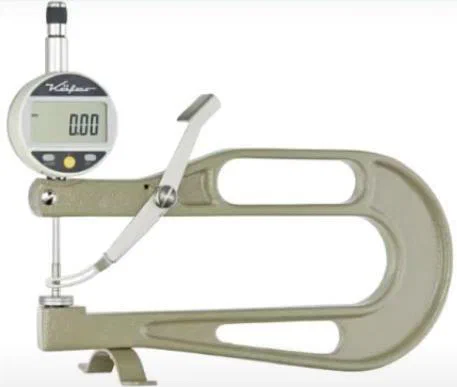
In measurements after disassembly, they found rubbers up to 4.18mm thick. Below is the measuring device used to measure the thickness of the rubbers after disassembly:
This extra thickness delivers up to 10% more performance compared to a rubber within the 4mm limit. Those rackets passed the normal thickness test with the racket assembled, because the blades had been severely prepared for it.
Below are some images:
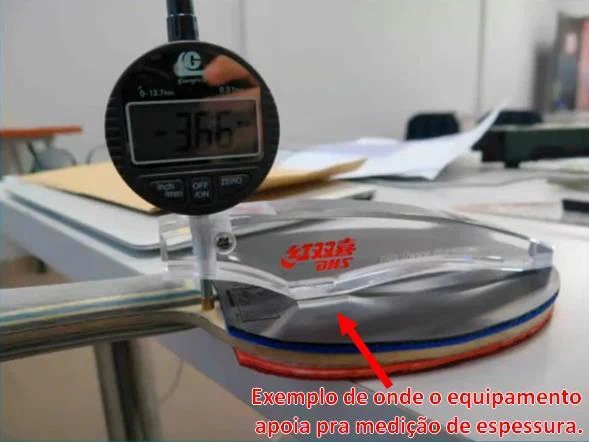
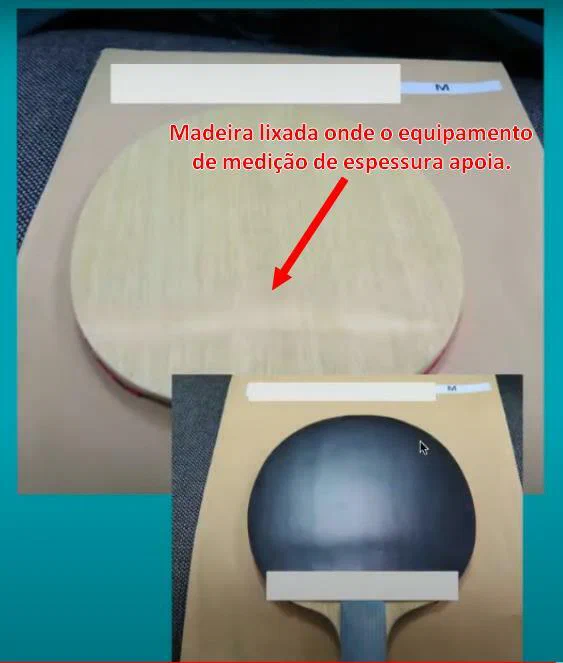
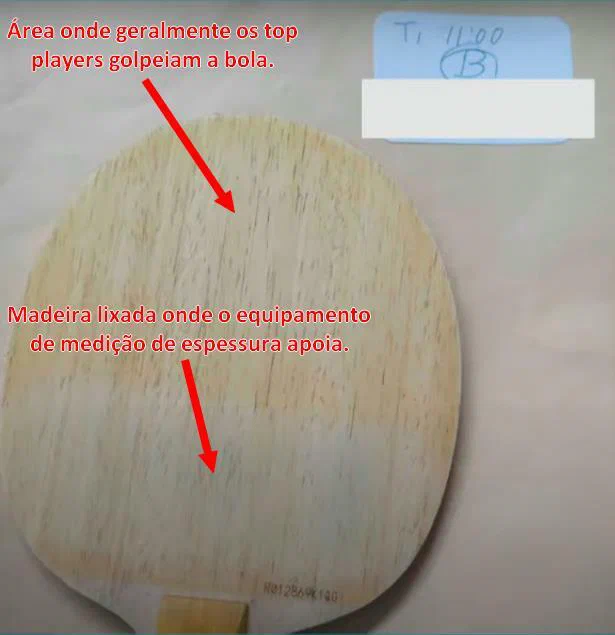
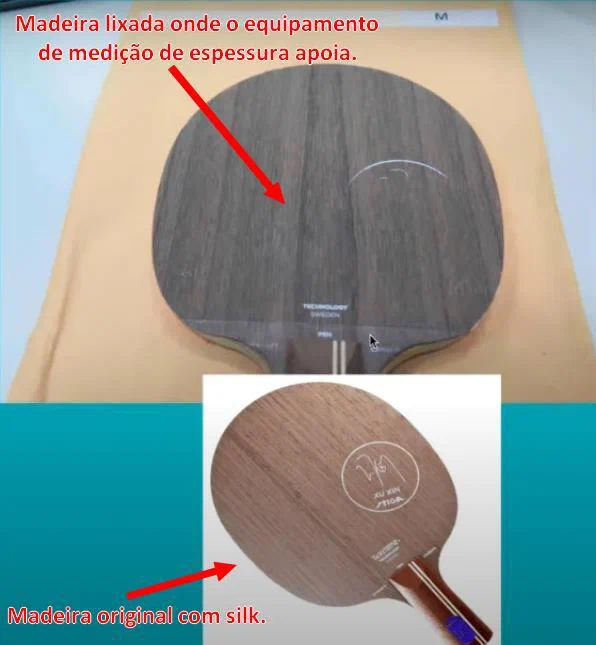
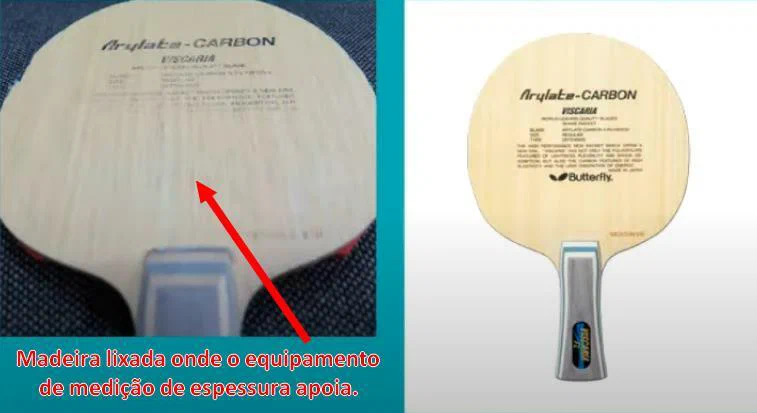
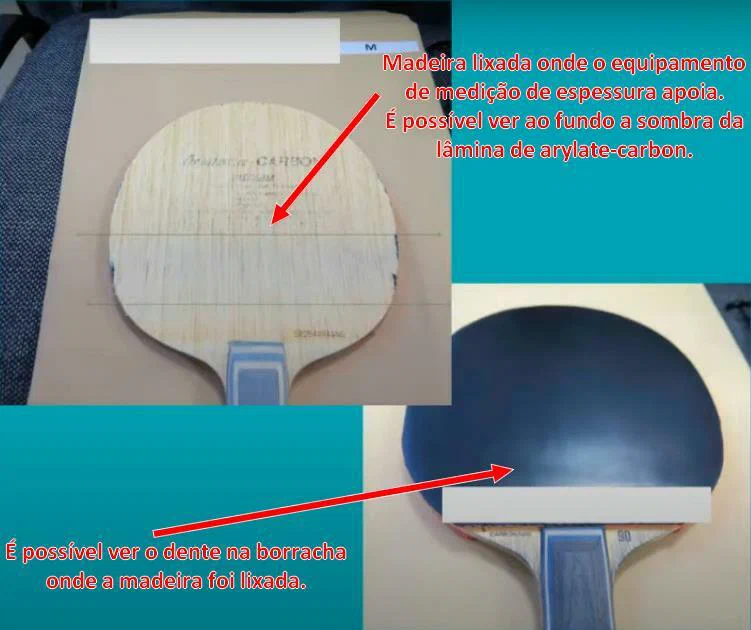
From the images, the players caught were using Chinese rubber or were Chinese. Since the list of players was not disclosed, it is not possible to know exactly.
At the beginning of these tests there were heated discussions, but after they explained that the goal was to protect honest players from cheaters, reactions were positive.
What the ITTF concluded
After these tests, they realized that the performance advantage for a player using rubbers thicker than 4mm was enormous and equality among players would not be guaranteed that way. The players even suggested raising the thickness limit, a sign that they are still chasing performance through their rubbers and that simply switching to a faster blade would not solve it in this case.
And when the factory booster runs out?
That was a case of cheating to get better performance, and that is what racket control is for. But let’s flip the situation: a rubber whose performance has dropped because its factory booster has already been used up is also a factor of inequality. In that case, with the goal of restoring the factory tension, booster should be widely used, especially if the following conditions are met:
- The European/Japanese rubber has been used for at least around 40 hours and still has usable grip on the top sheet.
- Booster is not harmful to health, so the racket passes the tests as long as it is within the 4mm thickness limit.
- Booster contains no VOC, so the racket passes the tests.
If the rubber is Chinese and does not have a porous sponge, such as the GoldArc (made in Germany), it was developed to be used with booster, and this is simply not said openly for commercial reasons. So use it from new, as long as it does not exceed the 4mm limit and the booster does not contain VOC.
Benefits of using booster
- It is ecologically responsible, because rubbers will last longer and far fewer of them will be thrown into nature.
- Your used rubber returns to factory tension/performance one or more times until the grip fades and it has to be replaced. Playing with a used rubber stays enjoyable for much longer, as if it were new.
- The rubber’s spin/speed potential is kept for much longer.
- If you bought a used rubber and it did not fit your blade because it had shrunk, booster can bring it back to its original size. After using booster on a shrunken rubber, it is normal for it to grow 0.5cm or even more around its entire circumference.
- If you don’t play official tournaments, you can supercharge your racket and make it more pleasant and faster to play and have fun with.
- You feel the ball better on a rubber whose factory booster has been replenished. The feel is spectacular.
- The sound of the rubber gets much better, reminding you a little of the sound of speed glue.
- The rubber lifts the ball more, which is great for attacking.
Tips for use
Now that I have probably convinced you that using booster is not wrong — on the contrary, it should be encouraged — let me give you some usage tips. If you train every day, replenish the booster every 30 days; otherwise, every 2 months. Prefer a booster that is very efficient, lets you control the amount applied, is not harmful to health and has no smell, has a physiological pH (it doesn’t harm the skin) and has technical support from the manufacturer. Our SpeedUp 360 offers all of that, plus an instruction manual via QR Code, an applicator sponge, and my regular technical support.
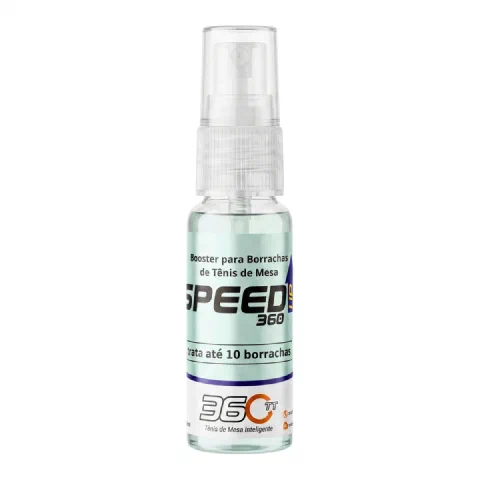 SpeedUp 360 boosterUniversal 360TT booster: works on any brand or type of rubber, including pips. Treats up to 10 rubbers per bottle.
Visit the store →
Oh, and booster can (should?) also be used on the top sheet, but that is a subject for another time.
Now I want to hear from you: do you use booster? How often do you reapply it? Tell me in the comments.
boster · buster · tuning · oil · speed up · after treatment · rubber tension
Read also
Why Is Your Glue Water-Based Today? The "Speed Glue" Crisis
Why is your table tennis glue water-based? Discover the story of speed glue, the famous "click", the gas masks and the ban on solvents. Read on.
From the 38mm Ball to 40+: A Complete Guide to Choosing Yours
From 38mm celluloid to ABS plastic: understand how the ball changed table tennis and find out which DHS 40+ ball is right for your level of play.

DHS Hurricane 3 NEO: The Guide to the World's Most Famous and Most Used Rubber
Commercial, Provincial, National or Player Edition? See what changes in the DHS Hurricane 3 NEO, which hardness to pick and how to avoid counterfeits.

Comments
Comment with your account (email or Google). Every comment is reviewed before it appears.